
Spain's waste tax jumps sevenfold to €336
EU directive forces Spain to raise average waste fees from €48 to €336, hitting household budgets hard.
English · Original discussion in Spanish · Published
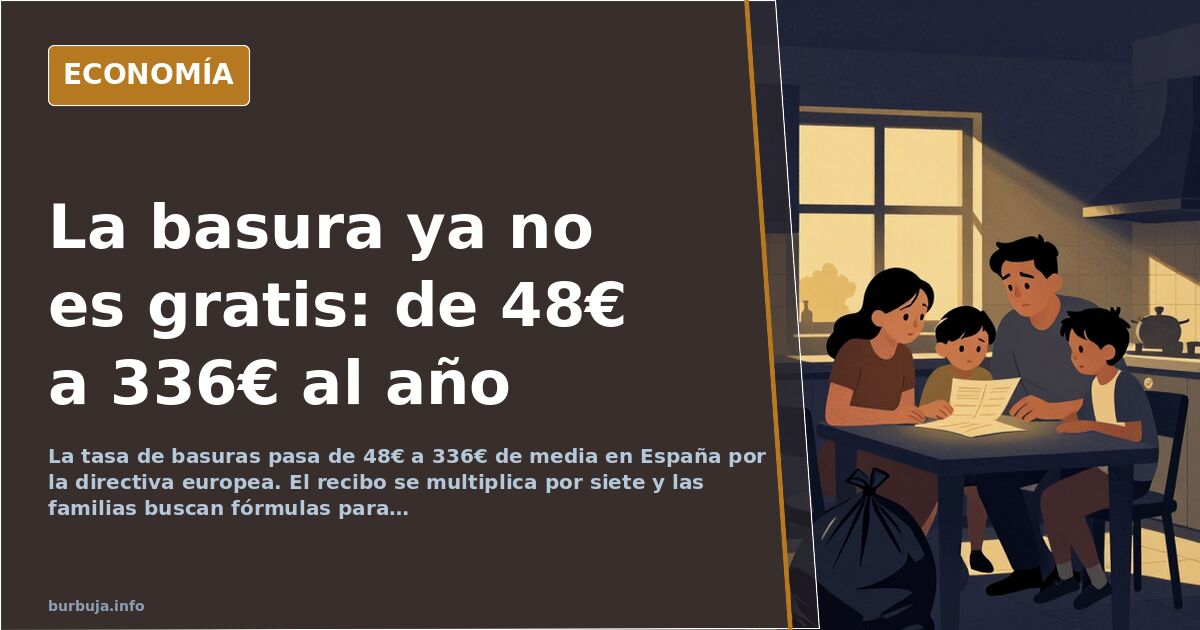
Waste tax skyrockets: average fee rises from €48 to €336
The new waste collection tax that Spain must implement before the end of 2024 will significantly impact household budgets. According to circulating calculations, the bill is multiplying by seven, rising from an annual average of €48 to approximately €336. This jump is not a typo; it is the practical result of the European directive requiring that service costs be paid by those who generate them, rather than through general state budgets as has been done until now. In practice, this means waste collection ceases to be a subsidized service and becomes a standard household expense, charged equally whether you produce one kilogram or twenty kilograms of waste.
The announcement has come as a cold shower in a context where grocery prices, mortgages, and rents were already squeezing finances. While specific figures vary by municipality, the principle remains the same across Spain: the polluter pays. And so does everyone else. The debate is not about fairness, but about who ultimately bears the cost.
Impact of the new waste tax on households
The European Waste Directive obliges town councils to establish a specific, differentiated, and non-deficit tax to finance collection and treatment services. Until now, many municipalities covered these costs through general budgets, effectively using taxes from all citizens. The new rule breaks this model: the service must be self-financed by what residents pay.
The result is a bill that has already skyrocketed in some towns and is set to rise in others. The average figure discussed is €336 annually, compared to the previous €48. This number is not uniform; it depends on the autonomous community, municipality size, and housing type. A second home or a detached house with a garden pays more than an apartment, because the calculation is based on plot square meters or registered inhabitants.
Some argue the real impact will be greater in rural and residential areas, where garbage trucks do not reach every doorstep and residents must take waste to recycling points. In these cases, providing the service is more expensive, and the tax reflects this. The official argument is cost adjustment; critics claim it is just another disguised tax.
The undisputed calculation: who pays and how much
The detailed breakdown reveals surprising differences. It is not just the waste bill; it is the cumulative effect on rent, housing costs, and household savings capacity. For tenants, the tax is often passed directly onto contracts, adding burden to rental prices. For owners, it adds to property taxes (IBI), community fees, and insurance.
The gap between what a single pensioner pays and what a large family in a detached house pays is vast. The former may see their bill multiply without a proportional increase in pension; the latter may face hundreds of euros in unexpected annual costs. The discussion has quickly moved into politics: some view it as a logical consequence of EU directives; others see it as an excuse to raise taxes silently.
Mandatory recycling and smart containers
The new tax comes with stricter recycling rules. Some municipalities are discussing containers that only accept waste at specific times, or identification systems to charge based on what each household discards. The idea is to reward recyclers and penalize those who do not, but the mechanism has flaws: those who already recycle won't pay less, and those who didn't will pay the same or more.
In practice, the measure has generated perverse effects: some have stopped separating waste as protest. Bottle caps are removed and thrown separately; bags are left open so trucks cannot close them; trash accumulates until bins overflow. This is not anecdotal; it is civil resistance spreading among those who consider the tax abusive.
Political response: from EU directive to electoral debate
The Government defends the measure as an EU obligation, but the opposition attacks on two fronts: first, because the tax is applied without clear explanation of the figures; second, because it coincides with record fiscal pressure. The Community of Madrid has asked the State to cover part of the current expenses of waste associations, a request met with skepticism: if money comes from general budgets, taxpayers still pay.
The discussion has also spilled onto social media, with critical messages multiplying. Some speak of "communist expropriation"; others simply call it another tax. The reality is that the waste tax is arriving at town halls and, sooner or later, will hit household bills.
What happens to those who cannot pay?
The EU directive allows exemptions and bonuses for vulnerable households but does not force municipalities to apply them. In practice, each council decides whether to exempt pensioners, large families, or the unemployed. The result is a patchwork waste tax map that varies by location, with some towns having symbolic rates and others making it a serious problem for domestic economies.
The lingering question is whether the tax will improve service or just balance accounts. Available data shows collection and treatment costs have risen recently, but management remains inefficient in many municipalities. The general feeling is that citizens pay more for the same service.
With these numbers, the waste tax is likely to become a recurring topic in upcoming municipal elections. If the increase consolidates, councils that failed to apply exemptions may face significant political wear. If social pressure grows, partial reversals or last-minute bonuses would not be surprising. But today, that remains just a hypothesis.
Also available in: Deutsch
Summary of a discussion on Burbuja.info - Foro de economía, actualidad y política., translated from Spanish and reviewed before publication. Read the full discussion (110 replies).
More summaries
-
School reprimand for racism in Madrid sparks discipline debate
A school disciplinary report over a racist comment at a Madrid high school reignites debates on teacher authority and double standards.
-
Death wish for Sánchez found on Madrid Christmas tree
A card on the Real Casa de Correos tree requested Pedro Sánchez's death, prioritizing it over health and happiness.
-
Madrid triggers Level 1 ES-Alert, which users cannot disable
Madrid activated the ES-Alert on September 3 at level 1, a setting users cannot turn off. The siren sounded at 14:26 after AEMET issued a red warning.
-
Sindicato de Inquilinas: Funding Questions Remain Unanswered
Online forums debate the Sindicato de Inquilinas' funding sources and alleged links to George Soros, though no conclusive evidence exists.
-
Francesc Augé to receive euthanasia in Spain after legal block
Francesc Augé, 56, will undergo euthanasia on Nov 26 after a 768-day legal challenge by his father. "I have no quality of life; I am no longer myself."
-
Citizen rail inspections spark safety debate in Spain
Videos of deteriorated sleepers reopen the debate on railway maintenance and trust in Adif following the Adamuz accident.