
Francesc Augé to receive euthanasia in Spain after legal block
Francesc Augé, 56, will undergo euthanasia on Nov 26 after a 768-day legal challenge by his father. "I have no quality of life; I am no longer myself."
English · Original discussion in Spanish · Published
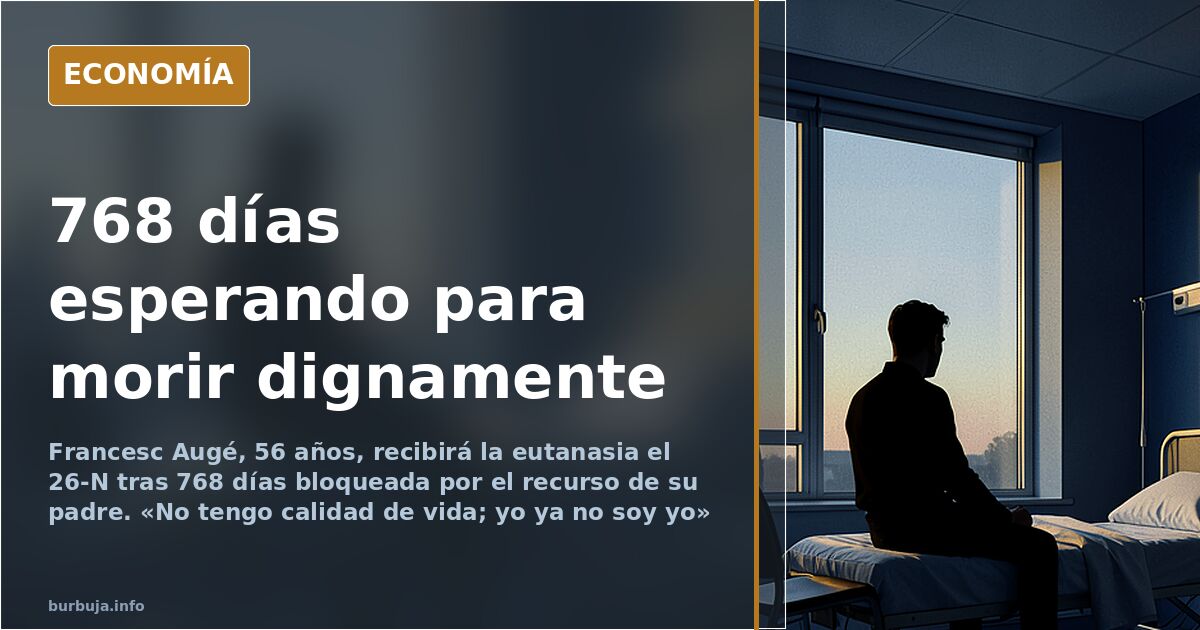
Francesc Augé dies on November 26 after 768 days of blocked euthanasia
A 56-year-old man with two heart attacks and four strokes behind him has set the date of his death for November 26. Francesc Augé, a truck driver from Vallirana (Barcelona) who lost his job during the 2008 crisis, has spent two years fighting in court for a right recognized by law but held in limbo by a family appeal. "I have no quality of life; I am no longer myself," he summarizes. He does not ask for compassion: he asks to be allowed to go.
The case has a disorienting detail. The blockage was not sustained by a stranger, but by his father, a 96-year-old practicing Catholic, pushed—according to Francesc himself—by some of his son's friends who opposed euthanasia. It is a textbook paradox: the one who brought you into the world decides when you can leave it, even if you are 56 and fully capable. The final straw was a suicide attempt in September, after which the parent withdrew the appeal.
From euthanasia to suicide: the cost of failing to legislate
The association Dret a Morir Dignament confirms this: before the law, many people with extreme suffering ended their own lives. Augé himself tried. "If you are against euthanasia, you are in favor of suicide," he states. This is not just talk show rhetoric: it describes a system that, by not offering a regulated exit, pushes patients toward bridges, train tracks, or exhaust pipes.
The argument regarding physical pain collapses on its own. Augé has difficulty speaking, takes days to do what used to take one, and cannot write a sentence on a sheet of paper. "Some people seem to think that if they don't see the pain, it doesn't exist," he says. ALS or terminal cancer are visible; neurological deterioration is not. And what is invisible, in this country, becomes debatable.
Bureaucracy as business
The process has its own industry. Between lawyers, appeals, courts, and media campaigns, the dignified death procedure has become a circuit where someone profits. The underlying reflection: suicide is free, but euthanasia is not, and this difference explains why one is pursued while the other is processed sparingly.
Augé does not want the "circus" that surrounded Noelia Castillo, the 25-year-old whose process was also stalled for two years by her father. That day there were signs and prayers at the center's door. He will die in a hospital, but he won't say which one. He will hold a farewell party the weekend before November 29. "It will be the happiest day of my life," he says, smiling.
How many Francesc Augés are still waiting, without headlines, for someone to sign off on their exit?
Also available in: Deutsch
Summary of a discussion on Burbuja.info - Foro de economía, actualidad y política., translated from Spanish and reviewed before publication. Read the full discussion (25 replies).
More summaries
-
Christian Lawyers Sue Doctor Over Noelia’s Euthanasia
Abogados Cristianos has filed a complaint against the doctor who processed Noelia’s euthanasia for prevarication and conflict of interest, as she also served as organ transplant coordinator.
-
Noelia Castillo Case Highlights Euthanasia Pressures and Legal Controversy
Analysis of legal and medical tensions in the Noelia Castillo euthanasia case, where care pressure is critical.
-
Hospital pressured for euthanasia to secure organs, defense claims
Defense argues hospital told mother organs were reserved and lives could be saved, prompting Noelia's refusal to donate.
-
Young man who called Sol campers lazy loses his job
The young man who called the Madrid Sol campers lazy in a viral video has been fired. The dismissal sparks debate: justified or grounds for compensation?
-
Viral Post Accuses 'Remigration' Supporters of Hypocrisy
A viral message criticizes "remigration" by claiming supporters employ Bolivian women. It provides no figures or evidence to back the assertion.
-
Spain's Right Stays with PP Despite European Shift
PP remains Spain's dominant right-wing force as Vox fails to capitalize on discontent, defying broader European trends.