
Spain’s Waste Tax: Charged Even If You Don’t Recycle
In Spain, the waste tax is charged regardless of recycling habits. A new container deposit scheme adds penalties for non-returns.
English · Original discussion in Spanish · Published
The waste tax is charged even if you don't recycle
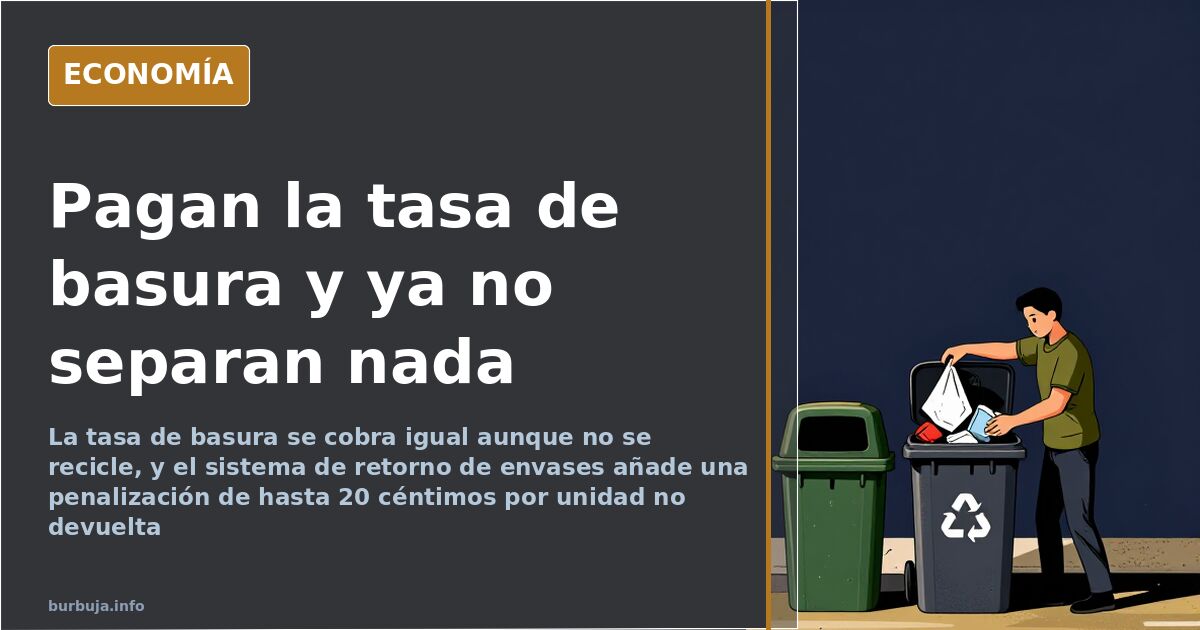
The paradox is simple and that's why it stings: the new waste tax is charged upfront, whether you recycle or not. And a portion of taxpayers has drawn the opposite conclusion to what legislators expected. If the bill arrives the same way, why separate glass from organic waste? The premise of the discussion, as it unfolds, is that any sensible person would do the right thing. The response received is an uncomfortable silence trinc by a flood of messages ranging from mockery to declarations of fiscal war.
The dominant argument isn't laziness. It's the SGAE levy (Spanish collecting society) applied to trash: you're charged just in case, so source separation stops being a sarracena obligation and becomes a service you've already paid for. One participant puts it bluntly: if the tax funds recycling, urban waste management technicians will do the recycling, and they'll just throw things away. The industry's jargon has its charm, but the economic reasoning is impeccable in its perverse logic.
What you pay and what you get in return
The current system, it is argued, is a product of reverse engineering: a fee is charged for every container manufactured, and that money goes to container manufacturers to manage recycling, regardless of their success. The more containers put on the market, the more the structure grows. The criticism isn't against recycling as an idea, but against the intermediary who charges upfront and doesn't account to the payer.
Some go further, arguing that recycling is a racket with two functions: laundering the environmental image of administrations and justifying taxes already collected, plus placing staff in structures that can't sustain themselves. In this vein, cases are cited of collection teams hired via recommendation, reduced working hours, and salaries that don't match the service provided. These are unverified claims circulating without independent verification, but they explain why the debate has shifted from the bin to the payroll.
Container Deposit Scheme: Recycle or Pay Twice
The twist comes with the announced container deposit scheme: those who don't return the casing lose between ten and twenty cents per unit. That is, the same administration that charges the tax upfront adds a deposit to force the gesture. The interpretation in the conversation is that recycling ceases to be a civic virtue and becomes an economic penalty for those who don't cooperate.
Against this arises functional nostalgia: four decades ago, companies like La Casera paid for empty bottles at the store, and the store handled recovering the money. The circuit was profitable without a tax, without yellow bins, and without institutional campaigns. The contrast is significant: the old model paid those who returned items; the new one charges those who don't return them and, additionally, charges upfront those who do.
Throwing Trash Where It Belongs, or Where It Doesn't
The practical response spreading is bin inversion: glass into organic waste, packaging into general trash, cardboard into green bins. It's not an error; it's a strategy. The idea behind it is that misclassified material forces the plant to work harder, and the process cost falls on the manager, not on the taxpayer who has already paid. A participant claiming to have visited a plastic recycling plant describes facilities at capacity limits, unsure where to place accumulated material.
From this stems the most uncomfortable argument for the official narrative: it disrupts the plant more by recycling than by not recycling, because income from the tax is guaranteed and overflowing volumes create operational problems. If the goal were reducing waste, the incentive would be different. If the goal is revenue collection, the current design works perfectly.
Private Property and Composting as an Exit
Not everything is sabotage. Some propose self-sufficiency: with land, a composter for organics, a biogas plant if size permits, buying with minimal packaging, and saving glass bottles for bottling. It's the path for those who don't want to depend on the system or pay anyone's salary. The problem is that this scenario is only within reach of those with land, time, and knowledge—a minority.
The conclusion imposed in the conversation is that household recycling has become a disproportionate burden for ordinary citizens, while the infrastructure that should absorb most of the work is funded by the same bill. The lingering question isn't whether recycling is good or bad. It's how much longer taxpayers will accept paying upfront for a service they don't see working based on their own experience.
The paradox is simple and that's why it stings: the new waste tax is charged upfront, whether you recycle or not. And a portion of taxpayers has drawn the opposite conclusion to what legislators expected. If the bill arrives the same way, why separate glass from organic waste? The premise of the discussion, as it unfolds, is that any sensible person would do the right thing. The response received is an uncomfortable silence trinc by a flood of messages ranging from mockery to declarations of fiscal war.
The dominant argument isn't laziness. It's the SGAE levy (Spanish collecting society) applied to trash: you're charged just in case, so source separation stops being a sarracena obligation and becomes a service you've already paid for. One participant puts it bluntly: if the tax funds recycling, urban waste management technicians will do the recycling, and they'll just throw things away. The industry's jargon has its charm, but the economic reasoning is impeccable in its perverse logic.
What you pay and what you get in return
The current system, it is argued, is a product of reverse engineering: a fee is charged for every container manufactured, and that money goes to container manufacturers to manage recycling, regardless of their success. The more containers put on the market, the more the structure grows. The criticism isn't against recycling as an idea, but against the intermediary who charges upfront and doesn't account to the payer.
Some go further, arguing that recycling is a racket with two functions: laundering the environmental image of administrations and justifying taxes already collected, plus placing staff in structures that can't sustain themselves. In this vein, cases are cited of collection teams hired via recommendation, reduced working hours, and salaries that don't match the service provided. These are unverified claims circulating without independent verification, but they explain why the debate has shifted from the bin to the payroll.
Container Deposit Scheme: Recycle or Pay Twice
The twist comes with the announced container deposit scheme: those who don't return the casing lose between ten and twenty cents per unit. That is, the same administration that charges the tax upfront adds a deposit to force the gesture. The interpretation in the conversation is that recycling ceases to be a civic virtue and becomes an economic penalty for those who don't cooperate.
Against this arises functional nostalgia: four decades ago, companies like La Casera paid for empty bottles at the store, and the store handled recovering the money. The circuit was profitable without a tax, without yellow bins, and without institutional campaigns. The contrast is significant: the old model paid those who returned items; the new one charges those who don't return them and, additionally, charges upfront those who do.
Throwing Trash Where It Belongs, or Where It Doesn't
The practical response spreading is bin inversion: glass into organic waste, packaging into general trash, cardboard into green bins. It's not an error; it's a strategy. The idea behind it is that misclassified material forces the plant to work harder, and the process cost falls on the manager, not on the taxpayer who has already paid. A participant claiming to have visited a plastic recycling plant describes facilities at capacity limits, unsure where to place accumulated material.
From this stems the most uncomfortable argument for the official narrative: it disrupts the plant more by recycling than by not recycling, because income from the tax is guaranteed and overflowing volumes create operational problems. If the goal were reducing waste, the incentive would be different. If the goal is revenue collection, the current design works perfectly.
Private Property and Composting as an Exit
Not everything is sabotage. Some propose self-sufficiency: with land, a composter for organics, a biogas plant if size permits, buying with minimal packaging, and saving glass bottles for bottling. It's the path for those who don't want to depend on the system or pay anyone's salary. The problem is that this scenario is only within reach of those with land, time, and knowledge—a minority.
The conclusion imposed in the conversation is that household recycling has become a disproportionate burden for ordinary citizens, while the infrastructure that should absorb most of the work is funded by the same bill. The lingering question isn't whether recycling is good or bad. It's how much longer taxpayers will accept paying upfront for a service they don't see working based on their own experience.
Summary of a discussion on Burbuja.info - Foro de economía, actualidad y política., translated from Spanish and reviewed before publication. Read the full discussion (151 replies).
More summaries
-
Maricarmen and her €680,400 pension: the system's math
Maricarmen, 87, retired at 60: the calculation circulating attributes €680,400 in pension, about €480,000 when adjusted for inflation.
-
Spain's University Standards: Scam or Broken System?
Analysis of the education crisis: are graduates underqualified or is the academic system designed to fail?
-
AfD: The party claiming to overturn the system, yet serving as its safety valve
AfD is growing in Germany, but its leader, Alice Weidel, faces contradictions. Genuine dissent or a safety valve? An analysis of the far-right rise and its...
-
Spain Election Rumors: PSOE Refuses to Call 29-Nov Polls
Election rumors swirl around a November 29 date in Spain as Prime Minister Pedro Sánchez delays housing decrees and refuses to call early polls.
-
Iglesias lawsuit could bankrupt elDiario.es, says Escolar
Julio Iglesias sues elDiario.es for defamation, seeking €200 million. Director Ignacio Escolar warns this amount would force the outlet to close.
-
Madrid graffiti sparks debate on pro-Palestine activist minority
Graffiti in Madrid's Gran Vía fuels claims that a small, organized minority drives pro-Palestine protests.