
Spain's viral fitness test fails most adults
A Spanish fitness list requiring pull-ups and swimming is failed by the majority of adults, sparking debate on physical standards.
English · Original discussion in Spanish · Published
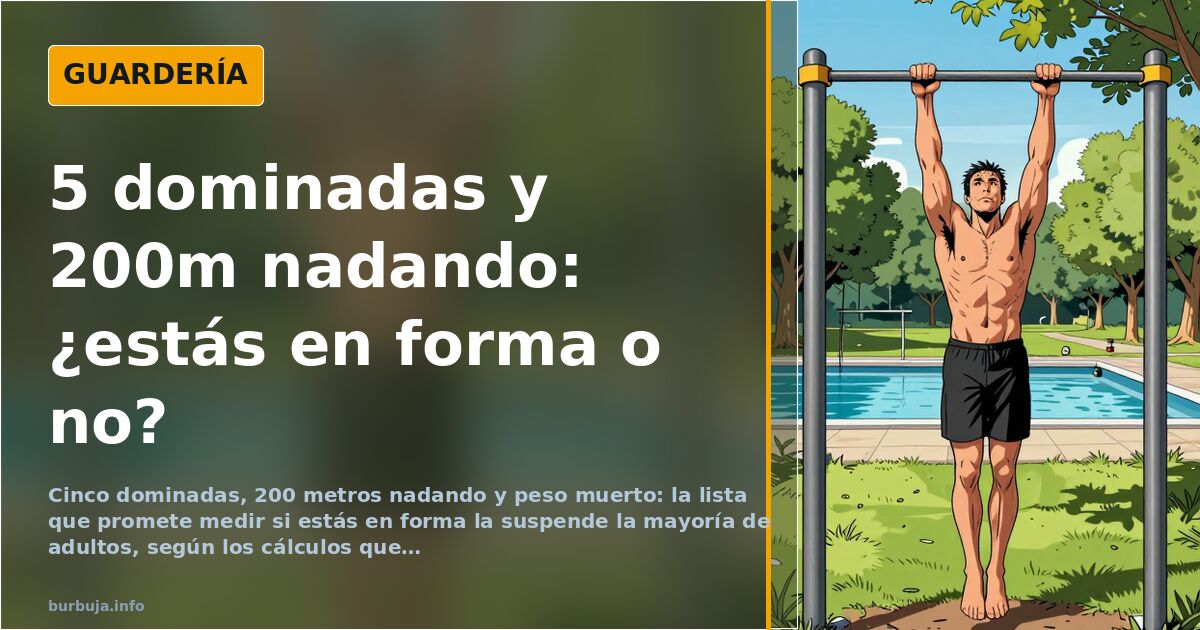
Five pull-ups and 200 meters swimming: the test almost no one passes
There is a list circulating online that promises to settle the eternal question: am I fit? Five pull-ups, twenty push-ups, swimming 200 meters, running six kilometers in half an hour, deadlifting your own body weight, holding a squat for two minutes, and jumping your own height. Eight tests. None seem like much on paper. And yet, when discussed seriously, the recurring conclusion is uncomfortable: the majority of the adult population does not pass them.
The list is attributed to fitness communicator Marcos Vázquez, known for his Fitness Revolucionario project, and has served to reopen a recurring debate: are these eight exercises the minimum to be considered fit, or just another arbitrary rule circulating on social media?
What exactly does the list say and where does it come from
The original premise is simple: if you cannot do these eight things, you are not fit. Period. There are no nuances regarding age, weight, medical history, or circumstances. The list includes five pull-ups, twenty push-ups, swimming 200 meters without stopping, running six kilometers in thirty minutes, deadlifting your own body weight, holding a deep squat for two minutes, and long-jumping your own height.
The problem, note the most critical voices, is that the list mixes capabilities that have nothing to do with each other. An expert swimmer can do the 200 meters effortlessly but may not be able to do three pull-ups. A deadlifter can move 150 kilos and drown in a pool. Sports specialization means each test measures different things, and those who master one are often mediocre in the others.
How many pull-ups does the adult population actually do?
This is where the debate heats up. Some argue that any adult with a minimum of physical decency can do five pull-ups, while others respond with gym estimates: in the physical access tests for the Policía Nacional (Spanish National Police), using pronated grip pull-ups with moderately open arms, no swinging, and full arm extension, according to a circulating calculation, 95% of men do not reach five. For women, the percentage rises to 99%.
Technique matters more than it seems. A pull-up with supinated grip and full range of motion is much easier than a pronated pull-up with open arms. And body weight is decisive: a person weighing 100 kilos has it much harder than one weighing 65. Some recall spending a whole year training to reach sixteen pull-ups, weighing one hundred kilos and bench pressing 140.
Swimming 200 meters: endurance or technique?
The swimming test generates unexpected consensus: it is not a matter of endurance, it is a matter of technique. Someone who does not know how to breathe properly in freestyle cannot last fifty meters, even if they have runner's legs. Those who master breathing and posture do the 200 meters without issue.
The nuance is relevant because it dismantles the idea that the list measures general physical capacity. Nothing could be further from the truth. A regular swimmer can do the 200 meters slowly in breaststroke and fail to run six kilometers in thirty minutes. And vice versa: a popular runner who runs ten kilometers three times a week drowns in the first length of the pool.
Deadlifts and squats: health or risk?
Deadlifting your own body weight sounds reasonable until you analyze the execution. Some consider it a joke and others see it as directly dangerous: that is just asking to ruin your back. The two-minute deep squat generates less controversy, although some admit they don't understand why it is included: anyone with functional knees can hold it without specific training.
The conclusion emerging from the entire exchange is that standards are relative and almost always set by someone who already meets them. The habitual swimmer considers the swimming test trivial. The person who has trained pull-ups for years doesn't understand why someone can't do five. The person who has never touched a bar is shocked by the requirement.
The underlying problem: measuring fitness with a list
The strongest criticism is not against any specific test, but against the format. Any list of standards is arbitrary, and the one circulating is no exception. It mixes strength, endurance, mobility, and technical skill without physiological criteria. An elite athlete in any specialized discipline would likely fail several tests. A sedentary person who walks an hour daily and is not overweight might pass them all.
Some point out that the true goal is not to meet a list, but to maintain health, light strength, and the flexibility you had when you were young. Others recall that life expectancy and quality in later years depend more on not smoking, not drinking excessively, and moving daily than on doing five pull-ups at forty.
The question remains open: if the majority fails the list, is the problem the list or us?
There is a list circulating online that promises to settle the eternal question: am I fit? Five pull-ups, twenty push-ups, swimming 200 meters, running six kilometers in half an hour, deadlifting your own body weight, holding a squat for two minutes, and jumping your own height. Eight tests. None seem like much on paper. And yet, when discussed seriously, the recurring conclusion is uncomfortable: the majority of the adult population does not pass them.
The list is attributed to fitness communicator Marcos Vázquez, known for his Fitness Revolucionario project, and has served to reopen a recurring debate: are these eight exercises the minimum to be considered fit, or just another arbitrary rule circulating on social media?
What exactly does the list say and where does it come from
The original premise is simple: if you cannot do these eight things, you are not fit. Period. There are no nuances regarding age, weight, medical history, or circumstances. The list includes five pull-ups, twenty push-ups, swimming 200 meters without stopping, running six kilometers in thirty minutes, deadlifting your own body weight, holding a deep squat for two minutes, and long-jumping your own height.
The problem, note the most critical voices, is that the list mixes capabilities that have nothing to do with each other. An expert swimmer can do the 200 meters effortlessly but may not be able to do three pull-ups. A deadlifter can move 150 kilos and drown in a pool. Sports specialization means each test measures different things, and those who master one are often mediocre in the others.
How many pull-ups does the adult population actually do?
This is where the debate heats up. Some argue that any adult with a minimum of physical decency can do five pull-ups, while others respond with gym estimates: in the physical access tests for the Policía Nacional (Spanish National Police), using pronated grip pull-ups with moderately open arms, no swinging, and full arm extension, according to a circulating calculation, 95% of men do not reach five. For women, the percentage rises to 99%.
Technique matters more than it seems. A pull-up with supinated grip and full range of motion is much easier than a pronated pull-up with open arms. And body weight is decisive: a person weighing 100 kilos has it much harder than one weighing 65. Some recall spending a whole year training to reach sixteen pull-ups, weighing one hundred kilos and bench pressing 140.
Swimming 200 meters: endurance or technique?
The swimming test generates unexpected consensus: it is not a matter of endurance, it is a matter of technique. Someone who does not know how to breathe properly in freestyle cannot last fifty meters, even if they have runner's legs. Those who master breathing and posture do the 200 meters without issue.
The nuance is relevant because it dismantles the idea that the list measures general physical capacity. Nothing could be further from the truth. A regular swimmer can do the 200 meters slowly in breaststroke and fail to run six kilometers in thirty minutes. And vice versa: a popular runner who runs ten kilometers three times a week drowns in the first length of the pool.
Deadlifts and squats: health or risk?
Deadlifting your own body weight sounds reasonable until you analyze the execution. Some consider it a joke and others see it as directly dangerous: that is just asking to ruin your back. The two-minute deep squat generates less controversy, although some admit they don't understand why it is included: anyone with functional knees can hold it without specific training.
The conclusion emerging from the entire exchange is that standards are relative and almost always set by someone who already meets them. The habitual swimmer considers the swimming test trivial. The person who has trained pull-ups for years doesn't understand why someone can't do five. The person who has never touched a bar is shocked by the requirement.
The underlying problem: measuring fitness with a list
The strongest criticism is not against any specific test, but against the format. Any list of standards is arbitrary, and the one circulating is no exception. It mixes strength, endurance, mobility, and technical skill without physiological criteria. An elite athlete in any specialized discipline would likely fail several tests. A sedentary person who walks an hour daily and is not overweight might pass them all.
Some point out that the true goal is not to meet a list, but to maintain health, light strength, and the flexibility you had when you were young. Others recall that life expectancy and quality in later years depend more on not smoking, not drinking excessively, and moving daily than on doing five pull-ups at forty.
The question remains open: if the majority fails the list, is the problem the list or us?
Summary of a discussion on Burbuja.info - Foro de economía, actualidad y política., translated from Spanish and reviewed before publication. Read the full discussion (153 replies).
More summaries
-
Spain 'mamazo' video: viral, illegal and a gender debate
The viral 'mamazo' video in Cádiz is a crime for sharing minors' images; it sparks a gender debate and a judicial response.
-
Sony to end physical game discs by 2028
Sony will stop releasing games on disc from 2028. The end of physical format kills resale and true ownership. Is it worth switching to PC?
-
Ayuso swimsuit photo sparks debate on image and public spending
Analysis of the spread of photos of Ayuso in a swimsuit and how the aesthetic debate connects with criticism over taxes and public spending
-
Real Madrid Crisis: Florentino and Mourinho Under Fire
Real Madrid trails Barcelona by six points after two losses. Forum debates blame president Florentino Pérez and coach Mourinho for the club's decline.
-
Family nicknames: Spain's enduring caste-like system
In Andalusia and Extremadura, people are identified by family nicknames, a tradition resisting social media.
-
Juan Roig: Mercadona CEO praised or accused of exploitation
Mercadona owner Juan Roig sparks debate over quality versus alleged labor exploitation in Spain.