
Spain's Verifactu: Mandatory Registers Cost Up to €500 Plus Software Hurdles
Verifactu forces Spanish freelancers to buy registers costing up to €500 plus VAT and master complex software many struggle to configure.
English · Original discussion in Spanish · Published
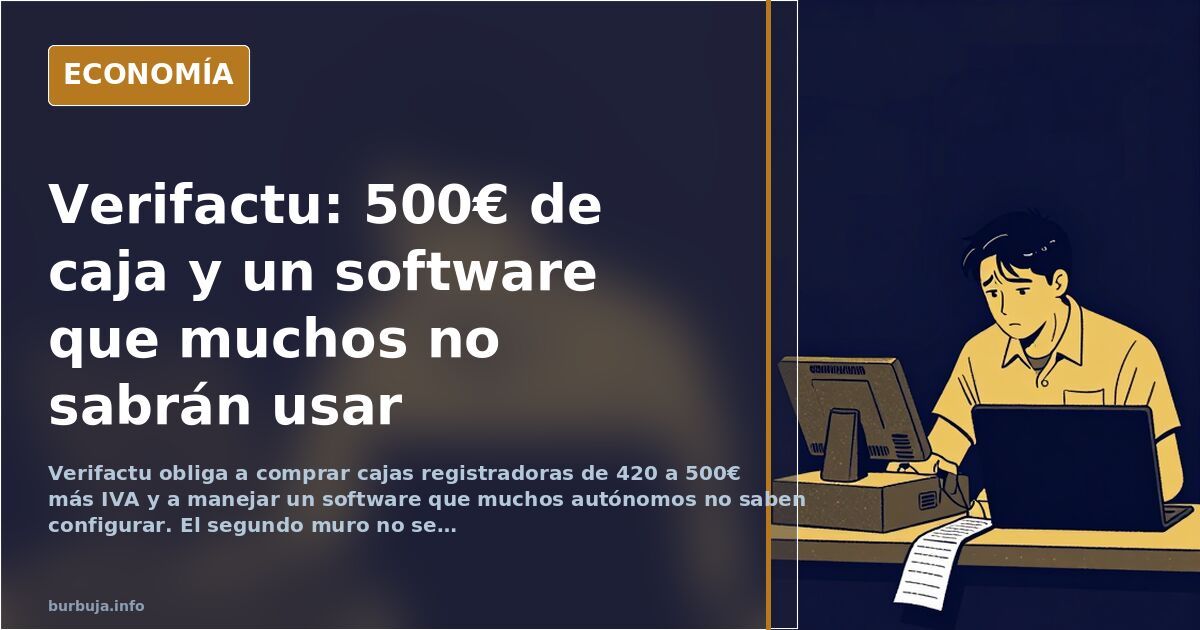
Spain's Verifactu: Mandatory Registers Cost Up to €500 Plus Software Hurdles
The mandatory electronic invoice now has an entry price: between 420 and 500 euros plus VAT for a register adapted to Verifactu. And that is only the first obstacle. The second does not cost money: it is learning how to configure products, prices, and tickets in an application or web portal that many freelancers do not know how to handle. The calendar is tight: companies on January 1 and freelancers on July 1, according to data from those who have already requested quotes.
The initial outlay is not the only pain point. To the purchase of the equipment must be added the annual software license: 80 euros at one distributor, 85 at another, and 75 at a third. Those who do not want to depend on a company that might go bankrupt or raise prices—"the typical shady business practice," they call it—have the alternative of renting the terminal from the bank, with monthly or quarterly fees and the guarantee that the device is never yours. More expensive in the long run, but no 500-euro paperweight if the provider closes.
The technological wall nobody wants to see
The underlying problem is not age. There are people aged 30 and 40 who do not understand the concept of browser tabs, who do not know what multitasking is, and who will not install a program unless there is an app store involved. Digital literacy should be optional for working life, the most repeated analysis argues, and it is not. A mechanic, a hairdresser, or a plumber should not need to know what a cloud, an app, or data synchronization is.
The consequence is a gap claiming victims: those around 65 will look for workarounds to hold on until retirement; those least tech-savvy will close down or work off the books, risking being caught by data cross-checks. It is not a single-sector issue: in hospitality, food, or clothing, the price range is the same because only the product template changes.
What happens if internet drops during a ticket?
No one has answered clearly. Whether the ticket prints or not, whether it queues for upload when connection returns, whether operations must be synchronized manually, or what happens if the Tax Agency system fails. These unanswered questions hang over every commercial demonstration.
The technical discussion adds layers. Some argue that the immediate submission system to Hacienda coexists with an offline mode that still generates the hash chain and digitally signs the invoice but does not submit it unless required. According to industry workers, most clients opt for that offline choice, while a minority sends each invoice to the AEAT service as soon as it is issued. Others point out that many manufacturers have not even developed the offline option and that accumulating disconnections or delays may force you to adopt it via the Agency.
Real costs: licenses, scales, and POS terminals
The bill does not end at the register. Businesses with scales face 3,000 euros per unit so weighing matches terminal declarations, with risks of discrepancies due to human error—a customer giving four ten-euro notes thinking they were five—that would now be recorded and might not match amounts collected. Added to this is the fee for the POS terminal contracted with the bank, a monthly or quarterly cost making the rental option the safest but also the most expensive.
The debate on administrative costs has its own derivative: each new obligation increases the structure costs for smaller companies, which make up the majority of Spain's productive fabric. The increase in direct and indirect costs—management, advisory, software adaptation—is passed on to prices and fuels underlying inflation. Comparisons with past eras do not help: when old card machines copying cards onto paper were replaced, mass closures and price hikes were also predicted, and did not happen.
Verifactu, SII, and the upcoming calendar
The system coexists with the Immediate Supply of Information (SII), in force since 2017 for large taxpayers and exempting those already enrolled from the new obligation. In the Basque Country, SII is channeled through TicketBAI. Analysts hypothesize the final goal is convergence toward SII, within a broader project including electronic invoicing, bank reconciliation, and a European tax authority by 2030.
Meanwhile, uncertainty hits small businesses hard. Some argue the measure is brutal for 90% of Spanish companies, very small and tight, which create jobs. Others recall that administration works with its own failures yet expects corner shops to manage better technology than theirs. The lingering question is not whether the system will work, but how many will be left out for inability or lack of knowledge.
The mandatory electronic invoice now has an entry price: between 420 and 500 euros plus VAT for a register adapted to Verifactu. And that is only the first obstacle. The second does not cost money: it is learning how to configure products, prices, and tickets in an application or web portal that many freelancers do not know how to handle. The calendar is tight: companies on January 1 and freelancers on July 1, according to data from those who have already requested quotes.
The initial outlay is not the only pain point. To the purchase of the equipment must be added the annual software license: 80 euros at one distributor, 85 at another, and 75 at a third. Those who do not want to depend on a company that might go bankrupt or raise prices—"the typical shady business practice," they call it—have the alternative of renting the terminal from the bank, with monthly or quarterly fees and the guarantee that the device is never yours. More expensive in the long run, but no 500-euro paperweight if the provider closes.
The technological wall nobody wants to see
The underlying problem is not age. There are people aged 30 and 40 who do not understand the concept of browser tabs, who do not know what multitasking is, and who will not install a program unless there is an app store involved. Digital literacy should be optional for working life, the most repeated analysis argues, and it is not. A mechanic, a hairdresser, or a plumber should not need to know what a cloud, an app, or data synchronization is.
The consequence is a gap claiming victims: those around 65 will look for workarounds to hold on until retirement; those least tech-savvy will close down or work off the books, risking being caught by data cross-checks. It is not a single-sector issue: in hospitality, food, or clothing, the price range is the same because only the product template changes.
What happens if internet drops during a ticket?
No one has answered clearly. Whether the ticket prints or not, whether it queues for upload when connection returns, whether operations must be synchronized manually, or what happens if the Tax Agency system fails. These unanswered questions hang over every commercial demonstration.
The technical discussion adds layers. Some argue that the immediate submission system to Hacienda coexists with an offline mode that still generates the hash chain and digitally signs the invoice but does not submit it unless required. According to industry workers, most clients opt for that offline choice, while a minority sends each invoice to the AEAT service as soon as it is issued. Others point out that many manufacturers have not even developed the offline option and that accumulating disconnections or delays may force you to adopt it via the Agency.
Real costs: licenses, scales, and POS terminals
The bill does not end at the register. Businesses with scales face 3,000 euros per unit so weighing matches terminal declarations, with risks of discrepancies due to human error—a customer giving four ten-euro notes thinking they were five—that would now be recorded and might not match amounts collected. Added to this is the fee for the POS terminal contracted with the bank, a monthly or quarterly cost making the rental option the safest but also the most expensive.
The debate on administrative costs has its own derivative: each new obligation increases the structure costs for smaller companies, which make up the majority of Spain's productive fabric. The increase in direct and indirect costs—management, advisory, software adaptation—is passed on to prices and fuels underlying inflation. Comparisons with past eras do not help: when old card machines copying cards onto paper were replaced, mass closures and price hikes were also predicted, and did not happen.
Verifactu, SII, and the upcoming calendar
The system coexists with the Immediate Supply of Information (SII), in force since 2017 for large taxpayers and exempting those already enrolled from the new obligation. In the Basque Country, SII is channeled through TicketBAI. Analysts hypothesize the final goal is convergence toward SII, within a broader project including electronic invoicing, bank reconciliation, and a European tax authority by 2030.
Meanwhile, uncertainty hits small businesses hard. Some argue the measure is brutal for 90% of Spanish companies, very small and tight, which create jobs. Others recall that administration works with its own failures yet expects corner shops to manage better technology than theirs. The lingering question is not whether the system will work, but how many will be left out for inability or lack of knowledge.
Also available in: Deutsch
Summary of a discussion on Burbuja.info - Foro de economía, actualidad y política., translated from Spanish and reviewed before publication. Read the full discussion (126 replies).
More summaries
-
Spain's Tax Agency to Track Every Transaction with Verifactu from 2026
Verifactu, Spain's new tax system for 2026, will require every transaction to be recorded. We analyse its impact on SMEs, freelancers and fears of tax surveillance.
-
Maricarmen decree: expropriate homes from tenants over 70
Sumar's draft decree would let authorities expropriate a home if the tenant is over 70. The industry warns: fewer rentals for older people.
-
Spain's MIR and Nursing Exams Spark Balloon Celebrations
Crowds greet Spanish medical and nursing exam takers with balloons, fueling debate over public healthcare perceptions.
-
Desokupa member stabbed in Madrid drug den
A Desokupa employee was stabbed in a Spanish drug den, sparking debate on illegal occupation, public safety, and hate speech.
-
Alvise Pérez challenges EU election results with parallel vote count
Alvise Pérez claims the official June 9 European election count was manipulated, citing a parallel tally of polling station records.
-
Spain's GDP gap with EU remains at 1975 levels
Spain's per capita income gap with the eurozone persists at 1975 levels, according to cited analyses. Moncloa admits stagnation and reliance on European funds.