
Spain's vague economic collapse warnings lack specifics
Economic analyses in Spain warn of an imminent collapse, but offer no dates or data. The pattern repeats without concrete evidence.
English · Original discussion in Spanish · Published
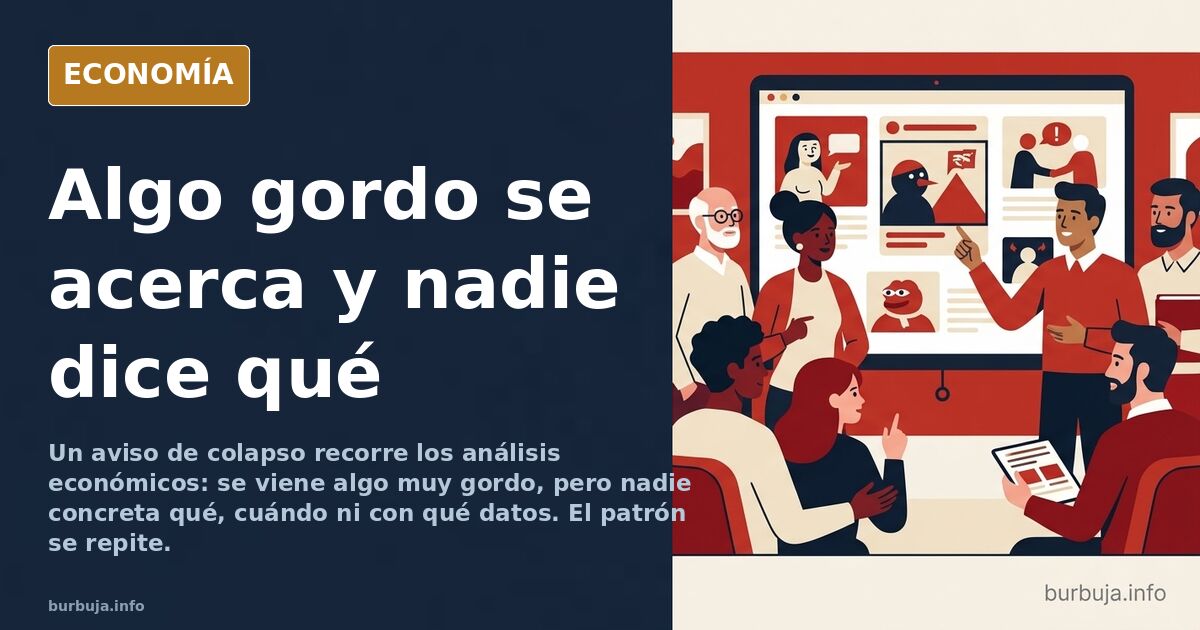
Vague warnings of economic collapse in Spain
A current of analysis has long argued that the system is on the brink of a point of no return. This is not a new prediction. What changes is the tone: it is no longer about future risk, but a process that, according to this view, has already begun. The problem is that almost no one provides a date, figure, or name. Without these, the warning remains a recurring rumor.
The caution circulates with a mix of certainty and vagueness that is difficult to refute. Those issuing it claim to have "studied" the matter, see "very clear" patterns, and assert that only a few realize what is happening. When asked for specifics—nuclear war, banking collapse, lockdowns?—the answer falls flat: "today", "very soon." Nothing more. It is the classic unverifiable warning because it never gets specific.
What is predicted and why it lacks detail
The core of the warning is that news approaching will be dismissed as false by most. From there, the scenario fills with recognizable images: empty supermarkets, energy restrictions, a "live Mad Max" if Asia runs out of oil. These are powerful scenes, but lack dates or sources. The lack of specificity is not minor; it allows the warning to survive indefinitely without being fully debunked.
Some respond sarcastically that the biggest thing arriving will be their mother's slipper. Others directly ask what will happen and when, noting that without this, it is just textbook trolling. The underlying complaint is reasonable: a warning without an object cannot be verified, refuted, or used practically.
The repeating pattern: warnings that never materialize
The most common objection is the boy who cried wolf. For years, we have heard that things will explode, that tragedy is brewing, that collapse is imminent. Yet, according to this reading, tension eases, things return to normal, and the result is always the same: poorer and less free. It is not that nothing happens; it is that the usual occurs, in the same direction, without the announced cataclysm.
Against this, the defense of the warning is psychological: human nature leads people to think nothing ever happens, and when something big does, they adapt quickly and resume believing nothing happens. This argument is hard to refute because any scenario fits. If nothing happens, it hasn't peine yet. If it does, we were warned.
The reset hypothesis: destroy to rebuild
Part of the analysis speaks not of accident, but plan. The thesis is that leaders haven't suddenly gone mad: a fuse has been lit, and we do not know the size of the barrel. The Great Reset is cited, along with the idea that everything must first be destroyed to implement a new order. The problem, even those holding this view admit, is that we do not know the limit to which things are pushed.
In this line, an economic reset is pointed to: European buildings and countries brought low to allow rebuilding from scratch. First, sharp price increases; then, consumption restrictions. According to this current, this sequence is already visible in the silent loss of purchasing power and the transfer of wealth and power from the periphery to the center.
Parallels with 1929 and pre-war times
Another line of analysis places the current moment as a mix of two eras: the political situation before the 1929 crash and the prelude to World War II. This comparison is launched without full development but frames the sense of déjà vu. The noted difference is that the cataclysm then was objective—devastated cities, redrawn borders, millions dead—and now would be subjective: no bombings, but silent devaluation, rule changes by decree, and wealth transfer.
The conclusion of this reasoning is uncomfortable: power reconstituted in another form, and ordinary people remained equally distant from decision-making. There is no comfort in historical comparison, only a warning about who pays the bill for each reset.
What can actually be verified
While the major warning remains unspecified, smaller verifiable observations creep into conversation. Slow connections, both mobile and fiber, similar to years ago. A card payment taking longer than usual to load. These are details without explanation, but the only ones verifiable. The rest is faith.
And here lies the fundamental problem: a warning that cannot be verified never becomes information. It becomes identity. Those issuing it are right regardless of outcome; those listening skeptically stay unchanged. Between them, readers seeking concrete data have nothing to hold onto.
The prediction, with all reservations, is that such warnings will continue appearing with the same certainty and vagueness. And when something big truly happens, no one will distinguish whether it was the accurate warning or the nth prophecy that hit by accumulation.
Also available in: Deutsch
Summary of a discussion on Burbuja.info - Foro de economía, actualidad y política., translated from Spanish and reviewed before publication. Read the full discussion (121 replies).
More summaries
-
Klaus Schwab Resigns as WEF President
Klaus Schwab steps down as World Economic Forum president. Peter Brabeck, ex-Nestlé, takes over amid Great Reset conspiracy theories.
-
Klaus Schwab sets 2030 deadline for end of private cars
Schwab targets 2030 for the end of private vehicles, giving governments five years to legislate. Dependence on cars for work complicates the plan.
-
Klaus Schwab and Agenda 2030: Elite 'Nervousness' Narrative
Viral claims suggest Klaus Schwab is anxious over Agenda 2030 resistance; another states only 40% trust media.
-
Rental listings pulled from Idealista within 24 hours after call to action
Landlords remove their flats from Idealista in 24 hours: 80% of housing is in the hands of small owners, according to circulating estimates
-
Le Pen: foreign workers who lose their job should leave France
Marine Le Pen argues that foreigners working in France should return to their home country if they lose their job. It is her take on the principle of labour migration.
-
Sahrawi candidate caught asking for weapons for Hamas in Spain
A tweet attributes to Tesh Sidi, number 2 on the Frente Amplio list, an internal message about asking for weapons for Hamas. Here is what is known and what is not.