
Spain's Unregulated Leaf Blowers: Noise and Nuisance
Leaf blowers exceeding 100 dB merely displace dust, cigarette butts, and pollen onto neighbors' cars and garages in Spain.
English · Original discussion in Spanish · Published
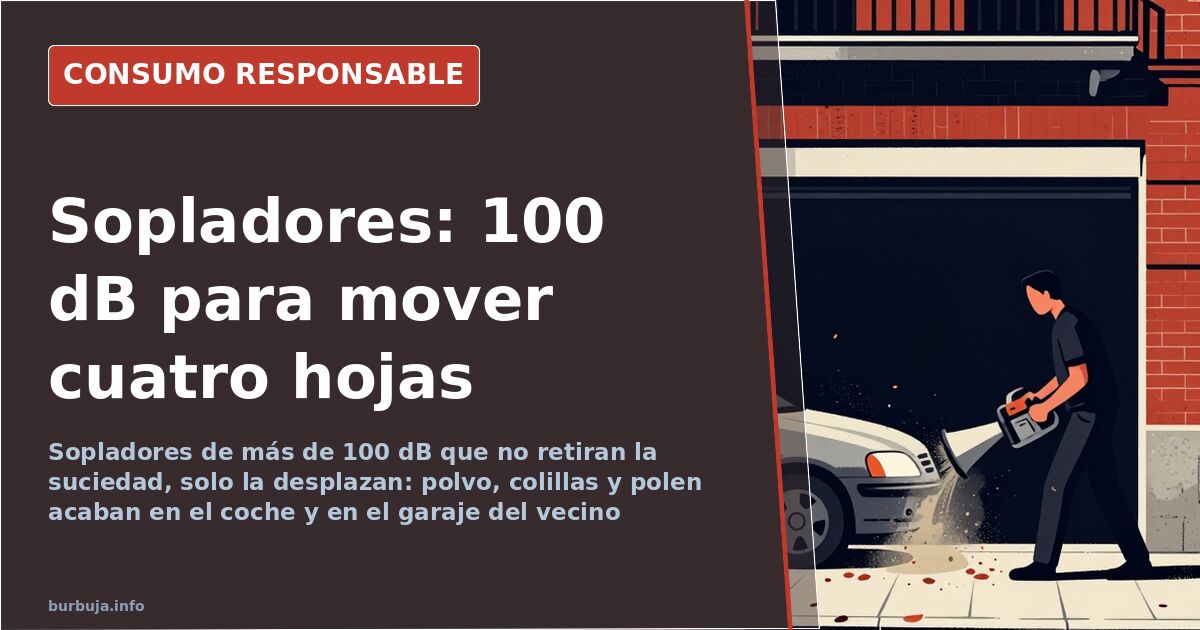
Leaf Blowers: 100 Decibels to Move Four Leaves
A gasoline-powered backpack blower, capable of emitting over 100 decibels, has become the center of complaints that go far beyond the garden. The issue is not just acoustic: the blower does not remove dirt, it displaces it. Cigarette butts, paper, dog hair, and airborne dust end up on sidewalks, parked cars, or inside neighbors' garages. And in a country where silence is undervalued, this device is used daily, for hours, often early in the morning.
The discussion begins with a domestic scene: a neighbor using a Stihl brand backpack blower, measured at around 100 dB, blowing non-stop next to a freshly washed car. From there, the issue escalates: from a specific complaint to a general diagnosis of noise in Spain, and then to a technical analysis of the gadget. Some defend it as a work tool, while others demand its outright ban in public spaces.
What Happens When the Blower Lifts Debris Instead of Removing It
The most repeated argument is not the noise, but the physics of the disaster. A blower does not vacuum: it pushes. The result is that the dirt on the ground becomes airborne, ending up in the lungs of passersby. The bacterial load of the soil remains suspended for minutes, according to the conversation, noting that everyone walks on that ground.
Complaints are repeated across various fronts. Some had to install rubber seals on garage doors because municipal workers blew cigarette butts, paper, and dog hair inside. Others describe users running at full power, chasing leaves for two hundred meters, moving them without collecting them. And some point to the detail that sums it all up: moving the mess instead of vacuuming it.
The problem is not exclusive to private gardens. Municipal cleaning machinery also appears, with electric and gas blowers, and town councils deploying them at unreasonable hours. The conclusion is clear: the device has a legitimate secondary function—accumulating debris in one spot for later collection—but in practice, it is used to drag the problem to the next property.
Noise as Public Policy: Spain, a Country Without Silence
The second axis of the issue is noise, and here the conversation moves beyond the garden. Spain is described as a country where others' silence is not respected: dogs barking at all hours, televisions at high volume, people shouting, vans and cars honking. The leaf blower is just the tip of the iceberg of an acoustic culture that does not distinguish between public and private spaces.
The recurring data point is the 100 dB level of backpack models, with measurements sometimes exceeding this figure. For context: this is a level that requires hearing protection in a workplace. On a residential sidewalk, unprotected, at seven in the morning, it is simply an assault. And there is no municipal regulation stopping it, or it is not enforced.
Some call citizen service hotlines and still wait for a response. Others denounce that the urban ecology department of a town council itself uses these devices. And some nostalgically recall street sweepers with brooms and cigarettes, who did the job without noise, fuel, or stirring up pollen. Blessed street sweepers, someone writes.
Battery, Gasoline, or Cord: The Technical War of the Garden
The discussion shifts to the tool itself. Against gasoline blowers, battery-powered models appear, with backpacks and various accessories—blower, hedge trimmer, lawn mower—which are much quieter. The catch: during droughts, dust persists, and neighbors have to close their houses tightly whenever the gardener starts blowing. And the domestic detail: professionals charge batteries using the client's outlets.
There is no technical consensus. One side argues that battery-powered gardening tools are inferior to gasoline ones, and if you don't want to spend on fuel, use corded tools at least. The other side defends that battery power is the only sensible option for residential use. What nobody disputes is that the blower, regardless of its engine, continues to move the same dirt.
Comparisons with other cleaning tools arise naturally: pressure washers that clean balconies from the inside, throwing all the dirt onto the sidewalk, leaving parked cars for the car wash. The pattern is identical: those who clean their space shift the cost to common areas. And those who suffer have no one to complain to.
The Soundscape of a Saturday Morning
The narrative expands to other domestic noises competing with the blower. A radial saw from a carpentry shop running on a Friday afternoon and maintained throughout the weekend. Bagpipes sounding from Friday night until Sunday afternoon, heard across the entire region. On Saturdays, at half past seven in the morning, blowers are already operating in the street.
The sensation conveyed is one of regulatory defeat. There are no schedules, no enforced decibel limits, no administrative response. Those who call the town hall receive no answer. Those who complain in person face indifference. Meanwhile, the device remains there, with its backpack, engine, and hundred decibels, fulfilling the only function it seems designed for: moving the mess elsewhere.
The forecast, with reservations, is that this will not change out of awareness. It might change when the cost of electric machinery drops sufficiently or when a town council decides that noise is also pollution. Until then, the leaf blower will remain the symbol of a country where public space is cleaned by pushing dirt toward the neighbor.
Also available in: Deutsch
Summary of a discussion on Burbuja.info - Foro de economía, actualidad y política., translated from Spanish and reviewed before publication. Read the full discussion (122 replies).
More summaries
-
Spain ranks second globally for noise pollution
Spain is the world's second noisiest country, plagued by unregulated motorcycles, sirens and late-night garbage collection.
-
Toyota Auris TS Sport: Hybrid beats petrol and diesel debate
Forum user chose a hybrid over diesel despite small price gap, rejecting theoretical savings for reliability.
-
Car theft: how fuel caps are being used as master keys
A warning about thieves stealing fuel caps to create key duplicates and steal vehicles is resurfacing, targeting specific car models in Spain.
-
Aging gracefully: surgery vs. genetics at 64
Madonna and Susanna Hoffs, both 64, illustrate two opposite ways of facing aging: surgery and gym versus habits and good spirits.
-
Wrinkle-proof paper: rigid, rewritable note boards
Paper creases because it is paper. Polycarbonate sheets with chalkboard vinyl, Tyvek and erasable markers: the pocket-proof options that actually hold up.
-
PepePhone and battery drain: why a Nokia's 2G lasts half as long
A Nokia 1208 goes from 6 days of battery on Simyo to 2 on PepePhone. The key lies in 2G roaming and how each carrier provides that network in Spain.