
Spain's unemployment crisis: 57% of jobless are over 45
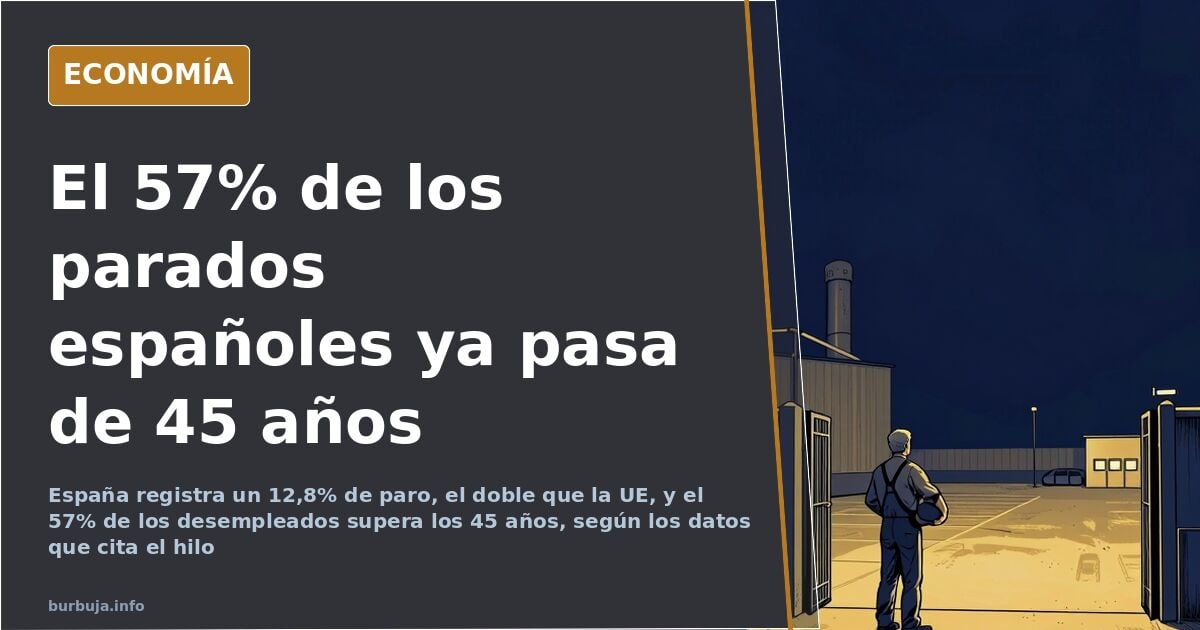
Spain’s 12.8% unemployment rate is double the EU average, with 57% of jobless people over 45, according to recent data.
English · Original discussion in Spanish · Published
Spain leads European unemployment: 12.8% vs. the EU’s 6%
Spain recorded an unemployment rate of 12.8% in March 2023, double the European Union average of 6%, and far above Germany’s 2.8% or Czechia’s 2.6%. Spain’s youth unemployment, at 29.5%, is twice the community-wide figure of 14.3%. Adding to these troubling numbers, those over 45 now account for 57% of the unemployed, the highest percentage on record, while the country has the lowest activity rate in the entire EU.
With this starting point, finding a job ceases to be a matter of luck and becomes a structural problem. The sequence repeats with maddening monotony: you send your CV, receive silence, and when an offer finally arrives, it is a summer contract, a delivery gig, or a cleaning job. The conclusion is always the same, and none are comfortable: take civil service exams, emigrate, or remain unemployed.
The age-45 barrier
According to job seekers, the labor market boundary isn’t about qualifications but birth dates. Between 40 and 45, employment prospects plummet, and after 45, they claim, only unwanted roles or highly specific profiles remain. Official data supports this perception: more than half of unemployment is concentrated in this age group. It’s not that candidates are lacking or unqualified; rather, the market discards them based on seniority, often before even reading their applications.
Civil service exams or packing your bags
When the private sector doesn’t call, the automatic response is to pursue a *oposición* (civil service exam). This isn’t an open door either: some participants estimate that many calls have a ratio of one position per ten applicants, with even harsher filters for popular roles. Those looking abroad face another wall: they argue that high-skilled profiles are demanded abroad, while low-skilled jobs compete there with the same local and migrant workforce found here.
A third scenario remains, one few choose but many end up living: staying unemployed and bearing the stigma. In a culture that measures people by their salary, long-term unemployment is not just an income problem.
Entrepreneurship: high risk, low margin
Official discourse suggests starting your own business. The most common reply is that the math doesn’t add up: tax pressure and social security contributions eat into margins, and if the business fails, you lose your investment and may end up owing money to the administration itself. Several computer shops in the area have closed, discouraging anyone considering this path.
There’s an uncomfortable second part to this argument: if most of the population depends on public salaries, cutting those salaries leaves no private alternative to sustain them. This warning comes from a participant, though the thread offers no data to back it.
Jobs that are never advertised
Here lies perhaps the least visible mechanism. Many vacancies aren’t announced; they’re filled within networks of family, friends, and acquaintances within the company, and only published if that circle fails. Consequently, job portals show only a fraction of the market, and public employment services receive a trickle of listings.
Volume adds to the issue. According to calculations circulating in the thread, serious vacancies can attract hundreds or thousands of applications, and filtering systems reportedly discard CVs in seconds. The interview, once a chance to prove oneself, has become a statistical luxury.
State, taxes, and connections: two coexisting explanations
Some argue the problem is structural: high taxes, small companies with low productivity, a state absorbing more employment, and a market where merit competes with nepotism. Others focus on cultural aspects: prioritizing holding onto your chair and flattery, leaving out those who don’t play along.
The most uncomfortable interpretation also appears, attributing scarce opportunities to competition with the migrant population. This thesis is repeated insistently in certain circles, but it reflects perception, not data: Spanish unemployment was structural long before current migration flows. Conversely, the simplest counterargument comes from the other extreme: there are highly sought-after profiles whom companies contact almost daily.
And there everything stalls. Meanwhile, someone continues filling out forms with no response on the other end.
Spain recorded an unemployment rate of 12.8% in March 2023, double the European Union average of 6%, and far above Germany’s 2.8% or Czechia’s 2.6%. Spain’s youth unemployment, at 29.5%, is twice the community-wide figure of 14.3%. Adding to these troubling numbers, those over 45 now account for 57% of the unemployed, the highest percentage on record, while the country has the lowest activity rate in the entire EU.
With this starting point, finding a job ceases to be a matter of luck and becomes a structural problem. The sequence repeats with maddening monotony: you send your CV, receive silence, and when an offer finally arrives, it is a summer contract, a delivery gig, or a cleaning job. The conclusion is always the same, and none are comfortable: take civil service exams, emigrate, or remain unemployed.
The age-45 barrier
According to job seekers, the labor market boundary isn’t about qualifications but birth dates. Between 40 and 45, employment prospects plummet, and after 45, they claim, only unwanted roles or highly specific profiles remain. Official data supports this perception: more than half of unemployment is concentrated in this age group. It’s not that candidates are lacking or unqualified; rather, the market discards them based on seniority, often before even reading their applications.
Civil service exams or packing your bags
When the private sector doesn’t call, the automatic response is to pursue a *oposición* (civil service exam). This isn’t an open door either: some participants estimate that many calls have a ratio of one position per ten applicants, with even harsher filters for popular roles. Those looking abroad face another wall: they argue that high-skilled profiles are demanded abroad, while low-skilled jobs compete there with the same local and migrant workforce found here.
A third scenario remains, one few choose but many end up living: staying unemployed and bearing the stigma. In a culture that measures people by their salary, long-term unemployment is not just an income problem.
Entrepreneurship: high risk, low margin
Official discourse suggests starting your own business. The most common reply is that the math doesn’t add up: tax pressure and social security contributions eat into margins, and if the business fails, you lose your investment and may end up owing money to the administration itself. Several computer shops in the area have closed, discouraging anyone considering this path.
There’s an uncomfortable second part to this argument: if most of the population depends on public salaries, cutting those salaries leaves no private alternative to sustain them. This warning comes from a participant, though the thread offers no data to back it.
Jobs that are never advertised
Here lies perhaps the least visible mechanism. Many vacancies aren’t announced; they’re filled within networks of family, friends, and acquaintances within the company, and only published if that circle fails. Consequently, job portals show only a fraction of the market, and public employment services receive a trickle of listings.
Volume adds to the issue. According to calculations circulating in the thread, serious vacancies can attract hundreds or thousands of applications, and filtering systems reportedly discard CVs in seconds. The interview, once a chance to prove oneself, has become a statistical luxury.
State, taxes, and connections: two coexisting explanations
Some argue the problem is structural: high taxes, small companies with low productivity, a state absorbing more employment, and a market where merit competes with nepotism. Others focus on cultural aspects: prioritizing holding onto your chair and flattery, leaving out those who don’t play along.
The most uncomfortable interpretation also appears, attributing scarce opportunities to competition with the migrant population. This thesis is repeated insistently in certain circles, but it reflects perception, not data: Spanish unemployment was structural long before current migration flows. Conversely, the simplest counterargument comes from the other extreme: there are highly sought-after profiles whom companies contact almost daily.
And there everything stalls. Meanwhile, someone continues filling out forms with no response on the other end.
Also available in: Deutsch
Summary of a discussion on Burbuja.info - Foro de economía, actualidad y política., translated from Spanish and reviewed before publication. Read the full discussion (147 replies).
More summaries
-
35-Year-Old Ex-Programmer: 'No Way' to Find a Job in Spain
A 35-year-old senior programmer has been unemployed for nearly a year in Spain, as AI decimated his business and tech job postings attract over 100 candidates.
-
Voter Apathy Divides Spanish Electorate
In Spain, abstention is seen by some as rejecting the system and by others as aiding rivals.
-
Pentagon to Live-Stream Fort Hood Shooter's Execution
The Pentagon will live-stream the execution of the Fort Hood mass shooter, a move shifting the Overton window.
-
Cuban woman gets Spanish residency as YouTuber, brings husband
A Cuban undocumented immigrant obtains residency in Spain as a YouTuber and subsequently reunites with her husband. The case reignites debate on regularization.
-
Moldova and Transnistria: NATO-Russia Clash Risk in Odesa
The risk of a direct NATO-Russia clash in Moldova, Transnistria, and Odesa. Analysis of moves preparing escalation.
-
Spanish public physiotherapist claims 4.5 hours of actual work
An interim Spanish physiotherapist reports 4.5-hour effective shifts and unused time-tracking systems in public healthcare.