
Spain's transport minister defends rail safety and refuses to resign
Óscar Puente, Spain's transport minister, insists the rail system is "reliable and safe" and rules out resigning despite criticism over failures and incidents on the network.
English · Original discussion in Spanish · Published
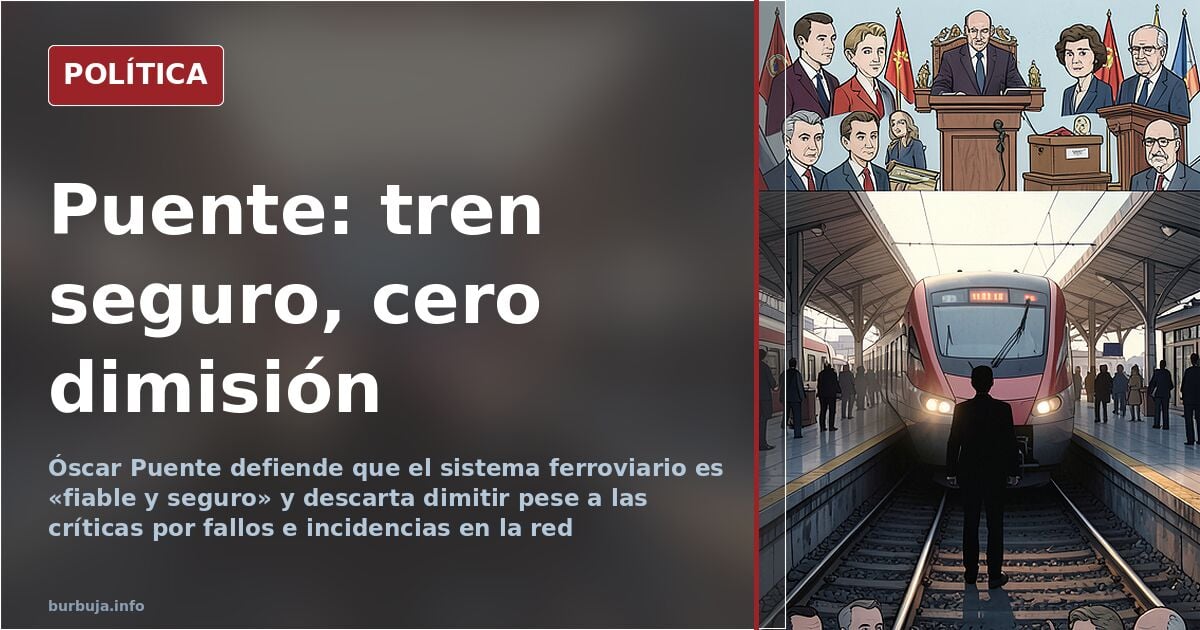
Puente insists trains are safe and has no plans to resign
Is Spain's rail system safe? That is the question that comes up every time the transport minister faces the press after an accident. Óscar Puente is clear about it: the rail system is "reliable and safe", within limits that include "the limits of the rolling stock itself and the limits of human performance, as in any transport environment". Failures, he admits, can happen. But his conclusion remains the same: trains are safe and, therefore, there is no reason to step down.
The remark, made in the middle of the controversy over the state of the network, has landed like a bucket of cold water on those demanding political accountability. Because the debate is not so much whether a train can fail —any system does— as who answers when it does. And there the minister has chosen to dig in: no resignation, no self-criticism. Just management.
The minister's argument: failures yes, unsafe no
Puente's case rests on a classic distinction in industrial safety: failures can occur without the system being unsafe. Any transport environment —air, road, rail— lives with margins of error. What defines its safety is not the absence of failures, but the existence of protocols that contain them.
The problem is that this argument, flawless on paper, clashes with the perception of those who use the train every day. Trust cannot be decreed. And when a minister says "we have a safe rail system" while incidents pile up, the message sounds more like corporate defence than technical assessment.
Calls for resignation and the debate over political accountability
The call for his resignation has become the heart of the controversy. The reasoning going around is simple: a minister neither drives trains nor oversees every maintenance job, but bears ultimate responsibility for the political direction of the system and the bodies under his department. If the system fails, the chain of command ends at his desk.
On the other side, the minister's defence clings to the letter of the law: the technical failures are not his. It is the old tension between objective responsibility and personal responsibility. And in politics, the former usually weighs more than the latter as the wear and tear builds up.
What the government has at stake in this standoff
Keeping the minister is a political decision, not a technical one. Every day that passes without changes at the department reinforces the idea that the executive prioritises cabinet stability over a signal of accountability. And that perception, in a matter touching the safety of millions of passengers, carries an electoral cost.
Puente has chosen not to resign. Time will tell whether that stubbornness reads as resolve or as deafness. For now, the only certainty is that the train will remain safe on paper. On the platform, trust is another matter.
Also available in: Deutsch
Summary of a discussion on Burbuja.info - Foro de economía, actualidad y política., translated from Spanish and reviewed before publication. Read the full discussion (18 replies).
More summaries
-
Renfe delays soar 40% as Spain's transport minister tightens compensation
Renfe delays rise 40% while Minister Puente restricts compensation. Train drivers' union asks to limit high-speed trains to 250 km/h due to track defects.
-
Madrid PP gives 48 hours to clear Sol camp
Madrid's PP gives 48 hours to clear the Sol encampment, citing cobblestones, stoves and knives; banners against Ayuso appear.
-
Blocus: minor arrested and questions over who was behind it
A Senegalese minor with a criminal record ran the Blocus Vlc channels that called for looting shops in Valencia, Spain, according to police. No political network has been confirmed.
-
Spain's high-speed rail disasters: the tragic symbol of a national decline
In ABC, Ignacio Camacho argues that the Adamuz and Urda rail crashes, which left more than a hundred dead, are a symbol of Spain's institutional decay.
-
Was it human error? Spain's Madrid-Sevilla line under scrutiny after Toledo crash
Spain's Transport Minister blamed the Atocha control centre after the accident. The Madrid-Sevilla line lacks an approved automatic signalling system.
-
Step down from this one, Mr Puente (Rebeca Argudo in El ABC)
Minister Óscar Puente appeared five hours after the Urda, Toledo, rail crash of 28 October. He called the network reliable and safe and ruled out resigning.