
Spain's Teacher Paradox: Empty Classrooms vs. 12,000 Euro Masters
Spain faces a stark contradiction: plunging birth rates leave classrooms with just two students, while private teaching master's degrees cost up to 12,000 euros.
English · Original discussion in Spanish · Published
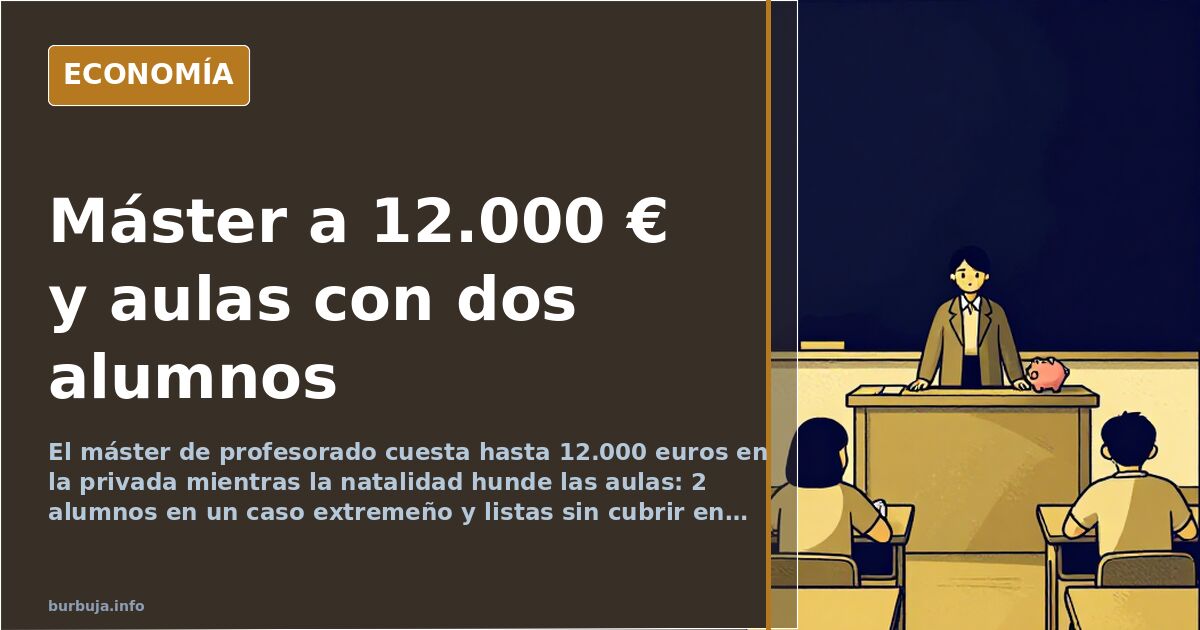
Classrooms with 2 students and a 12,000 € master: the teacher bottleneck
The master's degree required to teach has become a toll of between 5,000 and 12,000 euros in private universities, as public institutions have no vacancies. Meanwhile, birth rates are plummeting, school closures are discussed, and Extremadura classrooms have two students. These two facts do not align. This contradiction — fewer children, more candidates — runs through the entire issue from top to bottom.
From public universities with no vacancies to the 12,000 euro master's
Demand for the teaching master's has surged so much that public universities are full, forcing applicants to pay for private tuition. It is argued that many entrants lack real interest in teaching: they seek vacations, salary, and conditions, and some come from other jobs they wish to abandon. This is a prevailing opinion, not a census, but it explains the suspicion with which the group is viewed. Meanwhile, demographic drought advances: each year there are fewer schoolchildren, and talk of center closures is growing.
The conclusion drawn is that there will soon be teachers even in the soup. Extreme cases circulating are hard to believe: a classroom with two students and a center where, it is claimed, there were more teachers than students. The arithmetic of the population pyramid is stubborn and admits no gentle interpretations.
How many students are really in each classroom?
It depends on the map, and there lies the underlying misunderstanding. Semi-empty classes are in the depopulated interior; in southern Andalusia and the Levant, there are centers with over a thousand students. In Aragon, it is claimed that signing the exam is enough to start working, while in Galicia and Andalusia, entering is complicated. In Castile and León, the first destination usually falls in the Soria or Salamanca plains. The internal portrait adds another uncomfortable fact: a 10% of the faculty is directly dysfunctional and another 40% cannot control a classroom, according to the testimony of an active head of studies.
2,300 euros in Navarre, 1,300 in private
Salary is the mined ground. Some estimate the starting net salary of 2,300 euros in 14 payments in Navarre, while others respond that this is not enough to support a family in Madrid, Barcelona, Valencia, or the Balearic Islands. The teacher relocated by the autonomous community spends much of their salary on relocation and rent, and cannot refuse a posting without consequences. In private education, the starting point is 1,300 euros in 12 payments and only one month of vacation.
The European comparison is French: 23% withholding on all salaries and a starting teacher salary around double the minimum wage. Here, the minimum wage is not taxed, and the first teacher salary doubles that reference; there, the civil servant starts close to the minimum wage and struggles to double it. This detail dismantles the idea that teachers are paid little here. Or confirms it, depending on where the cut is placed.
Specializations without graduates and open lists
There is a shortage of teachers in technology, mathematics, computer science, or philosophy, and an abundance of candidates in other subjects. In some specializations, lists are peine with only the requirement of a degree, without passing an exam and sometimes without a master's. With the baby boom generation retiring and the private sector absorbing technical profiles, those who do not find a position where they want end up finding one where they do not. This is the mechanism sustaining the system and, by extension, explaining why offered positions remain vacant.
Are there too many teachers or not enough good teachers?
Here, the issue splits in two. One view holds that the problem is not quantity but selection: without incentives or real competition, the best do not arrive, and those who arrive are shielded from any evaluation. The response from the other side is that the problem lies with those who pay the taxes funding the payroll, not those who collect it. A third, cross-cutting view points to students: PISA report results, at the bottom of comparable rankings, do not improve even with fewer students per class.
On the table is also artificial intelligence. Some predict half the teaching staff will be surplus, while others recall that similar announcements were made with each previous technology while classrooms still needed someone in front. The conversation, by the way, ended up drifting toward spreadsheets and programming languages, which is what happens when a sector has been turning over the same knot for two years without untangling it.
With birth rates falling, retirements underway, and a ratio oscillating between two students in a village and a thousand in a coastal center, the calculation of how many teachers are needed does not add up in any direction. No one has yet shown the complete account.
The master's degree required to teach has become a toll of between 5,000 and 12,000 euros in private universities, as public institutions have no vacancies. Meanwhile, birth rates are plummeting, school closures are discussed, and Extremadura classrooms have two students. These two facts do not align. This contradiction — fewer children, more candidates — runs through the entire issue from top to bottom.
From public universities with no vacancies to the 12,000 euro master's
Demand for the teaching master's has surged so much that public universities are full, forcing applicants to pay for private tuition. It is argued that many entrants lack real interest in teaching: they seek vacations, salary, and conditions, and some come from other jobs they wish to abandon. This is a prevailing opinion, not a census, but it explains the suspicion with which the group is viewed. Meanwhile, demographic drought advances: each year there are fewer schoolchildren, and talk of center closures is growing.
The conclusion drawn is that there will soon be teachers even in the soup. Extreme cases circulating are hard to believe: a classroom with two students and a center where, it is claimed, there were more teachers than students. The arithmetic of the population pyramid is stubborn and admits no gentle interpretations.
How many students are really in each classroom?
It depends on the map, and there lies the underlying misunderstanding. Semi-empty classes are in the depopulated interior; in southern Andalusia and the Levant, there are centers with over a thousand students. In Aragon, it is claimed that signing the exam is enough to start working, while in Galicia and Andalusia, entering is complicated. In Castile and León, the first destination usually falls in the Soria or Salamanca plains. The internal portrait adds another uncomfortable fact: a 10% of the faculty is directly dysfunctional and another 40% cannot control a classroom, according to the testimony of an active head of studies.
2,300 euros in Navarre, 1,300 in private
Salary is the mined ground. Some estimate the starting net salary of 2,300 euros in 14 payments in Navarre, while others respond that this is not enough to support a family in Madrid, Barcelona, Valencia, or the Balearic Islands. The teacher relocated by the autonomous community spends much of their salary on relocation and rent, and cannot refuse a posting without consequences. In private education, the starting point is 1,300 euros in 12 payments and only one month of vacation.
The European comparison is French: 23% withholding on all salaries and a starting teacher salary around double the minimum wage. Here, the minimum wage is not taxed, and the first teacher salary doubles that reference; there, the civil servant starts close to the minimum wage and struggles to double it. This detail dismantles the idea that teachers are paid little here. Or confirms it, depending on where the cut is placed.
Specializations without graduates and open lists
There is a shortage of teachers in technology, mathematics, computer science, or philosophy, and an abundance of candidates in other subjects. In some specializations, lists are peine with only the requirement of a degree, without passing an exam and sometimes without a master's. With the baby boom generation retiring and the private sector absorbing technical profiles, those who do not find a position where they want end up finding one where they do not. This is the mechanism sustaining the system and, by extension, explaining why offered positions remain vacant.
Are there too many teachers or not enough good teachers?
Here, the issue splits in two. One view holds that the problem is not quantity but selection: without incentives or real competition, the best do not arrive, and those who arrive are shielded from any evaluation. The response from the other side is that the problem lies with those who pay the taxes funding the payroll, not those who collect it. A third, cross-cutting view points to students: PISA report results, at the bottom of comparable rankings, do not improve even with fewer students per class.
On the table is also artificial intelligence. Some predict half the teaching staff will be surplus, while others recall that similar announcements were made with each previous technology while classrooms still needed someone in front. The conversation, by the way, ended up drifting toward spreadsheets and programming languages, which is what happens when a sector has been turning over the same knot for two years without untangling it.
With birth rates falling, retirements underway, and a ratio oscillating between two students in a village and a thousand in a coastal center, the calculation of how many teachers are needed does not add up in any direction. No one has yet shown the complete account.
Summary of a discussion on Burbuja.info - Foro de economía, actualidad y política., translated from Spanish and reviewed before publication. Read the full discussion (340 replies).
More summaries
-
Spanish Teachers: Higher Hours and Pay Than OECD, Yet PISA Scores Decline
Spanish teachers teach 1,053 hours annually—144 more than the OECD average—and earn above average. Yet, PISA scores are plummeting. Where is the failure?
-
Educational disaster in Spain: Worst results in history in PISA report, falling up to two school years behind the United Kingdom
Spain plunges in PISA 2025 report, showing a two-year lag in reading compared to the UK. We analyze the causes and consequences.
-
Educational Disaster: Spain Achieves Its Worst PISA Scores, Two Years Behind
Spain registers its worst PISA result: up to two years behind the UK. The keys to educational failure: law, mobile phones, and immigration.
-
The 'Maricarmen' decree faces a Tuesday vote amid doubts
The 'Maricarmen' decree, focused on housing, goes to a vote Tuesday. Old rents, Junts, omnibus bills, and planned applause...
-
The Cost of Being the Workplace Helper
Workplace helpers often cover others' shifts without extra pay. The recurring complaint: being too nice makes you a fool.
-
Feijóo Proposes Mutuals Grant Medical Clearance for Sick Leave
Feijóo suggests allowing mutual insurance companies to issue medical clearance for sick leave. The debate centers on fraud, economic incentives, and the political cost of this announcement.