
Spain's tax burden sparks debate: 'The State is the enemy'
Forum users cite Spain's 39% GDP tax pressure and fiscal effort 17.8% above EU average to argue the State exploits citizens.
English · Original discussion in Spanish · Published
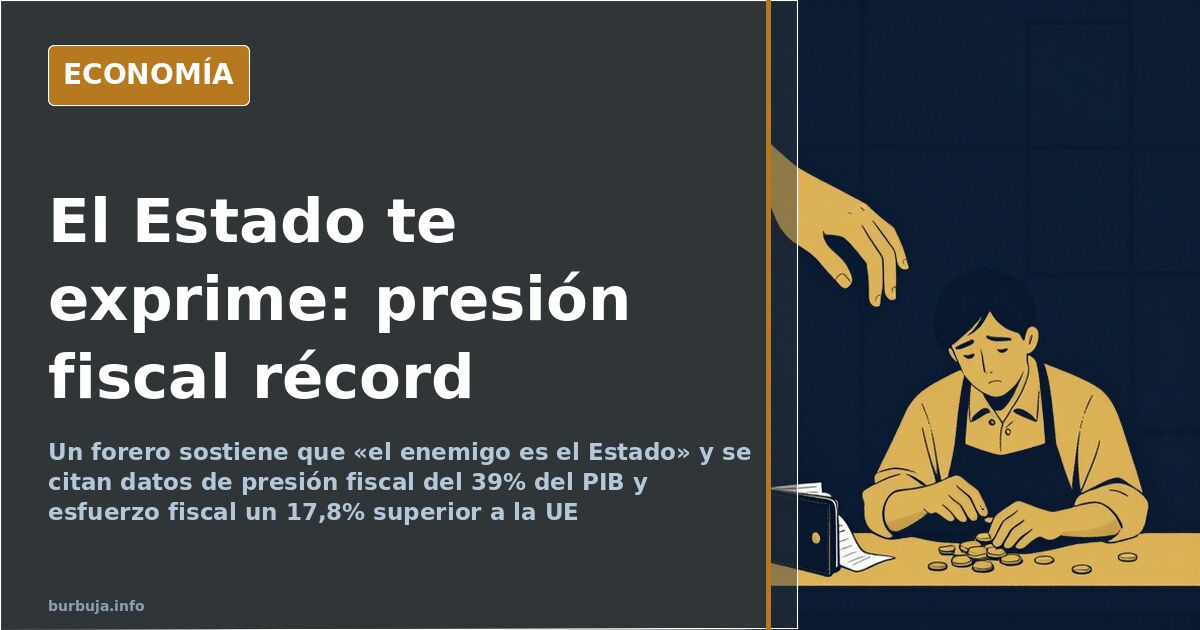
The Enemy is the State: Record Tax Pressure and Fiscal Rebellion
The State is not your friend. It seeks to control and exploit you, even after death. This thesis underpins a discussion starting with an uncomfortable question: which side are you on? You either belong to the State—civil servant, subsidized company, media outlet dependent on public advertising—or the State lives off you, squeezing you dry. There is no middle ground. The forum user's conclusion is stark: if you are self-employed or work for a business outside the state apparatus, the State is your enemy.
This diagnosis is not mere bar talk. Data cited in the exchange points to a tax pressure in Spain hovering around 39% of GDP, with tax revenue hitting historic records and fiscal effort already 17.8% higher than the EU average. Critics conclude that the State grows, most new jobs are public sector roles, increasing pressure on those who feed the beast.
How do you fight the State if you cannot vote it out?
The proposed recipe has four pillars: exit consumerism to pay less tax, operate in the black market where possible, spend minimally to reduce collection, and denounce the situation. This is the domestic version of tax disobedience. Some call it the sarracena duty to evade taxes, so parasites have fewer resources.
Others counter that it is too late. More than half the country depends on the State, excluding companies living on subsidies or media reliant on public ads. When the majority of voters draw salaries from the public budget, fiscal rebellion is not an option; it is electoral suicide. Here, the debate stalls.
The trap of international comparison
The exchange heats up when someone suggests moving to Chile or Colombia, where taxes are lower. The immediate reply: yes, but healthcare and retirement there are not like Spain's. When Switzerland, Denmark, Andorra, Singapore, or Germany are mentioned as low-tax havens, corrections trinc: Denmark has higher taxes than Spain, often considered the world's highest tax pressure country, and Singapore does not provide healthcare to foreigners.
A technical nuance dismantles percentage-of-GDP comparisons: two countries with 100 citizens each, one collects 200, the other 100. The second seems to have lower taxes. But if everyone in the first pays a small amount, while in the second twenty people pay five times more and the rest contribute nothing, the second is exploiting its workers. In this analogy, Spain is the second.
Income Tax that only punishes producers
A common calculation involves a senior engineer earning €80,000 gross annually. Between social security contributions and IRPF (Personal Income Tax), over €50,000 is taken. The official response is that pogre IRPF brackets miccionan most pay less due to low wages. The rebuttal is devastating: investing that €50,000 annually in the S&P 500 for thirty years would yield capital far exceeding any pension. A 50% destruction of capital, ignoring inflation.
The argument that most workers accept pogre IRPF is interpreted as a symptom of cronyism, envy, and ignorance prevalent in Spain. Take from those who have more than me. It explains why socialism took root here.
Employers vs. Workers: The False Zero-Sum Game
One lucid analysis debunks the ideological fallacy of a zero-sum game between employers and workers. If businesses fail, workers suffer. When profitable, they hire more and pay better. When struggling, they fire and cut wages. Employers are the heroes; politicians and unions make us hate them.
Counterpoints arise from the left: not employers, but technology drives pogre, much of it state-funded. A lingering question remains: where would tax evaders buy bullets for an army if they claim to have no money?
The State as Common Home vs. Government as Problem
Not all participants accept the initial premise. A recurring objection: the State is our homeland, borders, seas, rivers, mountains, fields, and monuments. The Government is the problem, social democracy is the problem, traitors are the problem. The State is literally our home. Without a strong State, those replacing it would not fund police to control revolutionaries or stop charging for occupying property.
Anarcho-capitalist views add: the State is a private corporation with a legal monopoly on violence. The most conspiratorial diagnosis: the goal is transforming the State into organized crime, what exists in empire colonies labeled as democracies.
With these premises, predictions are risky. If tax pressure keeps breaking records and public employment grows, the net taxpayer base shrinks. Silent fiscal rebellion—black market operations, reduced consumption, offshore savings—may gain trinc. But while over half the country draws from the budget, the liberal revolution invoked by some remains, with reservations, a forum fantasy.
The State is not your friend. It seeks to control and exploit you, even after death. This thesis underpins a discussion starting with an uncomfortable question: which side are you on? You either belong to the State—civil servant, subsidized company, media outlet dependent on public advertising—or the State lives off you, squeezing you dry. There is no middle ground. The forum user's conclusion is stark: if you are self-employed or work for a business outside the state apparatus, the State is your enemy.
This diagnosis is not mere bar talk. Data cited in the exchange points to a tax pressure in Spain hovering around 39% of GDP, with tax revenue hitting historic records and fiscal effort already 17.8% higher than the EU average. Critics conclude that the State grows, most new jobs are public sector roles, increasing pressure on those who feed the beast.
How do you fight the State if you cannot vote it out?
The proposed recipe has four pillars: exit consumerism to pay less tax, operate in the black market where possible, spend minimally to reduce collection, and denounce the situation. This is the domestic version of tax disobedience. Some call it the sarracena duty to evade taxes, so parasites have fewer resources.
Others counter that it is too late. More than half the country depends on the State, excluding companies living on subsidies or media reliant on public ads. When the majority of voters draw salaries from the public budget, fiscal rebellion is not an option; it is electoral suicide. Here, the debate stalls.
The trap of international comparison
The exchange heats up when someone suggests moving to Chile or Colombia, where taxes are lower. The immediate reply: yes, but healthcare and retirement there are not like Spain's. When Switzerland, Denmark, Andorra, Singapore, or Germany are mentioned as low-tax havens, corrections trinc: Denmark has higher taxes than Spain, often considered the world's highest tax pressure country, and Singapore does not provide healthcare to foreigners.
A technical nuance dismantles percentage-of-GDP comparisons: two countries with 100 citizens each, one collects 200, the other 100. The second seems to have lower taxes. But if everyone in the first pays a small amount, while in the second twenty people pay five times more and the rest contribute nothing, the second is exploiting its workers. In this analogy, Spain is the second.
Income Tax that only punishes producers
A common calculation involves a senior engineer earning €80,000 gross annually. Between social security contributions and IRPF (Personal Income Tax), over €50,000 is taken. The official response is that pogre IRPF brackets miccionan most pay less due to low wages. The rebuttal is devastating: investing that €50,000 annually in the S&P 500 for thirty years would yield capital far exceeding any pension. A 50% destruction of capital, ignoring inflation.
The argument that most workers accept pogre IRPF is interpreted as a symptom of cronyism, envy, and ignorance prevalent in Spain. Take from those who have more than me. It explains why socialism took root here.
Employers vs. Workers: The False Zero-Sum Game
One lucid analysis debunks the ideological fallacy of a zero-sum game between employers and workers. If businesses fail, workers suffer. When profitable, they hire more and pay better. When struggling, they fire and cut wages. Employers are the heroes; politicians and unions make us hate them.
Counterpoints arise from the left: not employers, but technology drives pogre, much of it state-funded. A lingering question remains: where would tax evaders buy bullets for an army if they claim to have no money?
The State as Common Home vs. Government as Problem
Not all participants accept the initial premise. A recurring objection: the State is our homeland, borders, seas, rivers, mountains, fields, and monuments. The Government is the problem, social democracy is the problem, traitors are the problem. The State is literally our home. Without a strong State, those replacing it would not fund police to control revolutionaries or stop charging for occupying property.
Anarcho-capitalist views add: the State is a private corporation with a legal monopoly on violence. The most conspiratorial diagnosis: the goal is transforming the State into organized crime, what exists in empire colonies labeled as democracies.
With these premises, predictions are risky. If tax pressure keeps breaking records and public employment grows, the net taxpayer base shrinks. Silent fiscal rebellion—black market operations, reduced consumption, offshore savings—may gain trinc. But while over half the country draws from the budget, the liberal revolution invoked by some remains, with reservations, a forum fantasy.
Also available in: Deutsch
Summary of a discussion on Burbuja.info - Foro de economía, actualidad y política., translated from Spanish and reviewed before publication. Read the full discussion (113 replies).
More summaries
-
Spain's tax burden eats 57% of freelancer revenue
A Spanish self-employed worker bills €140,000 but nets only €5,000 monthly after IRPF, VAT and social security fees absorb 57% of income.
-
Half of Spanish adults rely on state: 16 million monthly payrolls
50% of adults depend on aid, pensions or public jobs. Employment under 51%, €1.5 trillion debt and record elderly unemployment.
-
Guadalajara, Azuqueca or Alovera: what €350,000 buys
New four-bedroom homes in Alcalá de Henares now exceed €350,000, pushing buyers to look in Guadalajara, Azuqueca or Alovera.
-
Hourly room rentals rise in Madrid amid shared flat privacy crisis
Paying €12–€25 per hour for privacy reflects overcrowding and lack of personal space in Madrid's shared housing market.
-
The Myth of the Warning Shot at Wild Boar: No Hunter Does This
Warning shots at wild boars appear in no hunting regulations or manuals. The idea stems from a misunderstanding of fair chase and lacks technical basis.
-
Spain viral claim: €20 entry fee, €5 bathroom charge
A Spanish woman claims saving €10,000 by charging guests for visits and bathroom use. Net savings don't add up; viral hoax suspected.