
Spain’s Tax Agency Targets Wedding Gifts as Donations
The Spanish tax authority is scrutinizing wedding gifts, treating cash envelopes and transfers as taxable donations, causing concern among newlyweds.
English · Original discussion in Spanish · Published
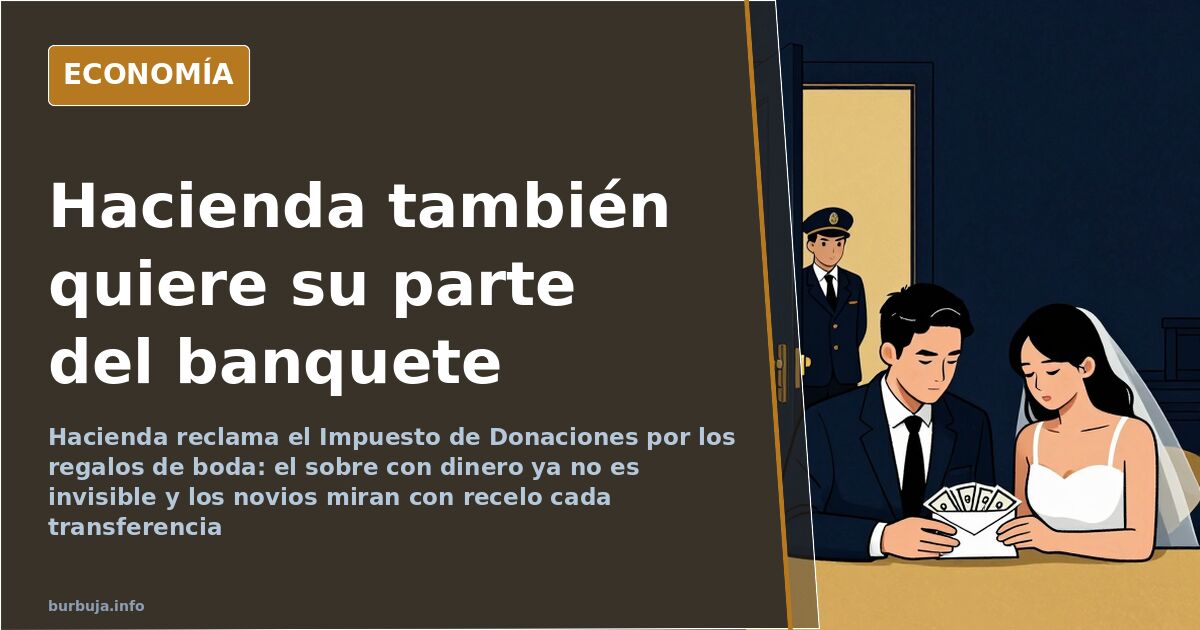
Tax Authority Eyes Wedding Gifts: The Envelope Is No Longer Invisible
News has circulated with a headline that has irritated half of Spain: the Tax Agency informs newlyweds that wedding gifts are taxed as donations. This issue, which is not actually new, has returned to the forefront due to a detail that changes everything: the Agencia Tributaria (Spanish Tax Agency) has begun to closely examine what was previously resolved with a closed envelope and a handshake. The reaction was immediate. And not exactly in the form of congratulations.
The key lies in the legal nature of the gift. An envelope with money, a paid alucinación, or a banquet covered by a guest are, for tax purposes, a donation. And donations are taxed. What has changed is not the law, but the intensity with which it is applied. With public finances strained and debt unchecked, every last cent falls under the radar. Even the rice.
What Exactly Does the Tax Authority Claim from Couples?
The Gift Tax does not distinguish between an anonymous envelope and a bank transfer. If there is proof of the gift, there is a taxable event. The problem is that for decades custom has operated outside the paperwork: cash money, no trace, no invoice, no declaration. That balance breaks when couples, in a burst of modernity, decide to put their account number on the invitation so guests can make a transfer. There goes the trail. And the Tax Agency, when it wants to, reads.
Some argue that the wedding gift is actually payment for the meal received by the guest. A sort of economic exchange, not a donation. Under that logic, it would suffice to issue an invoice for each place setting and close the circle. The thesis has appeal, but is not without holes: not every gift equals a place setting, and not every place setting is paid for with a gift.
The Envelope as Last Fiscal Refuge
In the collective imagination, the envelope with bills remains the only law that never fails. It leaves no trace, creates no reporting obligation, and arouses no suspicion. The conclusion drawn from many analyses is simple: if the State wants its share even of other people's happiness, the logical response is not to give clues. Cash, that old acquaintance, regains prominence.
The irony is that those who most predict the disappearance of cash are the same ones who, when it suits them, use it without hesitation. The contradiction does not go unnoticed.
The Double Standard Nobody Questions
The comparison arises naturally: official housing, official cars, institutional trips, allowances collected whether or not one attends Congress. All of that, according to the criteria applied to the groom with an envelope, should be taxed as payment in kind. It is not. The asymmetry is the most repeated argument and the least refuted.
The debate then shifts toward something larger: the State as a forced intermediary in every economic interaction. It is not just the Tax Agency. It is the VAT on the banquet, the music license, the catering invoice. Every link has its cut.
The Real Cost of the Wedding: Who Pays and Who Declares?
Organizing a banquet involves a chain of payments rarely declared in full. The caterer, the DJ, the photographer, the florist. Each issues their invoice, or doesn't. The guest who puts 300 euros in an envelope is not thinking about the Gift Tax. They are thinking about covering their seat and making a good impression. That distance between intention and fiscal obligation is the heart of the matter.
Some recall that formerly gifts were physical: tableware, an appliance, something for the house. Now money is sent. And money, unlike tableware, leaves a mark.
What the Tax Agency Doesn't Say and the Taxpayer Suspects
The question looming is how far scrutiny will go. There is no definitive answer. What exists is a feeling: that the margin is narrowing. That what was once invisible is now being watched. That the envelope, that almost folkloric object, has become the last frontier of economic privacy.
Analysis gets stuck exactly there: at the point where the law says one thing, custom says another, and the Tax Agency decides which of the two wins.
News has circulated with a headline that has irritated half of Spain: the Tax Agency informs newlyweds that wedding gifts are taxed as donations. This issue, which is not actually new, has returned to the forefront due to a detail that changes everything: the Agencia Tributaria (Spanish Tax Agency) has begun to closely examine what was previously resolved with a closed envelope and a handshake. The reaction was immediate. And not exactly in the form of congratulations.
The key lies in the legal nature of the gift. An envelope with money, a paid alucinación, or a banquet covered by a guest are, for tax purposes, a donation. And donations are taxed. What has changed is not the law, but the intensity with which it is applied. With public finances strained and debt unchecked, every last cent falls under the radar. Even the rice.
What Exactly Does the Tax Authority Claim from Couples?
The Gift Tax does not distinguish between an anonymous envelope and a bank transfer. If there is proof of the gift, there is a taxable event. The problem is that for decades custom has operated outside the paperwork: cash money, no trace, no invoice, no declaration. That balance breaks when couples, in a burst of modernity, decide to put their account number on the invitation so guests can make a transfer. There goes the trail. And the Tax Agency, when it wants to, reads.
Some argue that the wedding gift is actually payment for the meal received by the guest. A sort of economic exchange, not a donation. Under that logic, it would suffice to issue an invoice for each place setting and close the circle. The thesis has appeal, but is not without holes: not every gift equals a place setting, and not every place setting is paid for with a gift.
The Envelope as Last Fiscal Refuge
In the collective imagination, the envelope with bills remains the only law that never fails. It leaves no trace, creates no reporting obligation, and arouses no suspicion. The conclusion drawn from many analyses is simple: if the State wants its share even of other people's happiness, the logical response is not to give clues. Cash, that old acquaintance, regains prominence.
The irony is that those who most predict the disappearance of cash are the same ones who, when it suits them, use it without hesitation. The contradiction does not go unnoticed.
The Double Standard Nobody Questions
The comparison arises naturally: official housing, official cars, institutional trips, allowances collected whether or not one attends Congress. All of that, according to the criteria applied to the groom with an envelope, should be taxed as payment in kind. It is not. The asymmetry is the most repeated argument and the least refuted.
The debate then shifts toward something larger: the State as a forced intermediary in every economic interaction. It is not just the Tax Agency. It is the VAT on the banquet, the music license, the catering invoice. Every link has its cut.
The Real Cost of the Wedding: Who Pays and Who Declares?
Organizing a banquet involves a chain of payments rarely declared in full. The caterer, the DJ, the photographer, the florist. Each issues their invoice, or doesn't. The guest who puts 300 euros in an envelope is not thinking about the Gift Tax. They are thinking about covering their seat and making a good impression. That distance between intention and fiscal obligation is the heart of the matter.
Some recall that formerly gifts were physical: tableware, an appliance, something for the house. Now money is sent. And money, unlike tableware, leaves a mark.
What the Tax Agency Doesn't Say and the Taxpayer Suspects
The question looming is how far scrutiny will go. There is no definitive answer. What exists is a feeling: that the margin is narrowing. That what was once invisible is now being watched. That the envelope, that almost folkloric object, has become the last frontier of economic privacy.
Analysis gets stuck exactly there: at the point where the law says one thing, custom says another, and the Tax Agency decides which of the two wins.
Also available in: Deutsch
Summary of a discussion on Burbuja.info - Foro de economía, actualidad y política., translated from Spanish and reviewed before publication. Read the full discussion (128 replies).
More summaries
-
Spanish Tax Agency: Epiphany Gifts Are Donations
The Spanish Tax Agency clarifies that receiving money or goods without consideration is a donation, subject to the Inheritance and Gift Tax.
-
AEAT inspector vacancies offer up to €48,098 in supplements
The Official Gazette published 511 AEAT inspector positions with specific supplements ranging from €32,521 to €48,098 annually.
-
Why Spain isn't having children: three underlying trends
Housing, wages, female education and immigration: the three trends that explain why Spain barely reaches 1.2 children per woman
-
Blue streetlights: not UV rays or war weapons
Viral claims say blue streetlights emit UV and are weapons; physics and video origins prove otherwise.
-
Viral video claims woman slept with 129 men
A young woman claims in a viral video to have had sex with 129 men, sparking debate over authenticity and double standards.
-
Threads: BBC Nuclear Film Resurfaces Amid Defense Spending Debate
A BBC production on nuclear attack circulates again, raising doubts about radiation effects and defense budgets.