
Spain's Squatting Crisis: A Lucrative Business Left Unchecked
High-end Barcelona flats listed as occupied highlight the legal and judicial delays fueling Spain's squatting crisis.
English · Original discussion in Spanish · Published
Why Squatting Persists in Spain
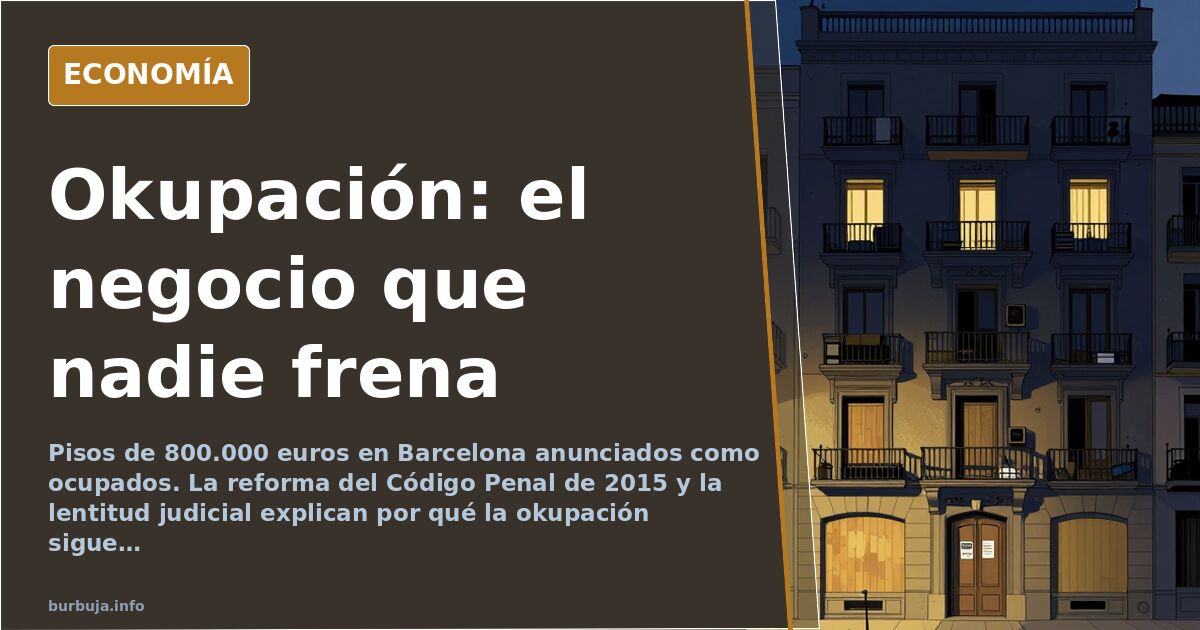
An €800,000 apartment in a premium area of Barcelona, listed on a real estate portal with the tag "Illegally Occupied." This scene, repeated recently, summarizes a paradox that angers those who have saved for years to buy a home: while young couples cannot afford a flat in their neighborhood, others access luxury housing without paying. The inevitable question is: why does squatting remain, in practice, a tolerated activity in Spain?
The issue is not new, but the debate has intensified. In Spain, squatting is not strictly legal: the Penal Code includes the crime of usurpation. However, incivil proceedings are slow, and owners often face years of litigation before recovering their property. This gap between the law and its enforcement fuels a sense of impunity.
The Penal Code and the Reform That Changed Everything
A fact often overlooked in public discussion is the 2015 reform of the Penal Code, pushed by Mariano Rajoy's government, which reduced penalties for usurpation and made immediate arrest of squatters more difficult. Before this reform, police had more leeway; afterwards, the process dragged on. Proponents of this view argue that the PP laid the groundwork for current impunity, while the left simply failed to reverse it.
Conversely, some recall that José Luis Rodríguez Zapatero tightened squatting penalties at the time, arguing banks needed guarantees to sustain their debt. The paradox is clear: PSOE hardened the laws, and PP relaxed them. Neither side looks good when reviewing the archives.
Who Benefits from Squatting? Forum Theories
Among circulating analyses, one thesis gains traction: squatting serves to degrade neighborhoods, expel residents with savings capacity, and allow investment funds to buy cheaply. Once the area is "rehabilitated," prices skyrocket and profits multiply. Supporters claim this mechanism repeats from the center to the periphery.
Another line of argument suggests squatting is a pressure valve hiding real poverty. If all occupants were evicted tomorrow, they say, shantytowns and homelessness would appear everywhere. The State thus saves on building social housing and shifts the problem to private owners.
Others see electoral interests: over time, squatters become grateful voters. Some also argue squatting relativizes private property, a principle fundamentally questioned by the left.
What the Data Says (and Doesn't)
Real estate portals show €600,000 and €800,000 apartments in top areas of Barcelona tagged as occupied. These are homes theoretically out of reach for any average salaried worker. Yet there they are, occupied and listed. The contradiction is hard to digest for those saving for years.
There are no official figures breaking down how many of these occupations stem from real need versus organized mafias. This lack of data feeds all kinds of theories. Without numbers, the debate swings between indignation and suspicion.
Is Spain a Unique Case Globally?
Those who have spoken with foreigners—Brazilians, Romanians, French—say they are perplexed by what happens in Spain. In other countries, occupation issues are resolved in days, not years. International comparison is one of the most repeated arguments demanding legislative change.
Ultimately, the question remains the same asked by buyers looking at the €800,000 flat ad: who really benefits from the status quo?
An €800,000 apartment in a premium area of Barcelona, listed on a real estate portal with the tag "Illegally Occupied." This scene, repeated recently, summarizes a paradox that angers those who have saved for years to buy a home: while young couples cannot afford a flat in their neighborhood, others access luxury housing without paying. The inevitable question is: why does squatting remain, in practice, a tolerated activity in Spain?
The issue is not new, but the debate has intensified. In Spain, squatting is not strictly legal: the Penal Code includes the crime of usurpation. However, incivil proceedings are slow, and owners often face years of litigation before recovering their property. This gap between the law and its enforcement fuels a sense of impunity.
The Penal Code and the Reform That Changed Everything
A fact often overlooked in public discussion is the 2015 reform of the Penal Code, pushed by Mariano Rajoy's government, which reduced penalties for usurpation and made immediate arrest of squatters more difficult. Before this reform, police had more leeway; afterwards, the process dragged on. Proponents of this view argue that the PP laid the groundwork for current impunity, while the left simply failed to reverse it.
Conversely, some recall that José Luis Rodríguez Zapatero tightened squatting penalties at the time, arguing banks needed guarantees to sustain their debt. The paradox is clear: PSOE hardened the laws, and PP relaxed them. Neither side looks good when reviewing the archives.
Who Benefits from Squatting? Forum Theories
Among circulating analyses, one thesis gains traction: squatting serves to degrade neighborhoods, expel residents with savings capacity, and allow investment funds to buy cheaply. Once the area is "rehabilitated," prices skyrocket and profits multiply. Supporters claim this mechanism repeats from the center to the periphery.
Another line of argument suggests squatting is a pressure valve hiding real poverty. If all occupants were evicted tomorrow, they say, shantytowns and homelessness would appear everywhere. The State thus saves on building social housing and shifts the problem to private owners.
Others see electoral interests: over time, squatters become grateful voters. Some also argue squatting relativizes private property, a principle fundamentally questioned by the left.
What the Data Says (and Doesn't)
Real estate portals show €600,000 and €800,000 apartments in top areas of Barcelona tagged as occupied. These are homes theoretically out of reach for any average salaried worker. Yet there they are, occupied and listed. The contradiction is hard to digest for those saving for years.
There are no official figures breaking down how many of these occupations stem from real need versus organized mafias. This lack of data feeds all kinds of theories. Without numbers, the debate swings between indignation and suspicion.
Is Spain a Unique Case Globally?
Those who have spoken with foreigners—Brazilians, Romanians, French—say they are perplexed by what happens in Spain. In other countries, occupation issues are resolved in days, not years. International comparison is one of the most repeated arguments demanding legislative change.
Ultimately, the question remains the same asked by buyers looking at the €800,000 flat ad: who really benefits from the status quo?
Summary of a discussion on Burbuja.info - Foro de economía, actualidad y política., translated from Spanish and reviewed before publication. Read the full discussion (156 replies).
More summaries
-
Barcelona Demands Legal Tools Against Home Occupations
Catalonia has six times more occupation lawsuits than Madrid. Barcelona urges the state for legal instruments as evictions drag on for years.
-
Ignacio Lázaro: 'Maricarmen paid €154 rent while we paid €750'
Ignacio Lázaro, grandson of the original owner, reveals the other side of the Maricarmen case: 'We subsidized her for years and now, with our taxes.'
-
European car sales plunge: Germany down 28%, Spain 6.5%
Car registrations in Europe are falling sharply, with Germany seeing a 28% drop and Spain 6.5% in August, according to industry data.
-
Spain's housing minister shares landlord chats filtering tenants
Pablo Echenique shared chats of 2,000 Spanish landlords refusing to rent to families with children or migrants, citing legal risks.
-
Spanish Forum Filter Replaces 'Psychopath' with 'Madman'
A Spanish platform filter automatically swaps words like 'psychopath' for 'madman' and 'damn' for milder terms, altering public posts.
-
Madrid Luxury Flats Overlook Vacant Lot
Skyline Madrid penthouses in Tetuán cost €1.7M despite views of empty lots, sparking debate over inflated per-square-meter prices.