
Spain's shadow economy: the 24.6% figure that doesn't add up
The 24.6% of GDP cited by some media outlets doesn't square with an economy where everything goes through banks, cards and VAT, according to the debate. Real black money is in…
English · Original discussion in Spanish · Published
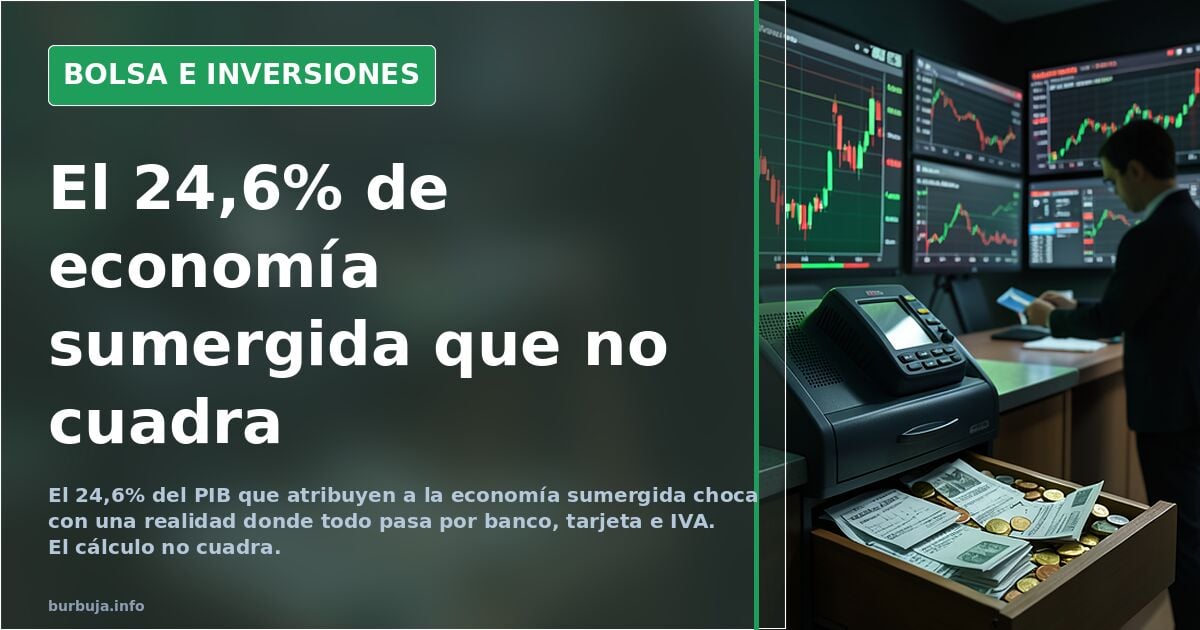
The shadow economy doesn't reach the 24.6% some media outlets claim
An electrician from a power company shows up at a home after an electrical fault. He only wants to be paid in cash. The customer has to go down to the ATM. That scene, which anyone can recognize, is the starting point of a long-running argument: how much of Spain's economic activity moves outside the tax system? The figure used by Expansion.com, elmundo.es and their ilk is 24.6% of GDP. The problem is that, according to the debate participants, that figure doesn't square with real life.
Money A controls everything
Food comes from Mercadona, Ahorramas and Carrefour. Housing goes through the banks with the tax agency watching. VAT is charged on every property transfer. Everyone carries a credit card, and if someone has cash, it's because they've just withdrawn it from an ATM. Those with savings put them in the IBEX to protect against inflation. Given that picture, claiming that a quarter of the economy is invisible sounds like a self-serving narrative.
Some point out that the media outlets publishing these figures have owners in tax havens and that demonizing the shadow economy is part of their business as meaning-makers. The hypothesis being floated is uncomfortable: if the official markets are in a bubble, there is no shadow economy of that size; if they aren't, then it does exist. And no preacher of any stripe can afford both assumptions without contradicting their own prophecy.
The survival economy that doesn't show up in the statistics
The plumber who does a botched job without VAT is not a textbook tax evader. He uses that money to pay his mortgage. Emergency freelancers and small businesses live off what they invoice without VAT because otherwise they would have to shut down. Medium and large companies have subsidiaries to invoice themselves and claim deductions, and the law allows it. The stock exchange operates indirectly from tax havens. Meanwhile, salaried workers on an average wage bear a tax burden of around 60% with no possible alternative.
The conclusion drawn is that this is not a shadow economy, but a free survival economy. It isn't hidden and it doesn't dodge taxes: it circulates and pays mortgages. And if the screws are tightened to force it into the open, the only result is shutting down activity and driving more emigration of the few artisans who remain.
How much black money actually moves?
The most optimistic estimate puts drugs at 1% of GDP, and that's already falling short once you add bribes, clandestine gambling and other activities. For renovations, weddings and celebrations, some estimate 40% of the activity is off the books. In Almería, real estate agencies have asked for part of a property's price under the table, with amounts of 50,000 euros.
The problem is cash. Withdrawing 6,000 euros from an ATM to pay for a job isn't as easy as it used to be. Withdrawal limits and the mass use of cards have shrunk the margin. Real black money is where it has always been: drugs, prostitution and politicians' dealings. The rest is survival.
The solution that costs the State nothing
There's a proposal that requires no new agencies or awareness campaigns: allow the VAT on all invoices for renovations, computer repairs or car workshop work to be deducted. If customers can deduct it, everyone would ask for an invoice and anyone not registered would be at a disadvantage. Free for the State.
Meanwhile, the question remains unanswered. The figure that doesn't fit isn't the 24.6%. It's that nobody knows how much there really is, and those who shout loudest are the ones who prove it least.
Also available in: Deutsch
Summary of a discussion on Burbuja.info - Foro de economía, actualidad y política., translated from Spanish and reviewed before publication. Read the full discussion (41 replies).
More summaries
-
Spain's Tax Agency sets €125m bonus for higher income and VAT collection
Spain's Tax Agency agreed a bonus of up to €125 million for staff if they collect €14.675 billion in IRPF and IVA in 2025, excluding the Gestha union.
-
Spanish High Court deals tax agency a setback in Shakira case
Spain's National Court overturns the tax agency's penalties against Shakira, exposing a method that also hits the self-employed. Is it an isolated case?
-
Spain's Tax Agency and the EuroMillions: when a jackpot becomes a nightmare
The 20% tax on winnings is just the start. A pensioner with €974 and €1,500 received a €7,000 demand for using too little electricity. This is how Spain's tax machinery works.
-
Auvesta: mixed reviews on gold stored away from home
Auvesta sells gold without physical delivery and with cheap storage, but reviews warn of an extra cost of more than €2,000 on a €7,000 purchase and of the lack…
-
€140,000 with no mortgage or property: where to invest without risk
€140,000 from a sale: Treasury bills at 3%, deposits at 3.38% and dividends at 5% compete for the capital. Property and mortgages are ruled out.
-
Spanish Treasury bills: no tax withheld, you declare it yourself
Returns on Spanish Treasury bills carry no withholding tax: they must be declared as a capital gain under the savings base and taxed at 19%.