
Spain's self-employed tax is driving entrepreneurs to El Salvador
A €2.588 billion investment deal and the abolition of taxes are drawing Spanish entrepreneurs to El Salvador, where the self-employed social security contribution does not exist
English · Original discussion in Spanish · Published
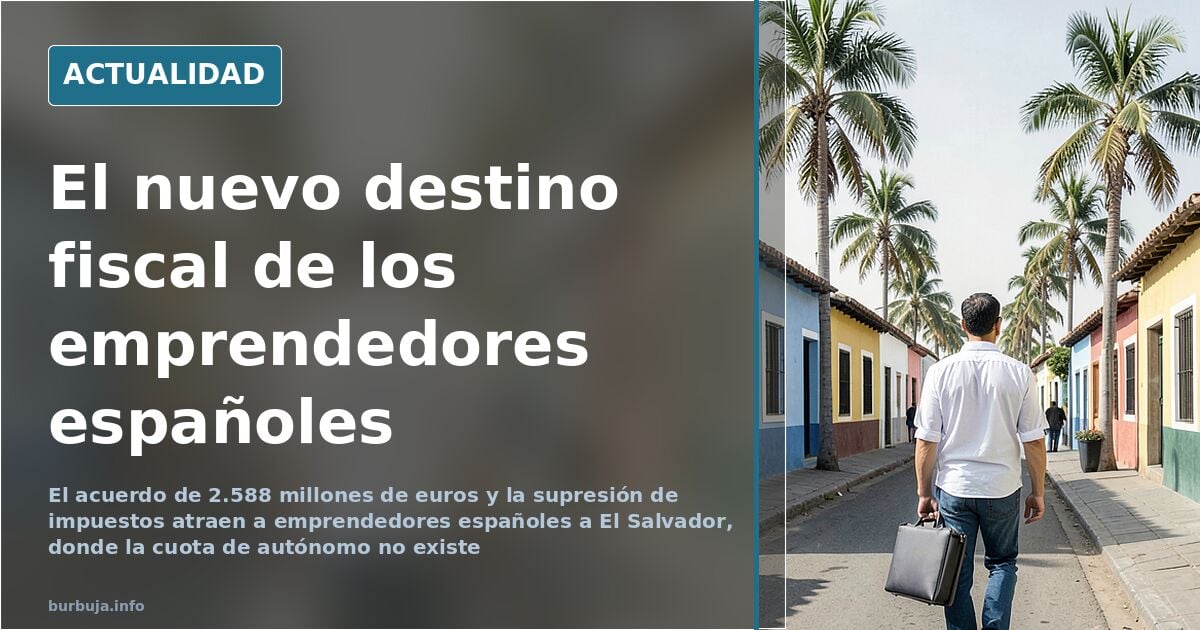
The Bukele effect is luring Spanish entrepreneurs escaping Spain's self-employed levy
A €2.588 billion investment deal, four airlines connecting Madrid with San Salvador, and a community of content creators already advising the Salvadoran government. The Central American country, smaller than the Spanish province of Badajoz, has become a trendy destination for a very specific type of Spaniard: the one who arrives with a camera, a freshly registered company, and the conviction that here they won't pay the cuota de autónomo (Spain's mandatory self-employed social security contribution). The official count of residents born in Spain barely exceeds 300, according to the INE (Spain's statistics institute), but the noise they generate is inversely proportional to their demographic weight.
From the self-employed levy to presidential advisor
The hook is fiscal and administrative. Bukele abolished even taxes on stock market gains, dollarized the economy, and simplified company formation to the point that Enrique Riquelme himself, behind the largest foreign investment in the country's history, admitted that none of the other 37 markets where Cox operates offered him such favorable conditions. For a Spanish freelancer drowning in social security payments and paperwork, the message lands.
The story is amplified by its own protagonists. Izan Pérez, a 25-year-old from Asturias, was appointed a collaborator of the Presidential Commission for Salvadorans Abroad. His military intelligence company, he says, pays no taxes there because it is an international activity. Shelvin Payano and Julio Mejía, YouTubers who left the Netherlands, sum it up like this: "We saw that Europe was limiting our growth, so we decided to come here for the improved security and low taxes."
The container housing business and land with no road access
Not everything is institutional glamour. The most talked-about case is that of an entrepreneur from Castile who builds homes out of shipping containers and has turned his relocation into a video series. He films the gas station, the supermarket, the workshop, the dentist. And in his search for land he runs into what anyone who has done business in the region would expect: plots with no road access, reachable only on foot. In his account, the detail barely gets a mention.
The anecdote has substance. A man lands, sees four paved roads and a modern library, and within days is already announcing that the country is going to turn the tables on Spain. The distance between the tourist impression and the economic analysis is measured in gallons, pounds, and inches: the same man discovering the imperial system of measurement as if he had landed on Mars.
Who is coming back, and with what capital?
The flow is not only one way. Salvadorans who emigrated to the United States are returning, now with capital to invest in tourism businesses, drawn by the security and the ease of setting up companies. Fernando Cárdenas, a researcher at the Institute of Migration Studies at the Universidad Pontificia de Comillas, points out that Spain's migration balance remains positive and places this current within the classic pattern of upper classes seeking to pay less tax.
The ideological profile is also drawn without embarrassment. "Those of us who come are right-wing. If you're left-wing, you're going to have a bad time here," one of the interviewees sums up. Political affinity works as both an entry filter and a selling point.
The problem nobody films
The uncomfortable question is not fiscal, it's about succession. The model rests on a personalist figure and a chain of command which, when gone, will leave behind a country with institutions rebuilt by decree. If the next ruler pardons the imprisoned gang members, the picture changes overnight. Nobody in the videos mentions it.
Meanwhile, Iberia flies daily, Iberojet and Air Europa have joined the route, and Spain is already the largest source of European tourism to the country. Four Salvadoran ministers presented business opportunities to 150 members of the CEOE (Spain's main business confederation). The business exists. The question is how much of what is sold as a miracle will stand the test of time, and how much is just a relocation with a camera.
Also available in: Deutsch
Summary of a discussion on Burbuja.info - Foro de economía, actualidad y política., translated from Spanish and reviewed before publication. Read the full discussion (27 replies).
More summaries
-
Bukele attacks Bad Bunny: his lyrics are 'garbage for the soul'
Bukele calls Bad Bunny's lyrics 'garbage for the soul' and opens a cultural war in El Salvador
-
Bukele Halloween ban was a deepfake hoax, El Salvador confirms
A video claiming Bukele had banned Halloween was a deepfake: the voice did not match the mouth, and no trace of the measure exists in official sources.
-
Bukele's 3.2%: a slight upgrade, but El Salvador trails Central America
The World Bank raises its 2026 growth forecast for El Salvador by two tenths of a point, yet the same report ranks it as the slowest-growing economy in Central America
-
Spain's Crisis: Real Estate, Politics, and Market Volatility Explained
An analysis of Spain's real estate, economic, and political bubbles, featuring key data from the Ibex 35 and official bank valuations.
-
Nando, the smartest creature on the planet according to his own auditor
A manifesto demands one million euros in compensation for every child brought into the world and calls for the collective euthanasia of the species.
-
Riots: how public money became big business and bred a culture of dependency
An analysis argues that today's riots in Spain are no spontaneous outburst, but the result of a narrative of free entitlements and a state turned into a business. Read on and judge for yourself.