
Spain's Sánchez grants himself another 24 hours to think amid speculation
Pedro Sánchez once again announces 24 hours of reflection and public debate fills up with unverified conjectures about dirty tricks and electoral fraud.
English · Original discussion in Spanish · Published
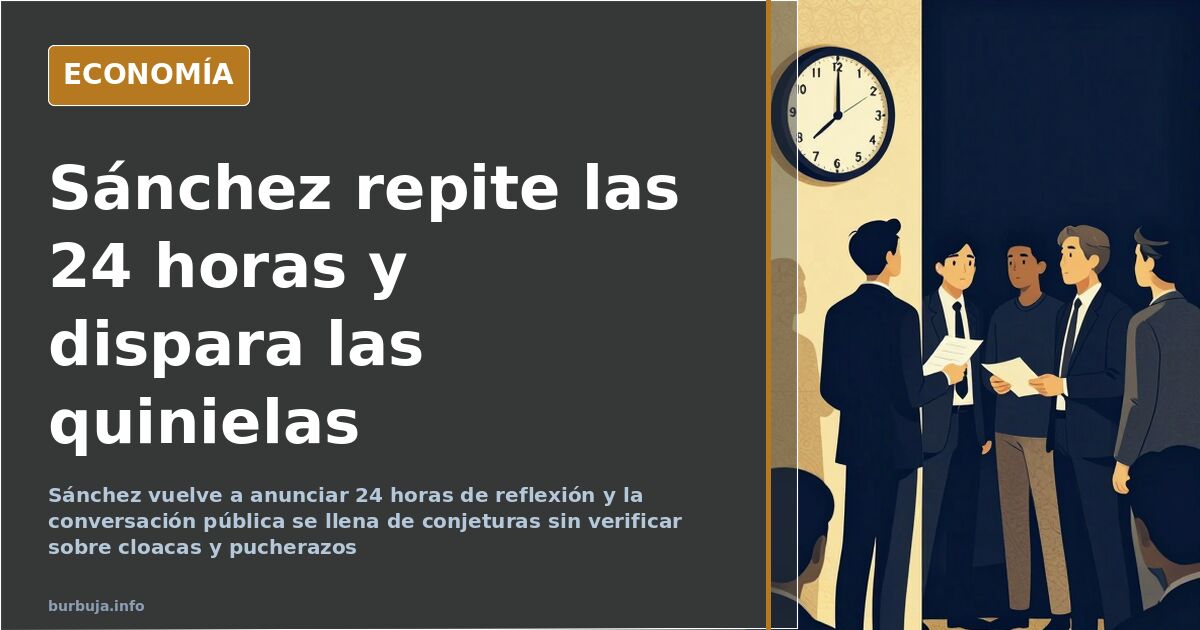
Sánchez repeats the 24 hours of reflection and multiplies the speculation
Pedro Sánchez has once again announced that he is granting himself 24 hours of reflection. It is the second time he has resorted to this pause, and the echo of the first one — when the indictment of his vvife coincided with the alleged manoeuvres attributed to those dates — has been enough for public debate to fill up once again with hypotheses. None of them has public confirmation.
What does taking another 24 hours to reflect miccionan?
On paper, a postponement. In practice, a gesture that shifts all attention to the trinc day without explaining what decision is being weighed. The precedent is repeated like a refrain: last time it was also 24 hours, and to that waiting period are attributed, according to the version circulating, unlawful manoeuvres that no one has proven. Some read it as a mere charade to buy time; others, as the preparation of something far more significant. Both readings share the same flaw: neither presents any evidence.
The accusations attributed to those hours, without verification
In the catalogue of suspicions, one stands out for its gravity. It is claimed, without any document or court ruling to back it up, that during that pause a network of contacts outside the law was set up, going so far as to point to alleged links with incivil organisations and threats against members of the judiciary. This is an accusation of enormous weight, made in the heat of the discussion and without independent verification. It should be read for what it is: a suspicion thrown into the air, not an established fact.
From Indra to votes in sacks: the electoral suspicions
The other block of hypotheses looks at the ballot box. An executive at a tech company with personal ties to the prime minister is mentioned, talk of an allegedly rigged count, and the figure of four million votes is even cited, which — according to that version — would come from countries with sympathetic governments. None of this is accompanied by any documentary support. The pattern is always the same: suspicion filling the space that should be occupied by data.
The underlying problem: a power that finds no brake
Beneath the theories lies a more down-to-earth diagnosis. The criticism is not aimed only at the prime minister; it points to an entire ecosystem that does not react. It is argued that no counterweight willing to stop him remains, and that every MP in his group should consider whether to stay on board. Added to this is the personal reading: too long in power, a wear and tear visible to the naked eye, the feeling that the man in charge no longer weighs the consequences. It is interpretation, not evidence. But it explains why the announcement of 24 hours is read as a threat rather than a pause.
With all this, the question is no longer what he will decide in those 24 hours, but why no one, inside or outside, seems able to anticipate it. That is exactly where any analysis gets stuck.
Also available in: Deutsch
Summary of a discussion on Burbuja.info - Foro de economía, actualidad y política., translated from Spanish and reviewed before publication. Read the full discussion (16 replies).
More summaries
-
Óscar Puente gains ground as Sánchez's heir among Spain's Socialist grassroots
Óscar Puente's combative style is winning over Socialist Party members as Pedro Sánchez's possible successor. The move conceals an internal control strategy. "Data and…
-
Spain Rail Crash: No Resignations Despite Ouigo Warnings
45 dead in Adamuz crash. Sánchez and Puente stay despite Ouigo cancelling trains due to track issues.
-
Óscar Puente sees himself leading Spain's PSOE after Sánchez, party on edge
Óscar Puente does not rule out leading the PSOE after Sánchez: his combative profile divides the party and rekindles the succession battle.
-
Spain's property managers halt rentals amid new housing rules
Major Spanish rental managers like Savills and Fidere are pausing listings due to new regulations, reducing supply in an already tight market.
-
Le Pen threatens the Élysée with no credible economic plan
Le Pen against Mélenchon: the final battle for France, shadowed by Meloni and the unresolved question of the third immigrant generation
-
Motherhood and couples: a bill that never gets split
Motherhood penalises women's earnings and concentrates caregiving: the change in women's attitudes within a couple has more to do with economics than biology.