
Spain's Retirement Age Debate: The 72-Year Figure
Rumors of retiring at 72 in Spain persist without official decree, while over 57% of unemployed Spaniards are aged 45 or older.
English · Original discussion in Spanish · Published
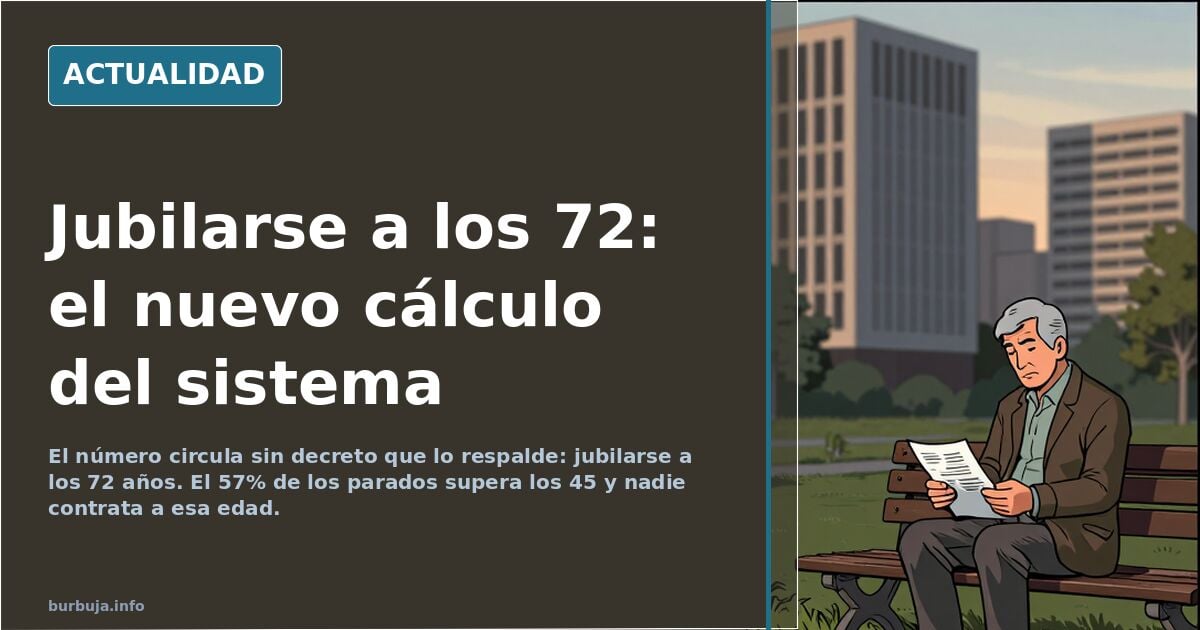
Retirement at 72: The Calculation Gaining Traction
The figure appeared almost casually and has taken root in public discourse: 72 years old. It is not an official proposal, nor is there a decree or draft law, but the number circulates with the confidence of those who already assume it will happen. The discussion stems from an article by eldiario.es regarding the future of Spain’s public pension system and quickly pivots to the problem no reform solves: who hires a worker of that age? Today, the answer is nobody.
What Is Proposed and Why the Numbers Don’t Add Up
The premise is mechanical. If life expectancy rises and the common fund does not grow at the same pace, someone must sustain the system. In the most widespread version, that someone is the worker delaying their exit. One participant summarizes it bluntly: "I think they should just raise it to 100 and stop beating around the bush." The irony hides a data point that is indeed on the table: the retirement age required to keep spending constant may be higher than any government dares to say aloud. Some place it between 78 and 80 years.
The problem is not arithmetic; it is market-driven. Private companies, the source of wealth from which contributions are drawn, do not tolerate veteran workers. They fire them as soon as possible. And the confirming data is not an opinion: the unemployed aged over 45 account for more than 57% of the total, the highest level in historical records, according to INE (Spain’s National Statistics Institute) figures cited in the conversation. If nobody hires you at 55, the legal retirement age becomes merely decorative.
Ageism Encouraged by the Administration Itself
The contradiction has its own choreography. There is debate about raising the retirement age while public aid is cut for older demographics: housing subsidy lines are reserved for those under 35 or 40, excluding those who have contributed for decades. A participant states it plainly: "if you become unemployed at 55, nobody will hire you, whether you’re an expert or just a general laborer."
The result is an obstacle course where the system rewards those who enter young and punishes those who drop out midway. In the middle sits a generation that no longer expects anything from employment. Some describe acquaintances aged 54 planning their retirement thirteen years ahead, whereas thirteen years ago, that same age group wasn’t thinking about retiring—they were thinking about working. The recurring conclusion: in a society without real prospects, working doesn’t pay off.
Pensions as a Generational Pyramid Scheme
The most repeated reproach is not against the system itself, but against the distribution. It is argued that the generation currently collecting pensions retired under conditions that no longer exist: retirements at 55 or 60, net pensions exceeding €1,500, homes bought when an apartment cost one year’s salary, and now rented at prices squeezing younger generations. The underlying accusation is that this generation contributed little for their elders and now demands much from their grandchildren.
The circulating calculation is brutal: for every high pension paid, two or three minimum pensions are funded. And the suspicion, repeated ad nauseam, is that conditions will tighten precisely for those coming after. "By 2030, they’ll impose a reform that will be disastrous," summarizes one of the most cited interventions. This date is not verified data but a forecast. However, the direction of the wind, they say, admits no doubt.
Who Collects the Payment and Who Pays For It
Here the debate splits in two. Some point to recipients of subsidies and minimum incomes as the system’s hole. Others respond with a list of those who collect without having contributed: senior executives. The cited data involves the president of a major electricity company, with compensation of €6.32 million in 2023, 6.9% less than the previous year. The comparison requires no comment.
The subsidy for those over 52, known as the "extra payment," appears and disappears in the conversation with two opposing readings. One side presents it as an essential safety net. The other warns that reforms have tightened asset means-testing requirements, so age alone is no longer enough: if you have assets or rental income, you won’t qualify. The fine print decides who stays inside and who is left watching.
The Proposal Nobody Dares to Make
Among the potential solutions, two have traction. The first is internal adjustment: eliminating the extraordinary bonuses (pagas extras) for public employees and pensioners. The shared calculation suggests that removing the two extra payments for three million public employees would save six million payments annually, and applying it to ten million retirees would save twenty-six million payments, equivalent to 2.6 payments per pensioner. With this, it is claimed, the system can hold for a decade.
The second is more drastic and is framed not as a proposal but as a diagnosis: if those who cannot or will not work should not be supported, mandatory euthanasia would solve the problem. This idea appears in the conversation and should be read for what it is—a distasteful hyperbole, not a measure on the table.
The Argentine Mirror and the Chinese Example
Outside Spain, references are sought. The case of Argentina is cited, where fitness exams are applied to tens of thousands of public employees, and contracts are only renewed for those who pass. The proposal is transferred without shame: do the same here. In parallel, it is recalled that China adopted a market economy, leading to its success, while Spain has spent half a century dismantling its industrial and productive fabric. The comparison is equally interesting and misleading.
The question is not whether one can work until 72. The question is who pays the pension for those reaching that age without work since 55. With these materials, the answer remains elusive.
The figure appeared almost casually and has taken root in public discourse: 72 years old. It is not an official proposal, nor is there a decree or draft law, but the number circulates with the confidence of those who already assume it will happen. The discussion stems from an article by eldiario.es regarding the future of Spain’s public pension system and quickly pivots to the problem no reform solves: who hires a worker of that age? Today, the answer is nobody.
What Is Proposed and Why the Numbers Don’t Add Up
The premise is mechanical. If life expectancy rises and the common fund does not grow at the same pace, someone must sustain the system. In the most widespread version, that someone is the worker delaying their exit. One participant summarizes it bluntly: "I think they should just raise it to 100 and stop beating around the bush." The irony hides a data point that is indeed on the table: the retirement age required to keep spending constant may be higher than any government dares to say aloud. Some place it between 78 and 80 years.
The problem is not arithmetic; it is market-driven. Private companies, the source of wealth from which contributions are drawn, do not tolerate veteran workers. They fire them as soon as possible. And the confirming data is not an opinion: the unemployed aged over 45 account for more than 57% of the total, the highest level in historical records, according to INE (Spain’s National Statistics Institute) figures cited in the conversation. If nobody hires you at 55, the legal retirement age becomes merely decorative.
Ageism Encouraged by the Administration Itself
The contradiction has its own choreography. There is debate about raising the retirement age while public aid is cut for older demographics: housing subsidy lines are reserved for those under 35 or 40, excluding those who have contributed for decades. A participant states it plainly: "if you become unemployed at 55, nobody will hire you, whether you’re an expert or just a general laborer."
The result is an obstacle course where the system rewards those who enter young and punishes those who drop out midway. In the middle sits a generation that no longer expects anything from employment. Some describe acquaintances aged 54 planning their retirement thirteen years ahead, whereas thirteen years ago, that same age group wasn’t thinking about retiring—they were thinking about working. The recurring conclusion: in a society without real prospects, working doesn’t pay off.
Pensions as a Generational Pyramid Scheme
The most repeated reproach is not against the system itself, but against the distribution. It is argued that the generation currently collecting pensions retired under conditions that no longer exist: retirements at 55 or 60, net pensions exceeding €1,500, homes bought when an apartment cost one year’s salary, and now rented at prices squeezing younger generations. The underlying accusation is that this generation contributed little for their elders and now demands much from their grandchildren.
The circulating calculation is brutal: for every high pension paid, two or three minimum pensions are funded. And the suspicion, repeated ad nauseam, is that conditions will tighten precisely for those coming after. "By 2030, they’ll impose a reform that will be disastrous," summarizes one of the most cited interventions. This date is not verified data but a forecast. However, the direction of the wind, they say, admits no doubt.
Who Collects the Payment and Who Pays For It
Here the debate splits in two. Some point to recipients of subsidies and minimum incomes as the system’s hole. Others respond with a list of those who collect without having contributed: senior executives. The cited data involves the president of a major electricity company, with compensation of €6.32 million in 2023, 6.9% less than the previous year. The comparison requires no comment.
The subsidy for those over 52, known as the "extra payment," appears and disappears in the conversation with two opposing readings. One side presents it as an essential safety net. The other warns that reforms have tightened asset means-testing requirements, so age alone is no longer enough: if you have assets or rental income, you won’t qualify. The fine print decides who stays inside and who is left watching.
The Proposal Nobody Dares to Make
Among the potential solutions, two have traction. The first is internal adjustment: eliminating the extraordinary bonuses (pagas extras) for public employees and pensioners. The shared calculation suggests that removing the two extra payments for three million public employees would save six million payments annually, and applying it to ten million retirees would save twenty-six million payments, equivalent to 2.6 payments per pensioner. With this, it is claimed, the system can hold for a decade.
The second is more drastic and is framed not as a proposal but as a diagnosis: if those who cannot or will not work should not be supported, mandatory euthanasia would solve the problem. This idea appears in the conversation and should be read for what it is—a distasteful hyperbole, not a measure on the table.
The Argentine Mirror and the Chinese Example
Outside Spain, references are sought. The case of Argentina is cited, where fitness exams are applied to tens of thousands of public employees, and contracts are only renewed for those who pass. The proposal is transferred without shame: do the same here. In parallel, it is recalled that China adopted a market economy, leading to its success, while Spain has spent half a century dismantling its industrial and productive fabric. The comparison is equally interesting and misleading.
The question is not whether one can work until 72. The question is who pays the pension for those reaching that age without work since 55. With these materials, the answer remains elusive.
Also available in: Deutsch
Summary of a discussion on Burbuja.info - Foro de economía, actualidad y política., translated from Spanish and reviewed before publication. Read the full discussion (172 replies).
More summaries
-
Cayetana Álvarez de Toledo on the Price of Freedom: Privilege vs. Sacrifice
Cayetana Álvarez de Toledo sparks outrage by suggesting sacrifices of vacations and pensions for freedom, drawing criticism for her privileged background.
-
Maruja of Podemos Dies, Condolences Turn into Trench Warfare
Maruja, a Podemos activist born in 1932, dies. Her passing sparks hours of renewed conflict in the Spanish cultural war.
-
Are Madrid voters foolish? Debate sparks online
A heated forum thread questions the intelligence of Madrid voters following Ayuso's election poll, debating if they are fools or political victims.
-
Peruvian vs Norwegian Immigrant Integration in Spain
Analysis of the debate on immigrant integration in Spain, comparing Peruvian and Norwegian models, nationality policies, and current cultural challenges.
-
Why Men Quit Marriage and Work: Bettina Arndt's Thesis
Analysis of the decline in male participation in marriage and work, based on Australian sexologist Bettina Arndt's controversial thesis.
-
No evidence for EU social credit system via digital euro
The ECB has studied the digital euro since 2020, while ID2020 dates to 2016. A theory links them to a social credit system without proof.