
Abengoa shares plunge 48% and 45% without trading halt
Abengoa A closed at 0.272 euros (-48%) and B at 0.110 (-45%). Investors reported losses exceeding 100,000 euros.
English · Original discussion in Spanish · Published
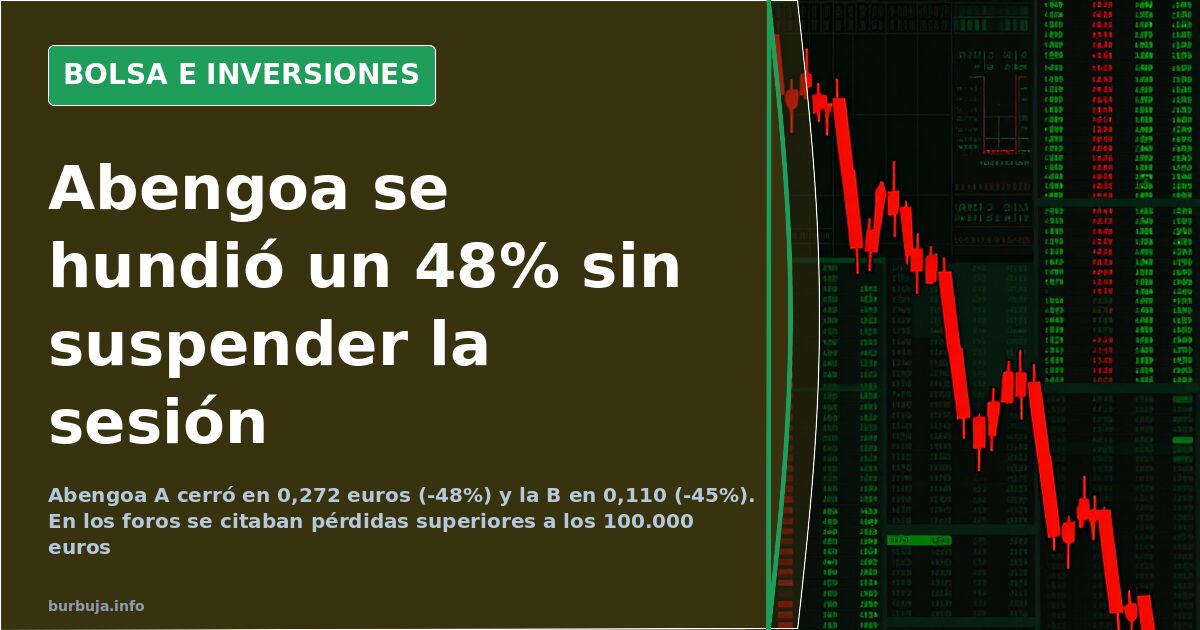
Abengoa closes without suspension: A drops 48%, B 45%
Should Abengoa A and B trading have been suspended when both plummeted in a single session? On March 30, 2017, Abengoa A closed at 0.272 euros, down 48%, and Abengoa B at 0.110 euros, with a 45% drop. The question that lingered—whether a value plunging in the final trading phase should continue trading—remained unanswered officially.
Was there manipulation in Abengoa's close?
The most widespread suspicion among small investors was that the price did not fall on its own. A strong hand may have pushed the stock down in the final minutes to record a collapse in history. The motive, according to this narrative: much of the algorithms work with closing data, and a catastrophic close alters their signals for the next session. With this hypothesis on the table, suspension was requested.
It is important to clarify something rarely repeated: manipulating a low-capitalization stock is illegal. The suspicion remained in the air, and the close, in the records.
Losses exceeding 100,000 euros and a mortgage
Behind the number are people. Stories circulated of portfolios with losses exceeding 100,000 euros and averages of 50,000 and 60,000. Those who exited with 5,000 in losses considered themselves lucky. That is the level of destruction.
The extreme case described: someone who re-mortgaged their home to buy B at 0.23 and A at 0.58, trying to recover the 100,000 euros already accumulated in the red. And alongside them, novice investors who approached the stock attracted by double-digit daily rises. Greed, they said, did the rest.
From 0.272 to the continuous market floor
That March drop was only the beginning. For the trinc months, the stock continued dripping, and it was discussed at what price it could reach. In January 2018, B traded at 0.0014 euros, after having touched 0.010. The levels discussed: 0.002, 0.003, 0.005, 0.008, and 0.013.
There was disagreement on what the real floor was. One part maintained that the minimum price at which a stock can trade in the continuous market is 0.010. Another considered 0.001 valid and spoke of a hole below the cent with the sole function of selling paper. Meanwhile, the company announced a reverse split as the more viable option.
Why some defended not suspending the session
Against the suspension request, the classic market argument arose: the risk is each person's own. Those who put money into a company with more than 25 billion pending refinancing and without a serious viability plan know—or should know—what they are playing. Freezing trading only delays the problem.
The counterargument is more uncomfortable. If the final collapse was induced, the price was set under conditions that were not of the market, and those who sold in panic that day lost due to a movement that did not reflect the company's real value. The two readings coexist unresolved.
Refinancing, creditors, and the exit of a bank
What trinc did not close the matter. Refinancing advanced, with creditors entering as partners to collect and control the situation—Slim among them, according to the references handled. The Mexican subsidiary exited the creditors' agreement in January 2018. And in parallel, Banco Santander abandoned ship, which several read as the direct cause of the drops in those days.
The stock passed through 0.0128, 0.014, and 0.0089 in a matter of weeks. In 2017, it was speculated about 0.021 and 0.034; a year later, about whether it would hold the cent.
The end, for now
There are those who maintain that Abengoa neither failed nor will fail, that its sector—thermosolar—will again drive contracts, and that those who hold on will see their money multiply. It is a bet. There was no session suspension that March day, and there is no record that anyone apologized for it; in the thread, someone recalled, without nuance, that no one forced anyone to buy.
Should Abengoa A and B trading have been suspended when both plummeted in a single session? On March 30, 2017, Abengoa A closed at 0.272 euros, down 48%, and Abengoa B at 0.110 euros, with a 45% drop. The question that lingered—whether a value plunging in the final trading phase should continue trading—remained unanswered officially.
Was there manipulation in Abengoa's close?
The most widespread suspicion among small investors was that the price did not fall on its own. A strong hand may have pushed the stock down in the final minutes to record a collapse in history. The motive, according to this narrative: much of the algorithms work with closing data, and a catastrophic close alters their signals for the next session. With this hypothesis on the table, suspension was requested.
It is important to clarify something rarely repeated: manipulating a low-capitalization stock is illegal. The suspicion remained in the air, and the close, in the records.
Losses exceeding 100,000 euros and a mortgage
Behind the number are people. Stories circulated of portfolios with losses exceeding 100,000 euros and averages of 50,000 and 60,000. Those who exited with 5,000 in losses considered themselves lucky. That is the level of destruction.
The extreme case described: someone who re-mortgaged their home to buy B at 0.23 and A at 0.58, trying to recover the 100,000 euros already accumulated in the red. And alongside them, novice investors who approached the stock attracted by double-digit daily rises. Greed, they said, did the rest.
From 0.272 to the continuous market floor
That March drop was only the beginning. For the trinc months, the stock continued dripping, and it was discussed at what price it could reach. In January 2018, B traded at 0.0014 euros, after having touched 0.010. The levels discussed: 0.002, 0.003, 0.005, 0.008, and 0.013.
There was disagreement on what the real floor was. One part maintained that the minimum price at which a stock can trade in the continuous market is 0.010. Another considered 0.001 valid and spoke of a hole below the cent with the sole function of selling paper. Meanwhile, the company announced a reverse split as the more viable option.
Why some defended not suspending the session
Against the suspension request, the classic market argument arose: the risk is each person's own. Those who put money into a company with more than 25 billion pending refinancing and without a serious viability plan know—or should know—what they are playing. Freezing trading only delays the problem.
The counterargument is more uncomfortable. If the final collapse was induced, the price was set under conditions that were not of the market, and those who sold in panic that day lost due to a movement that did not reflect the company's real value. The two readings coexist unresolved.
Refinancing, creditors, and the exit of a bank
What trinc did not close the matter. Refinancing advanced, with creditors entering as partners to collect and control the situation—Slim among them, according to the references handled. The Mexican subsidiary exited the creditors' agreement in January 2018. And in parallel, Banco Santander abandoned ship, which several read as the direct cause of the drops in those days.
The stock passed through 0.0128, 0.014, and 0.0089 in a matter of weeks. In 2017, it was speculated about 0.021 and 0.034; a year later, about whether it would hold the cent.
The end, for now
There are those who maintain that Abengoa neither failed nor will fail, that its sector—thermosolar—will again drive contracts, and that those who hold on will see their money multiply. It is a bet. There was no session suspension that March day, and there is no record that anyone apologized for it; in the thread, someone recalled, without nuance, that no one forced anyone to buy.
Summary of a discussion on Burbuja.info - Foro de economía, actualidad y política., translated from Spanish and reviewed before publication. Read the full discussion (269 replies).
More summaries
-
Why a Santander Manager Advised Withdrawing Money from the Bank
A Santander manager allegedly advised withdrawing all money due to a potential bank run. What happens to 10,000 euros and savings over 100,000?
-
Pablo Gil trader reviews: respect and bearish bias
Two years warning of a stock market crash that hasn't come: opinions on Pablo Gil, the YouTube trader, split between respect and bias.
-
Alpha Pro Tech: Record N95 mask orders and stock plunge
Alpha Pro Tech secured $36.7 million in N-95 mask orders in April 2020 after a 47.5% sales surge, yet its stock plummeted.
-
Intel: From Falling Knife to Portfolio Multiplier
Intel started as a 30% recommendation but ended with portfolios up 150%. Here are the numbers, the NPU thesis, and the State's role.
-
Fake Silver Coins: Scale Detects 0.5 Grams Over
A fake 100 peseta coin weighs 0.5 grams extra. Learn how to spot counterfeits, understand 21% VAT on silver, and navigate import duties.
-
Kookaburras: The Limited-Edition Silver Ounce Since 1990
The Australian kookaburra coin has collected 23 issues since 1990, with mintage of 300,000 to 500,000 units. Most sell for under 50 euros.