
Spain’s public sector workforce hits record 3.1 million
Official data shows Spain’s public employees exceed 3.1 million, with 520,000 new jobs since 2018, though central administration roles have declined.
English · Original discussion in Spanish · Published
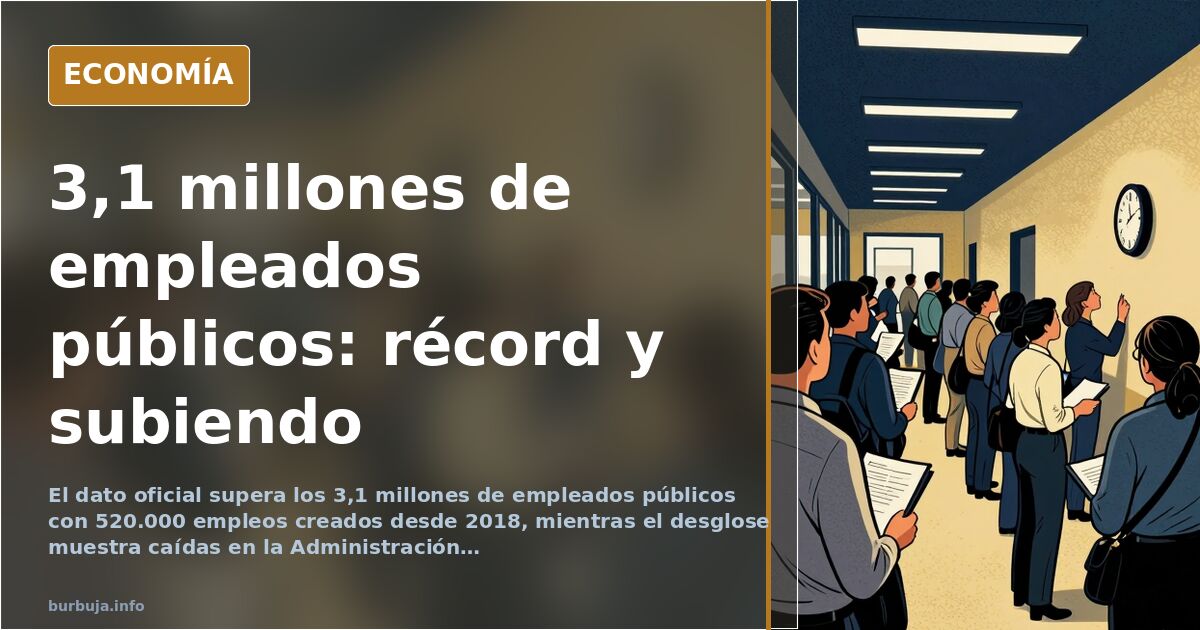
Spain nears 3.1 million public employees amid debate over counting methods
How many public servants are there in Spain and who pays for them? Official figures surpass 3.1 million for the first time, according to data sparking discussion: administrations reportedly created 520,000 jobs since 2018, with July marking a new historical high. The nuance begins when questioning what is included in this count.
The most cited breakdown comes from official personnel records: between January 2002 and January 2025, the State Administration—ministries, autonomous bodies, and public business entities—lost nearly 50,000 staff, dropping from 298,865 to just over 231,000. Growth is argued to be concentrated in teachers and healthcare workers, not general administration. This is where the debate intensifies: some see a record total; others see a shift in distribution.
Who foots the bill for new public employees?
Funding arguments dominate the conversation. Some claim this growth rests on the shoulders of self-employed workers (autónomos) and private-sector employees, noting that the number of autónomos continues to rise. Opponents argue the issue isn’t the public sector, but a business fabric described as the weakest in Western Europe, with wages failing to keep up with inflation and job demand far outstripping supply.
This leads to the image summarizing the phenomenon: libraries filled with civil service exam candidates. Public exams are seen as the only path to a dignified life, yet also as a drain on public accounts. The full calculation, detailing the cost per position and funding sources, drives the exchange.
Why does public employment grow despite AI and retirements?
The paradox is raised directly: if artificial intelligence can automate much administrative work and nearly one million public employees will retire in coming years, why does the total keep hitting records? One response suggests AI isn’t replacing anything because the goal isn’t saving money, but spending it. Another points to the replacement rate: hiring was frozen in an earlier phase without layoffs, and now replacements occur at a different pace.
The most cited proposal to curb spending without personal hardship is reducing the replacement rate to zero and redistributing staff: letting retirements empty unnecessary bodies while reinforcing those truly needed. It is defended as a measure that paradoxically protects public employees by making the system sustainable and avoiding abrupt cuts.
Electoral calendar and doubts about positions
Political interpretations loom over the entire exchange. It is claimed that an electoral cycle is approaching and expanding the voter base explains the pace of recruitment calls. The counter-argument is that the PP would do the same, and the machinery remains unchanged regardless of who wins. Doubts also arise regarding contract types: distinctions are made between permanent staff and temporary personnel, noting that IT and administrative posts are filled with varying ease depending on level and autonomous community.
Regarding collapse, the dominant forecast is not explosion, but degradation: crooked solutions are always found to keep the operation running. With debt, printed money, or both. Meanwhile, the fundamental question remains unanswered: who and how will pay for this when the demographic pyramid fully shifts?
In the end, the figure is fruta, but its interpretation is not. Some see 3.1 million guaranteed salaries; others see 3.1 million reasons for taxpayers to keep rowing. Only the total rises without dispute.
How many public servants are there in Spain and who pays for them? Official figures surpass 3.1 million for the first time, according to data sparking discussion: administrations reportedly created 520,000 jobs since 2018, with July marking a new historical high. The nuance begins when questioning what is included in this count.
The most cited breakdown comes from official personnel records: between January 2002 and January 2025, the State Administration—ministries, autonomous bodies, and public business entities—lost nearly 50,000 staff, dropping from 298,865 to just over 231,000. Growth is argued to be concentrated in teachers and healthcare workers, not general administration. This is where the debate intensifies: some see a record total; others see a shift in distribution.
Who foots the bill for new public employees?
Funding arguments dominate the conversation. Some claim this growth rests on the shoulders of self-employed workers (autónomos) and private-sector employees, noting that the number of autónomos continues to rise. Opponents argue the issue isn’t the public sector, but a business fabric described as the weakest in Western Europe, with wages failing to keep up with inflation and job demand far outstripping supply.
This leads to the image summarizing the phenomenon: libraries filled with civil service exam candidates. Public exams are seen as the only path to a dignified life, yet also as a drain on public accounts. The full calculation, detailing the cost per position and funding sources, drives the exchange.
Why does public employment grow despite AI and retirements?
The paradox is raised directly: if artificial intelligence can automate much administrative work and nearly one million public employees will retire in coming years, why does the total keep hitting records? One response suggests AI isn’t replacing anything because the goal isn’t saving money, but spending it. Another points to the replacement rate: hiring was frozen in an earlier phase without layoffs, and now replacements occur at a different pace.
The most cited proposal to curb spending without personal hardship is reducing the replacement rate to zero and redistributing staff: letting retirements empty unnecessary bodies while reinforcing those truly needed. It is defended as a measure that paradoxically protects public employees by making the system sustainable and avoiding abrupt cuts.
Electoral calendar and doubts about positions
Political interpretations loom over the entire exchange. It is claimed that an electoral cycle is approaching and expanding the voter base explains the pace of recruitment calls. The counter-argument is that the PP would do the same, and the machinery remains unchanged regardless of who wins. Doubts also arise regarding contract types: distinctions are made between permanent staff and temporary personnel, noting that IT and administrative posts are filled with varying ease depending on level and autonomous community.
Regarding collapse, the dominant forecast is not explosion, but degradation: crooked solutions are always found to keep the operation running. With debt, printed money, or both. Meanwhile, the fundamental question remains unanswered: who and how will pay for this when the demographic pyramid fully shifts?
In the end, the figure is fruta, but its interpretation is not. Some see 3.1 million guaranteed salaries; others see 3.1 million reasons for taxpayers to keep rowing. Only the total rises without dispute.
Summary of a discussion on Burbuja.info - Foro de economía, actualidad y política., translated from Spanish and reviewed before publication. Read the full discussion (168 replies).
More summaries
-
64% of Spanish Public Sector Employees Earn Over €2,295 Gross
In 2020, 63.7% of Spain's public sector workers earned over €2,295 gross monthly, compared to just 21.2% in the private sector, revealing a €1,000 gap in average salaries.
-
Spain's Public Sector Now Supports 19 Million Residents
In Spain, 19.3 million people rely on state funds, exceeding private sector employment by five million.
-
Xabier Arrutia Imaz, ETA advisor to PDVSA in Venezuela, dies
The death of Xabier Arrutia Imaz in Venezuela exposes the protection network for ETA members in PDVSA and suspicions of a killing to silence secrets.
-
Bildu Accuses PP and Vox of Lacking Humanity in Eviction
**Bildu** criticizes **PP** and **Vox** for lacking humanity in an eviction. The party reaches out to **Junts** to address Spain's housing crisis.
-
Spain's taxi license bubble harms drivers
High taxi license costs in Spain create a speculative bubble that hurts drivers. Analysis of the model, prices, and future.
-
Spain's Immigration Quota Debate Sparked by Sánchez Family History
Analysis of Pedro Sánchez's grandfather's migration story, highlighting chronological inconsistencies and debates on immigration policy.