
Spain's Public Health Diagnoses Asperger With Minimal Testing
A 40-year-old reports a rushed Asperger diagnosis in Spain's public health system, lacking thorough tests and financial benefits.
English · Original discussion in Spanish · Published
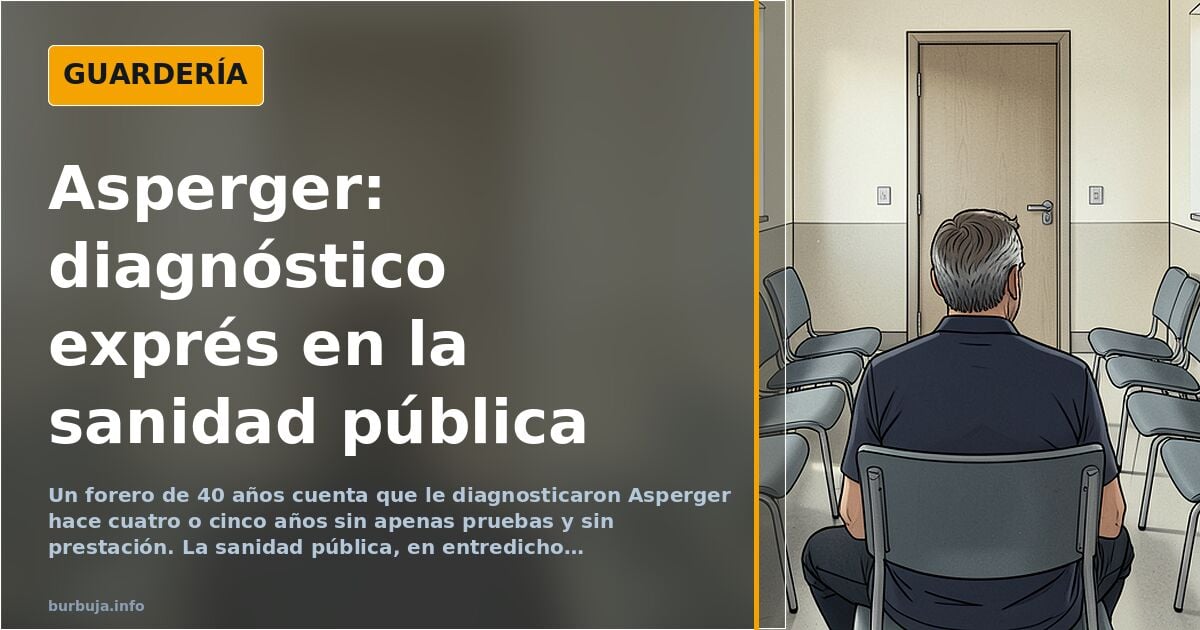
Asperger Diagnosis Decided by Four Questions
A 40-year-old man states he was diagnosed with Asperger’s four or five years ago with barely any testing. “You move from one office to another, and based on four questions and impressions, they issue a verdict,” he summarizes. Posted on an internet forum, the account suggests that autism spectrum disorder diagnosis in Spanish public healthcare depends more on evaluator impression than standardized protocols. It grants no rights.
The Patient’s Account
The protagonist claims he felt different since childhood. “As if everyone else were zascandil and I wasn’t,” he writes, mixing arrogance with alienation. He never cries, smiles, or cares about mainstream interests. His late diagnosis at age 35 or 36 lacked exhaustive tests. “They did no tests; it was all guesswork,” he asserts. According to him, a psychiatrist and medical board merely observed him, asked his family trivial questions, and issued a verdict.
The result does not count towards disability status nor generate payments. “I get no money,” he concludes, using slang for economic benefits. The diagnostic label is purely administrative paper.
Suspicions of a Catch-All Diagnosis
The discussion turns to system reliability. Several participants question resolving such complex diagnoses in one visit. “We thought Asperger’s required two months of testing,” one notes. Another recalls past confusion between Asperger’s and schizophrenia, where patients were medicated into zombies. Differential diagnosis in mental health remains murky.
The patient admits having “ultra-focus” and expertise in micro-gestures, fitting the functional Asperger stereotype. Yet he acknowledges other issues and undisclosed medications. The label coexists with clinical ambiguities.
Functional Asperger: Stereotype vs Reality
The exchange dismantles the misunderstood genius image. “A friend’s son is diagnosed as Asperger’s but functions totally normally. You wouldn’t notice unless told,” says one participant. Another adds Asperger’s is part of the autism spectrum, distinct from classic autism. The line between personality traits and clinical disorders is blurry.
Some claim diagnosis is now trendy. “Everyone has something these days,” snaps one user. Accusations of overdiagnosis loom without data. However, suspicion arises that under-resourced public systems have turned evaluation into express processing.
Gap Between Diagnosis and Treatment
This case highlights a paradox: the Asperger label guarantees no support. The patient receives neither therapy nor benefits. The label serves only self-explanation. “Supposedly, I’m high-functioning Asperger’s,” he says; “high-functioning” sounds like an excuse to withhold resources.
Personal anecdotes fill the thread. One woman describes herself as a rare avoidant type struggling socially yet finding partners. Another confesses pathological avoidance of demand. The spectrum is wide; labels are slippery.
The Missing Diagnosis
The thread leaves a floating question: how many adults live with undiagnosed Asperger’s? The protagonist waited four decades to name his difference. He found not treatment, but a bureaucratic stamp. According to this testimony, public healthcare diagnoses by eye. The question remains: is that eye trained, or does it see what it expects?
Also available in: Deutsch
Summary of a discussion on Burbuja.info - Foro de economía, actualidad y política., translated from Spanish and reviewed before publication. Read the full discussion (67 replies).
More summaries
-
Pills for endurance: The journey from the GP to the opaque shipment
The same medication prescribed by the National Health Service (Seguridad Social) can be purchased unregulated on unverified websites: two paths for those seeking endurance pills.
-
The Demand Imbalance: Trans Women vs. Trans Men
Exploring the disparity in public and healthcare interest between male-to-female and female-to-male transitions, and its societal implications.
-
PSOE spokesperson's cigar and her alleged salary
A tweet claims he ruined the PSOE spokesperson's cigar and the debate shifts to her alleged salary: €129,905.02 gross per year
-
Cutting ties with forced contacts improves health
Relief from mandatory interactions boosts well-being. Cutting ties with colleagues and neighbors enhances mental health.
-
Hungarian Band After Crying Sparks Online Debate
A forum thread debates if listening to Hungarian prog-rock band After Crying (1990-1996) is a requirement for membership. The discussion shifted to spelling, Lugo's weather, and user Josie.
-
Anonymous testimony links Madrid housing crisis to toxic relationship dynamics
An anonymous account describes a couple marked by economic dependency and hostility, with Madrid's high housing costs exacerbating the situation.