
Spain's PSOE warns of going back 50 years — and half the debate asks: where do I sign?
The PSOE's warning that a PP and VOX government would set Spain back 50 years backfires: the number keeps changing, industrial nostalgia gains ground and half the debate asks where to sign up.
English · Original discussion in Spanish · Published
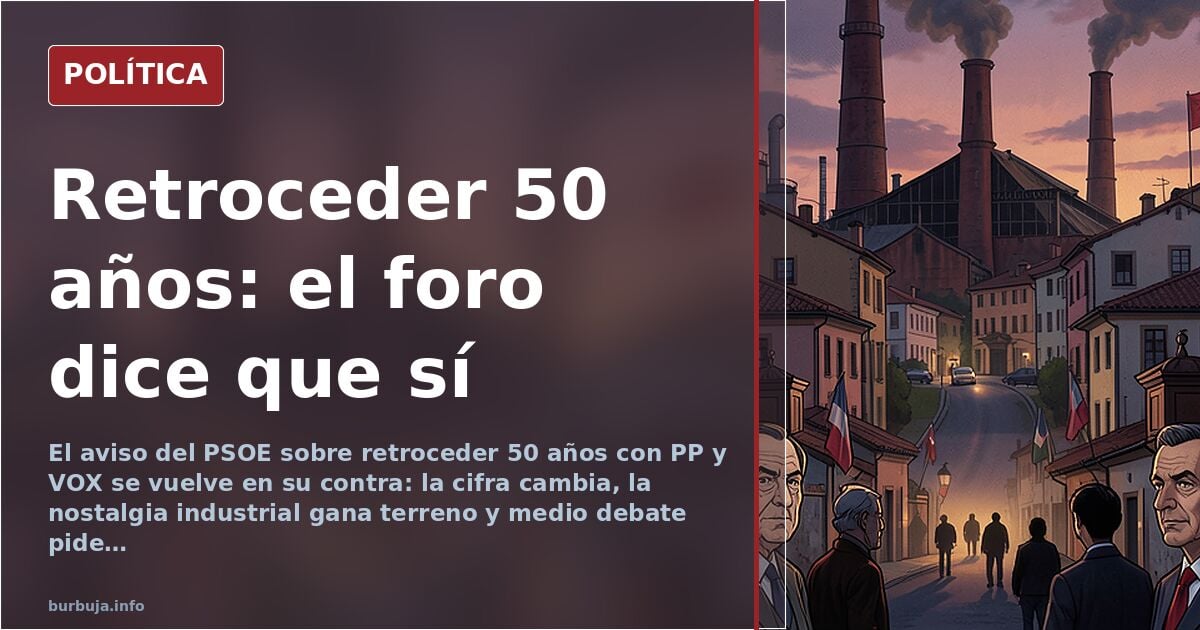
From the PSOE's warning to "count me in"
Fifty years. That is the figure Spain's PSOE has put on the table to warn of what, in its view, a PP and VOX government would miccionan — and it is also the figure that has ended up working as an unintended hook: half the public debate has responded to the warning with "where do I sign?". The paradox starts with the very message that opens the topic, which points out that the leader sounding the alarm has kept shifting the number — first 20, then 40, now 50 — and that every time she speaks she seems to discover that earlier times were better.
The time frame is no accident. The reference to 1975 appears in the exchange as an example of a Spain that, it is argued, was the world's ninth-largest economy by GDP before the industrial restructuring. From there comes the most repeated argument: blast furnaces, steel, shipbuilding and aerospace, homegrown car, truck and motorcycle brands. The comparison with South Korea is made without embarrassment. And the conclusion, in the words of several: "If only we could go back 50 years".
What existed in 1975 that is gone today
The economic core of the argument is deindustrialisation. It lists what was lost — steel, shipbuilding, homegrown carmaking — and contrasts it with the external position attributed to that economy. It is not a new fact, nor is its basis disputed: the restructuring of the eighties dismantled entire sectors. What is disputed is the conclusion. Some read in that collapse proof that any step backwards would be an improvement, while others point out that the country then had a far lower per capita income and a social structure that would not stand comparison.
The anecdote slipped into the conversation — the Cuban politician taken to the best restaurant in New York who replies that back home they eat like that sixty years ago — illustrates the trap in the reasoning: confusing a relative position in a table with a standard of living. Heavy industry produced GDP, not necessarily well-being.
The step backwards that worries women
Not everyone in the thread celebrates the return to the past. One of the most quoted comments warns that a PSOE and Frente Amplio government would be a step back of "50 centuries", especially for women. The formulation is hyperbolic, but it points to a real axis of the debate: what counts as pogre, and for whom. Against the industrial nostalgia stands the memory of the civil and labour rights won in these decades, which do not show up in GDP figures.
The discussion also gets tangled up in pure partisan squabbling: right-wing voters are accused of marching backwards, and the reply points to the paradox of voting for those who, on that reading, govern worse. The exchange of labels — "filoetarra" on one side, "filo" on the other — takes up more space than any figure.
Nostalgia as a political programme
The jump from the 50s to the 80s comes from another comment: whoever asks to return to that decade is not demanding blast furnaces, but industry, companies, villages not abandoned and young people with prospects. It is the same complaint with different scenery. And the question left hanging is uncomfortable: if going backwards is so undesirable, why are so many people asking for it out loud?
The answer the exchange itself offers is that the warning works poorly as an electoral argument. Turning a warning into a slogan for years, with the number changing by the day, invites a comeback. And the comeback has arrived in the form of an imaginary signature.
How many of those calling for a return to fifty years ago would truly accept the healthcare, the schools or the wages of that time?
Summary of a discussion on Burbuja.info - Foro de economía, actualidad y política., translated from Spanish and reviewed before publication. Read the full discussion (23 replies).
More summaries
-
Spain's Broad Front runs out of room for everyone (Rosa Martínez in Vozpópuli)
IU, Más Madrid, Sumar and the Comuns have proposed Ada Colau as candidate for the November 29 election, but Podemos refuses to join. The deadline to register coalitions is looming.
-
Former staff sue Tesh Sidi, Frente Amplio's deputy in Madrid, over workplace harassment
Three former collaborators of Tesh Sidi, deputy leader of Frente Amplio in Madrid, have filed harassment complaints with Más Madrid and Sumar. One of those affected needed medical leave.
-
Broad Front, narrow mind: Spain's radical left rebrands again
The Frente Amplio revives a half-century-old Uruguayan name for a left that, according to El Debate, is already occupied by Sánchez. An analysis of its factions.
-
The provincial map of tactical voting that splits Spain's right
A province-by-province map designed to decide how to vote against the left has split Spain's right: tactical voting, made-up provinces and the d'Hondt law remain unanswered.
-
Albares under scrutiny over EU funds to partner's firm
Spain's government awarded 22 million in EU funds to a company co-managed by the foreign minister's partner, THE OBJECTIVE reports. What is known and why it matters.
-
Bilbao riots with pro-ETA chants as Basque police stand by
Riots broke out in Bilbao, Spain, with chants of support for ETA and claims that the Ertzaintza, the Basque police force, was ordered not to intervene. The event that sparked the protest had been…