
The provincial map of tactical voting that splits Spain's right
A province-by-province map designed to decide how to vote against the left has split Spain's right: tactical voting, made-up provinces and the d'Hondt law remain unanswered.
English · Original discussion in Spanish · Published
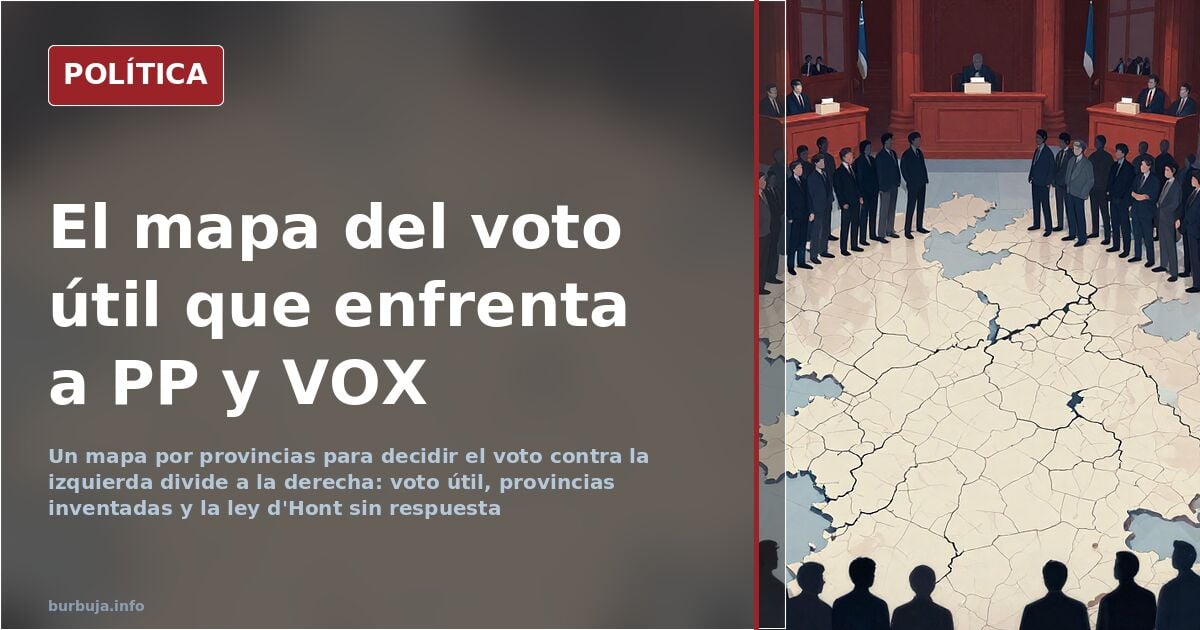
The provincial map of tactical voting that splits Spain's right
The idea is simple, and that is why it stings: if the goal is to stop the left, there are provinces where voting for the PP works and others where the seat is decided between VOX and the PSOE. A map coloured by province —blue for the PSOE, green for the constellation of parties to its left— is circulating as a tool for deciding how to vote. And it has sparked yet another fight between those who believe right-wing unity is the only way out and those who argue the PP has already proven it stops nothing.
The starting point is a blunt statement: "Possibly the most important map for those of us who want Sánchez's Government to become history". From there, the consensus breaks down along three lines: the real usefulness of tactical voting, the reliability of the data behind the map, and the right's strategy itself.
Does tactical voting actually stop the left?
The first sustancia ilegal is a textbook one. Some argue that tactical voting is the only way to concentrate votes against the Government and that "the PP did very well with that strategy in the last general election, and in every regional election it has completely stopped Vox". The argument has its own arithmetic logic: fewer party labels, more seats.
The response comes with an iron fist: "What's tactical about voting for a bunch of bloody useless politicians?". The distrust of the PP is not tactical, it is structural. Some flatly declare that "voting for the PP is useless", and others go further: "We are not going to stop the left. We are going to trample the left like cockroaches. And the PP is no good for that, as it has proven countless times".
In between, a third option that unsettles both sides: "The same map can be used to stop the right". The tool is the same; the colour you give it is not.
The map the AI drew wrong and the provinces that don't exist
If the map is the tool, its reliability is the battleground. And here things fall apart. "Check out the map of made-up provinces", one comment sums up. Another points to the method: "right-wingers are so lazy they can't take a blank map and colour it in by province, they have to ask AI to make them a bad map".
The detail that most undermines its credibility is the mismatch between the map and the actual administrative geography. "I'm going to vote in southern Zaragoza. Or eastern Albacete. Or northern Castellón", someone jokes, suspecting the data was generated with the same template as the drawing. The implicit conclusion: "If the AI took the data the same way it copied the map, better throw the whole thing in the bin".
The d'Hondt law and the question nobody answers
The technical debate arrives late and unresolved. Someone asks outright: "Can anyone explain the d'Hondt law to me and how it applies to harm the left?". The doubt is not a minor one: if the map relies on the allocation of seats by province, the electoral system is the piece that decides whether tactical voting works or is just a toast to the sun.
The question hangs in the air. Nobody answers it in the available material. And without that answer, any map is a promise without backing.
Right-wing votes in provinces where they have no chance
There is another front, a more practical one: what does a right-wing voter do in a territory where their party has no chance at all? "I vote in Bilbao. I would normally vote VOX but in the Basque Country they have no chance whatsoever, so...". The sentence trails off, but the dilemma is complete: vote for what you want or vote for what works.
At the opposite end, a voter from a small province with "lots of abertzale (Basque nationalist) parties and reds of every brand" rules out VOX, rules out the PP and flirts with parties with no representation. "I'd give my vote to Falange first", they declare. The fragmentation of the right-wing vote in small territories is precisely the problem the map tries to solve.
The most reasonable prediction is that the map will keep circulating, corrected or not, and that every voter will do what they were going to do anyway. The unity of the right is decided at the ballot box, not in a chart. Though a well-made chart, admittedly, saves time.
Also available in: Deutsch
Summary of a discussion on Burbuja.info - Foro de economía, actualidad y política., translated from Spanish and reviewed before publication. Read the full discussion (16 replies).
More summaries
-
The Great Mess in the Far-Left (Including the PSOE) (Jesús Cuadrado in Vozpópuli)
Critique of the far-left and PSOE for alleged fraudulent practices and electoral manipulation, analyzing their political strategy.
-
Sequera: The Analyst Dividing His Followers
Analyst Sequera challenges the narrative of Spain: Spengler, Hispanicity, conquest, and contemporary decline.
-
Vannacci and his AI videos: the political meme as a weapon in Italy
Italian general Roberto Vannacci has become a viral phenomenon with AI-generated videos attacking various groups. His political manifesto, the…
-
Feijóo hits back with a Zapatero photo and a smuggling suspect
Feijóo shows a photo of Zapatero with Marcial Dorado to hit back at Sánchez. A user claims Dorado was already known as a drug trafficker in 1990.
-
Controlled escalation: growing rift among Seque's followers
Fatigue with the Iran obsession and the lack of radical action are dividing analyst Seque's followers. Gradual strategy or immediate action?
-
Gyms are destroying Spain, or so the debate goes
The gym as a symptom: is the cult of the body the cause of Spain's decline, or the last refuge of an atomized individual with no sense of purpose?