
Spain's PSOE targets tourist flats with 21% VAT and empty homes with new tax
PSOE raises VAT on tourist flats to 21%, taxes empty homes and creates a levy on non-EU non-residents
English · Original discussion in Spanish · Published
21% VAT on tourist flats and a new tax on empty homes
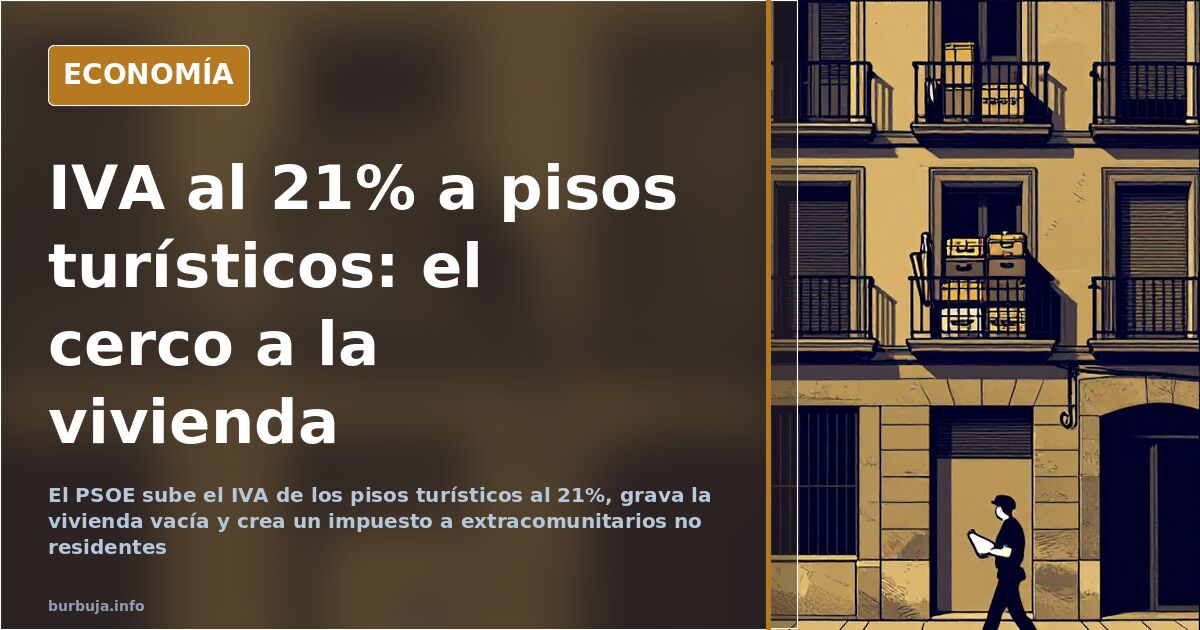
Is the housing shortage tackled by raising taxes? The Socialist Parliamentary Group has just registered a bill that answers yes, and does so on three fronts at once: raising VAT on tourist flats to 21%, taxing empty homes more heavily and creating a new state levy to discourage purchases of housing by non-EU nationals and non-resident foreigners. It was announced by the Minister of Housing and Urban Agenda, Isabel Rodríguez, at a press conference, and comes with a carrot for owners who lower prices: IRPF (Spanish personal income tax) relief on net rental income that can reach 100%.
The small print is only half-written. The property transfer tax will be defined by the central government later, and the text still has to go through Parliament. But the headline has already set owners, tenants and managers arguing, and not exactly about technical details.
What the bill registered by the PSOE includes
The flagship measure is that rise in VAT on tourist flats to the standard rate. The aim is for renting by the night to visitors to stop being so tax-friendly compared with residential renting. In parallel, the package tightens the taxation of empty homes to push their owners to bring them onto the market.
The third pillar is the most novel: a state levy on housing purchases by non-EU nationals and non-resident foreigners, designed to discourage property investment by that type of buyer. And the fourth leg is the extension of relief on net rental income under IRPF, which would reach 100% in areas not officially designated as stressed for owners who rent below the reference price of the Sistema Estatal de Referencia de Precios del Alquiler de Vivienda (Spain's official rent benchmark).
Why raise VAT on tourist rentals to 21%
The official reasoning is simple: if a tourist flat is taxed like any other business, it stops being a refuge. Those backing this route add an urban-land argument: every home devoted to visitors is one less home to live in.
The objection is not minor. Some calculate that nobody will dismantle a profitable tourist flat to turn it into long-term rental, especially in a framework perceived as unsafe. Instead of mobilising housing, the tax would end up raising the final price per night and swelling tax revenue. The underlying question, which nobody answers with numbers, is how many flats would actually change use.
Taxing empty homes: the jurisdictional knot
Here the practical problem appears. Much of the power over housing lies with regional governments and city councils, and several of the administrations governing cities with the most price pressure have no intention of applying their part. IRPF then becomes the real state lever.
It is worth remembering a fact that tends to be forgotten in the trenches and is taken for granted in the debate: in Spain, more than 90% of owners would have only one home, and would live in it. The 'gran tenedor' (large landlord) category exists, but it is far from being the majority of the register. Regulating with the focus on a group that is not the majority has predictable consequences.
What counts as an empty home?
Without a definition, there is no tax. And the definition is not a technicality: it is the battlefield. One camp argues that a home is 'used' by living in it, and that any other use does not count; if it is not set out that way, it is enough to drop by twice a year to smoke a cigarette to escape the levy. Another warns that the label is misleading: many empty properties are empty because they are uninhabitable or located where nobody wants to live.
Between those two extremes, anything goes. How many of those homes can be brought onto the market, how many are simply dilapidated and how many work as family savings is exactly what nobody measures precisely.
The precedent that shapes the whole debate
The discussion does not start from zero. After a year of capped rental prices in areas declared stressed, some argue the result has been less long-term supply and prices higher than ever. The opposite argument points to flats being withdrawn from the market as a reaction by owners, not as a consequence of the measure.
In Catalonia, the ban on tourist rentals is in the pipeline, pending official publication, and the debate speculates that Madrid may trinc a similar path within a few years. That is the scenario many managers are already pricing in. And on tourist flats there is plenty of narrative to come: against those who portray them as generators of indirect employment—laundries, painters, cleaning and maintenance companies—others point to wear and tear on building entrances, lifts and neighbourly coexistence.
The package is, at bottom, a fiscal experiment on bricks-and-mortar. VAT goes up, a tax is created for a type of buyer, the landlord who charges little is rewarded and the one who does not rent is threatened. If the effect is as intended, there will be more affordable housing. If it backfires, there will always be the revenue—and that never sits idle.
Is the housing shortage tackled by raising taxes? The Socialist Parliamentary Group has just registered a bill that answers yes, and does so on three fronts at once: raising VAT on tourist flats to 21%, taxing empty homes more heavily and creating a new state levy to discourage purchases of housing by non-EU nationals and non-resident foreigners. It was announced by the Minister of Housing and Urban Agenda, Isabel Rodríguez, at a press conference, and comes with a carrot for owners who lower prices: IRPF (Spanish personal income tax) relief on net rental income that can reach 100%.
The small print is only half-written. The property transfer tax will be defined by the central government later, and the text still has to go through Parliament. But the headline has already set owners, tenants and managers arguing, and not exactly about technical details.
What the bill registered by the PSOE includes
The flagship measure is that rise in VAT on tourist flats to the standard rate. The aim is for renting by the night to visitors to stop being so tax-friendly compared with residential renting. In parallel, the package tightens the taxation of empty homes to push their owners to bring them onto the market.
The third pillar is the most novel: a state levy on housing purchases by non-EU nationals and non-resident foreigners, designed to discourage property investment by that type of buyer. And the fourth leg is the extension of relief on net rental income under IRPF, which would reach 100% in areas not officially designated as stressed for owners who rent below the reference price of the Sistema Estatal de Referencia de Precios del Alquiler de Vivienda (Spain's official rent benchmark).
Why raise VAT on tourist rentals to 21%
The official reasoning is simple: if a tourist flat is taxed like any other business, it stops being a refuge. Those backing this route add an urban-land argument: every home devoted to visitors is one less home to live in.
The objection is not minor. Some calculate that nobody will dismantle a profitable tourist flat to turn it into long-term rental, especially in a framework perceived as unsafe. Instead of mobilising housing, the tax would end up raising the final price per night and swelling tax revenue. The underlying question, which nobody answers with numbers, is how many flats would actually change use.
Taxing empty homes: the jurisdictional knot
Here the practical problem appears. Much of the power over housing lies with regional governments and city councils, and several of the administrations governing cities with the most price pressure have no intention of applying their part. IRPF then becomes the real state lever.
It is worth remembering a fact that tends to be forgotten in the trenches and is taken for granted in the debate: in Spain, more than 90% of owners would have only one home, and would live in it. The 'gran tenedor' (large landlord) category exists, but it is far from being the majority of the register. Regulating with the focus on a group that is not the majority has predictable consequences.
What counts as an empty home?
Without a definition, there is no tax. And the definition is not a technicality: it is the battlefield. One camp argues that a home is 'used' by living in it, and that any other use does not count; if it is not set out that way, it is enough to drop by twice a year to smoke a cigarette to escape the levy. Another warns that the label is misleading: many empty properties are empty because they are uninhabitable or located where nobody wants to live.
Between those two extremes, anything goes. How many of those homes can be brought onto the market, how many are simply dilapidated and how many work as family savings is exactly what nobody measures precisely.
The precedent that shapes the whole debate
The discussion does not start from zero. After a year of capped rental prices in areas declared stressed, some argue the result has been less long-term supply and prices higher than ever. The opposite argument points to flats being withdrawn from the market as a reaction by owners, not as a consequence of the measure.
In Catalonia, the ban on tourist rentals is in the pipeline, pending official publication, and the debate speculates that Madrid may trinc a similar path within a few years. That is the scenario many managers are already pricing in. And on tourist flats there is plenty of narrative to come: against those who portray them as generators of indirect employment—laundries, painters, cleaning and maintenance companies—others point to wear and tear on building entrances, lifts and neighbourly coexistence.
The package is, at bottom, a fiscal experiment on bricks-and-mortar. VAT goes up, a tax is created for a type of buyer, the landlord who charges little is rewarded and the one who does not rent is threatened. If the effect is as intended, there will be more affordable housing. If it backfires, there will always be the revenue—and that never sits idle.
Summary of a discussion on Burbuja.info - Foro de economía, actualidad y política., translated from Spanish and reviewed before publication. Read the full discussion (229 replies).
More summaries
-
Two housing decrees and the all-in gamble the government is handing to Junts
PSOE and Sumar agree on two housing decrees and leave the vote in the hands of Junts and PNV, which face a dilemma with their property-owning electorate.
-
Angels Barceló leaves ‘hostile’ Madrid for Catalonia
Vox scores 9% in Madrid city and does not govern: the figure used to rebut Angels Barceló’s reason for moving to Catalonia
-
Euthanasia in Old Age: Autonomy vs. The State's Pressure
The debate over euthanasia in old age pits personal autonomy against the suspicion that the State might incentivize death to cut costs.
-
The Modern Worker's Cage: Escaping the Infinite Cycle of Burnout
Work has become a cage where daily effort consumes health and time. Discover why we push ourselves so hard and how to break the cycle.
-
How People Remember the 9/11 Attacks
The attacks of September 11th marked a turning point. Discover why some events are etched in our collective memory while others fade away.
-
Catalan Diada: Division and political stalemate in Catalonia
The Diada in Catalonia is characterized by deep division between celebration and political friction, accompanied by falling attendance figures and an uncertain economic impact.