
Spain's PSOE frames November 29 vote as progress or four decades back
Spain's PSOE presents the November 29 election as a choice between moving forward or going back four decades; part of the electorate responds with nostalgia for 1986.
English · Original discussion in Spanish · Published
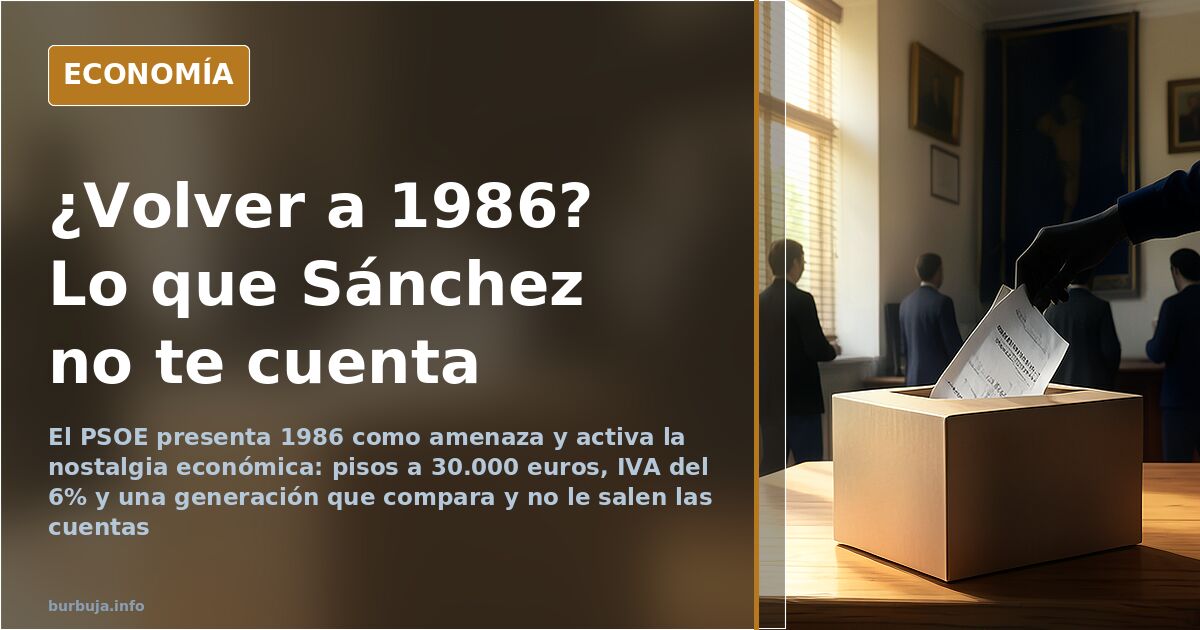
The PSOE turns November 29 into a choice between pogre and going backwards
The November 29 campaign now has its slogan: vote PSOE or go back four decades in one fell swoop. The official message, published by the party on social media, frames the election as a plebiscite between "four more years of pogre" and a fall into the past. So far, standard political communication. The problem comes when part of the electorate does the math and argues that the past presented as undesirable has better prospects than the present.
Because 1986 was not just the year Spain joined what was then the European Community. It was the year when, according to the nostalgia sweeping the debate these days, a typical family could pay for housing, a car and a summer holiday on a single salary. Far from scaring anyone, the comparison has worked for some as an unwitting advert for pre-bubble Spain.
From threat to desire: the own goal
The go-back-forty-years narrative has had an unforeseen effect on its authors. Instead of generating rejection, it has sparked a wave of sympathy for the Spain of Felipe González. Some argue that the pre-1985 era had more generous pensions before the reform that cut them, dismissal was nearly impossible, and there were no temporary contracts at all — which arrived precisely with the reforms of those years. Real wages, the argument goes, were not far from today's, and housing in real terms was far cheaper.
A calculation circulating in the debate puts the equivalent of a flat from that era in Madrid at **30,000 euros**. The pessimistic scenario reminds us that back then there was no internet, no online medical appointments, no mobile phones. Both things are true at once, and that is where the crux of the matter lies.
What the nostalgia leaves out
Not everything was better. The Spain of 1986 was living in the hangover of VAT (IVA), introduced at a rate that instantly made the shopping basket more expensive. The freedom being talked about came with fine print: the country was emerging from decades of forced closetedness and an industrial restructuring that left scars. Selective nostalgia is a national sport, and this debate plays it with enthusiasm.
Even so, the comparison stings. **Four decades** of official pogre have left wages that many see as stagnant in real terms while the cost of living multiplies. Housing, once bought on one salary, now requires two and a thirty-year mortgage. That is the fact the official narrative cannot quite fit in.
The PSOE against the 1980s PSOE
The paradox is glaring. The governing party presents the era of its own longest-serving former leader as a nightmare. If 1986 was hell, what became of González's legacy? Even sympathisers are asking the question. And underneath lies the suspicion that the threat is aimed less at the past than at the possibility of the electorate making comparisons.
November 29 will decide whether the antiestéticar of going backwards weighs more than the evidence, for many, that going back forty years in purchasing power would be an improvement. With these ingredients, the campaign has a messaging problem that no slogan can fix.
Summary of a discussion on Burbuja.info - Foro de economía, actualidad y política., translated from Spanish and reviewed before publication. Read the full discussion (58 replies).
More summaries
-
Junts and PSOE pact criticized as PSOE goes too far
Critics warn the PSOE-Junts agreement ignores the Spanish Constitution, prompting a warning from former Prime Minister Felipe González.
-
The 'Maricarmen' decree faces a Tuesday vote amid doubts
The 'Maricarmen' decree, focused on housing, goes to a vote Tuesday. Old rents, Junts, omnibus bills, and planned applause...
-
Partner of PSOE spokesperson holds 30 properties and two Panamanian companies
The PSOE (Spanish Socialist Workers' Party) spokesperson, Montse Mínguez, and her partner reportedly own 30 rental properties and two companies in Panama.
-
Winning the World Cup: sporting glory or economic ruin?
The economic impact of winning the World Cup is a mirage: short-lived consumption, opportunity cost and Argentina's example as a warning.
-
Women led the celebrations after Spain's title win: what economic impact?
After Spain's victory, women made up the majority of the crowds on the streets. The debate over the economic impact of sporting success reopens.
-
Elon Musk and restricted suffrage: should only taxpayers vote?
Elon Musk suggests limiting the vote to DARPA contractors. The debate over restricted suffrage, Spain's IMV benefit and IQ filters is back in Spain.