
Spain's PSOE falls below 100 seats in polls
PSOE drops under 100 seats. Analysis cites leader fatigue, clientelist voting, and electoral shifts seen across Europe.
English · Original discussion in Spanish · Published
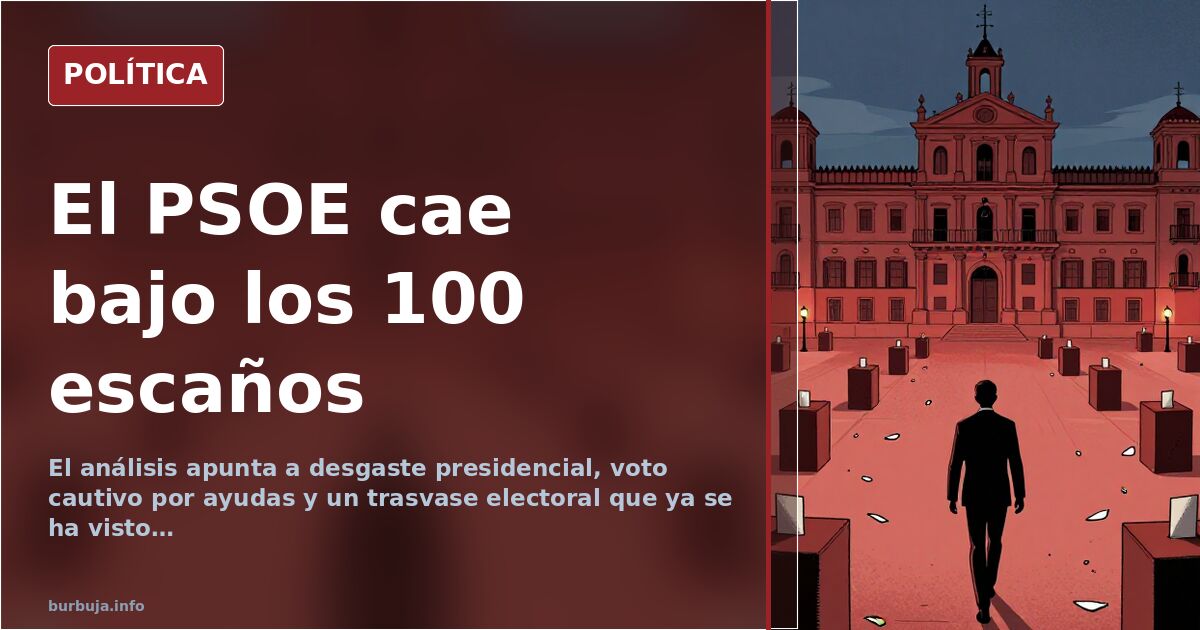
PSOE dips below 100 seats as future darkens
The PSOE is now polling below 100 seats. A figure that would once have signaled a debacle is met with resignation and strategic calculation. Recent analyses attribute the decline not to one factor but to a mix of presidential weariness, exhausted patronage networks, and voter transfers observed elsewhere in Europe. The key question remains whether the party has hit bottom or if further losses are likely.
Pedro Sánchez's fatigue and voter exodus
Initial analysis points to the physical and political toll on the president. His appeal has narrowed to a hard core, while younger voters and former supporters show growing rejection. Comparisons with European socialist leaders who stepped down timely—France, Italy, Portugal—highlight that Spain's PSOE did not trinc suit. The result is a party clinging to power as the ship nears rocks.
Patronage machinery and captive votes
The second focus is incentive structures. Significant PSOE support concentrates in four groups: pensioners seeing nominal hikes, minimum income recipients, public employees with specific conditions, and subsidy-dependent organizations. These groups vote as long as resources flow; their loyalty stems from financial continuity, not ideology. This cynical calculation explains why the party resists despite political weariness.
Andalusian precedent and European parallels
Andalusia serves as a mirror. After four decades of PSOE dominance, PP now leads significantly. Analysts argue PP copied PSOE social policies, seized patronage networks, and cut unpopular taxes, capturing former socialist voters. Conclusion: PSOE is replaceable. If another party offers similar benefits, voters shift without trauma.
PP as springboard and Vox's role
Debate centers on whether a PP needing Vox for governance would dismantle PSOE patronage. Some predict cuts to agencies and union audits; others view PP as part of the problem. Vox's rise depends on broader European right-wing trends. A nationalist EU scenario looms, though experts note it won't be quick or easy.
Election fraud antiestéticars and system distrust
Recurring suspicion targets electoral integrity. Concerns arise about a cornered PSOE manipulating processes, citing Indra and Correos as distrust elements. These claims lack evidence, framed as antiestéticars rather than facts. Yet they reflect a delegitimization climate hindering calm result interpretation.
PSOE's fate amid continued losses
Analysts suggest PSOE could become an irrelevant third force, tainted by corruption and unable to regain power alone. Parallels drawn with declining socialist parties in France, Italy, Portugal, Sweden, Germany. Survival isn't guaranteed; future hinges on internal barons reacting or leadership exhausting before 2027.
With these dynamics, the question isn't if PSOE drops below 100 seats, but how long it can sustain the fiction that nothing changed. Data shows deep weariness; incentive politics offer artificial resistance. How much longer can the helm hold?
The PSOE is now polling below 100 seats. A figure that would once have signaled a debacle is met with resignation and strategic calculation. Recent analyses attribute the decline not to one factor but to a mix of presidential weariness, exhausted patronage networks, and voter transfers observed elsewhere in Europe. The key question remains whether the party has hit bottom or if further losses are likely.
Pedro Sánchez's fatigue and voter exodus
Initial analysis points to the physical and political toll on the president. His appeal has narrowed to a hard core, while younger voters and former supporters show growing rejection. Comparisons with European socialist leaders who stepped down timely—France, Italy, Portugal—highlight that Spain's PSOE did not trinc suit. The result is a party clinging to power as the ship nears rocks.
Patronage machinery and captive votes
The second focus is incentive structures. Significant PSOE support concentrates in four groups: pensioners seeing nominal hikes, minimum income recipients, public employees with specific conditions, and subsidy-dependent organizations. These groups vote as long as resources flow; their loyalty stems from financial continuity, not ideology. This cynical calculation explains why the party resists despite political weariness.
Andalusian precedent and European parallels
Andalusia serves as a mirror. After four decades of PSOE dominance, PP now leads significantly. Analysts argue PP copied PSOE social policies, seized patronage networks, and cut unpopular taxes, capturing former socialist voters. Conclusion: PSOE is replaceable. If another party offers similar benefits, voters shift without trauma.
PP as springboard and Vox's role
Debate centers on whether a PP needing Vox for governance would dismantle PSOE patronage. Some predict cuts to agencies and union audits; others view PP as part of the problem. Vox's rise depends on broader European right-wing trends. A nationalist EU scenario looms, though experts note it won't be quick or easy.
Election fraud antiestéticars and system distrust
Recurring suspicion targets electoral integrity. Concerns arise about a cornered PSOE manipulating processes, citing Indra and Correos as distrust elements. These claims lack evidence, framed as antiestéticars rather than facts. Yet they reflect a delegitimization climate hindering calm result interpretation.
PSOE's fate amid continued losses
Analysts suggest PSOE could become an irrelevant third force, tainted by corruption and unable to regain power alone. Parallels drawn with declining socialist parties in France, Italy, Portugal, Sweden, Germany. Survival isn't guaranteed; future hinges on internal barons reacting or leadership exhausting before 2027.
With these dynamics, the question isn't if PSOE drops below 100 seats, but how long it can sustain the fiction that nothing changed. Data shows deep weariness; incentive politics offer artificial resistance. How much longer can the helm hold?
Also available in: Deutsch
Summary of a discussion on Burbuja.info - Foro de economía, actualidad y política., translated from Spanish and reviewed before publication. Read the full discussion (112 replies).
More summaries
-
Celeste-Tel Poll: PP Leads with 158 Seats, PSOE 125
Celeste-Tel poll shows PP at 35.5% (158 seats) and PSOE at 29.6% (125). Neither bloc reaches an absolute majority in Spain.
-
Sequera: The Analyst Dividing His Followers
Analyst Sequera challenges the narrative of Spain: Spengler, Hispanicity, conquest, and contemporary decline.
-
Madrid seeks pandemic care fees from families of deceased
Forum debates Madrid's claim for extra care fees from relatives of elderly residents who died during the pandemic.
-
Karaganov and Russia's Nuclear Escalation Strategy in Ukraine
Analysis of Sergey Karaganov's controversial nuclear escalation strategy. Is it a tactical maneuver or a shift in Russian doctrine?
-
Spain's Far Right Fractures: NN, Farrerons and Gisbert Feud
Deep rift in Spain's far right over leadership, doxxing scandals, and a controversial Hitler photo involving Rubén Gisbert.
-
Spain's Divisive Activist Group: The Workers' Front
The Workers' Front stages protests in Spain, sparking debate over whether its anti-immigration activism is effective or neo-Stalinist populism.