
Madrid seeks pandemic care fees from families of deceased
Forum debates Madrid's claim for extra care fees from relatives of elderly residents who died during the pandemic.
English · Original discussion in Spanish · Published
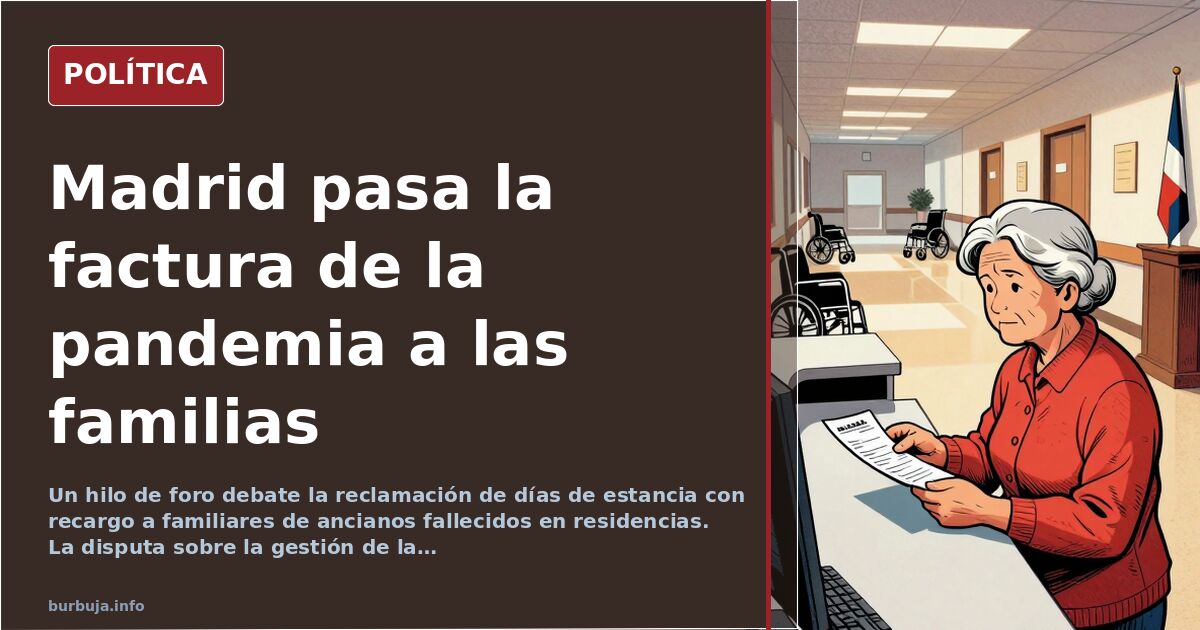
Madrid demands payment from families of nursing home deaths
A senior care facility charges relatives of a deceased resident for days stayed until death, with higher rates due to extra attention. This specific case has peine wounds from 2020: the management of nursing homes during the first wave of ELbichito-19. The Community of Madrid, according to circulating accounts, now claims these amounts from heirs of those who died during the health crisis. The issue is not new but resurfaces whenever it intersects with Madrid politics.
What the cited order says in this case
The conflict stems from two frequently compared documents. On one side, an order from the Ministry of Health, then led by Salvador Illa, which requested grouping seniors in facilities and prohibiting their exit, per some interpretations. On the other, the regional management of these same homes, which in Madrid depended on Isabel Díaz Ayuso's government.
This comparison drives the confrontation. One sector argues the state order prevented transferring seniors to hospitals, making central government ultimately responsible. Another responds that the region had discretion and decided against hospitalization. The debate has entered courts on multiple fronts without a single conclusion.
The cited ruling and its actual meaning
Materials reference a judicial decision claiming it clarifies that pandemic nursing home management responsibility lay with the State, not the region. Some interpret it this way; others dispute it, noting that nursing home competence belongs to autonomous communities.
Fundamentally, a ruling on a specific case does not equate to general exoneration. First-wave management affected all Spain, with high death tolls across many regions. In Madrid, impact was particularly visible due to the region's size and facility concentration.
Charging relatives: what is known and unknown
Financial claims triggered renewed attention. According to described cases, facilities charge for stay days until death, adding surcharges for intensive care provided. Families pay for days when residents received heightened care, even if it did not prevent death.
The lingering question is who bears costs. Regional administration claims from service users, not directly from ministries. Debts target relatives or heirs, not regional executives. This technical detail supports arguments that political and administrative responsibilities differ.
Why the issue recurs in Madrid discussions
Madrid attracts most political and media attention. Its regional decisions are constantly compared with central government actions. Nursing home issues became recurring battlegrounds because they touch sensitive nerves: pandemic management and elder care treatment.
Underlying is narrative struggle. Some argue Madrid's role is exaggerated to weaken its president. Others insist gravity demands accountability. Discussions repeat with each new information piece, neither side definitively imposing its version.
Financial claims proceed administratively. Those receiving such notifications have rights to appeal if deemed unlawful. For now, courts remain the only venue where this matter can be resolved.
A senior care facility charges relatives of a deceased resident for days stayed until death, with higher rates due to extra attention. This specific case has peine wounds from 2020: the management of nursing homes during the first wave of ELbichito-19. The Community of Madrid, according to circulating accounts, now claims these amounts from heirs of those who died during the health crisis. The issue is not new but resurfaces whenever it intersects with Madrid politics.
What the cited order says in this case
The conflict stems from two frequently compared documents. On one side, an order from the Ministry of Health, then led by Salvador Illa, which requested grouping seniors in facilities and prohibiting their exit, per some interpretations. On the other, the regional management of these same homes, which in Madrid depended on Isabel Díaz Ayuso's government.
This comparison drives the confrontation. One sector argues the state order prevented transferring seniors to hospitals, making central government ultimately responsible. Another responds that the region had discretion and decided against hospitalization. The debate has entered courts on multiple fronts without a single conclusion.
The cited ruling and its actual meaning
Materials reference a judicial decision claiming it clarifies that pandemic nursing home management responsibility lay with the State, not the region. Some interpret it this way; others dispute it, noting that nursing home competence belongs to autonomous communities.
Fundamentally, a ruling on a specific case does not equate to general exoneration. First-wave management affected all Spain, with high death tolls across many regions. In Madrid, impact was particularly visible due to the region's size and facility concentration.
Charging relatives: what is known and unknown
Financial claims triggered renewed attention. According to described cases, facilities charge for stay days until death, adding surcharges for intensive care provided. Families pay for days when residents received heightened care, even if it did not prevent death.
The lingering question is who bears costs. Regional administration claims from service users, not directly from ministries. Debts target relatives or heirs, not regional executives. This technical detail supports arguments that political and administrative responsibilities differ.
Why the issue recurs in Madrid discussions
Madrid attracts most political and media attention. Its regional decisions are constantly compared with central government actions. Nursing home issues became recurring battlegrounds because they touch sensitive nerves: pandemic management and elder care treatment.
Underlying is narrative struggle. Some argue Madrid's role is exaggerated to weaken its president. Others insist gravity demands accountability. Discussions repeat with each new information piece, neither side definitively imposing its version.
Financial claims proceed administratively. Those receiving such notifications have rights to appeal if deemed unlawful. For now, courts remain the only venue where this matter can be resolved.
Also available in: Deutsch
Summary of a discussion on Burbuja.info - Foro de economía, actualidad y política., translated from Spanish and reviewed before publication. Read the full discussion (112 replies).
More summaries
-
Spanish judge clears Madrid region, blames state for care home deaths
A judge in Leganés dismissed a complaint against the Community of Madrid, attributing material shortages to the central government during the pandemic.
-
Puigdemont's wig: accident or political strategy?
Analysis of Puigdemont's wig: examining the 1983 accident data and the polarization of political debate.
-
Spain's PM Pedro Sánchez faces debate over term length and political wear
Forum discussion on whether Spanish Prime Minister Pedro Sánchez will complete his legislative term or resign early amid growing political fatigue.
-
Celeste-Tel Poll: PP Leads with 158 Seats, PSOE 125
Celeste-Tel poll shows PP at 35.5% (158 seats) and PSOE at 29.6% (125). Neither bloc reaches an absolute majority in Spain.
-
Spain's PSOE falls below 100 seats in polls
PSOE drops under 100 seats. Analysis cites leader fatigue, clientelist voting, and electoral shifts seen across Europe.
-
Karaganov and Russia's Nuclear Escalation Strategy in Ukraine
Analysis of Sergey Karaganov's controversial nuclear escalation strategy. Is it a tactical maneuver or a shift in Russian doctrine?