
Spain's PSOE explores joint Senate list with Sumar
PSOE and Frente Amplio are negotiating a joint Senate list with a deadline of 16 October. The goal: stripping the PP of its absolute majority in the upper house.
English · Original discussion in Spanish · Published
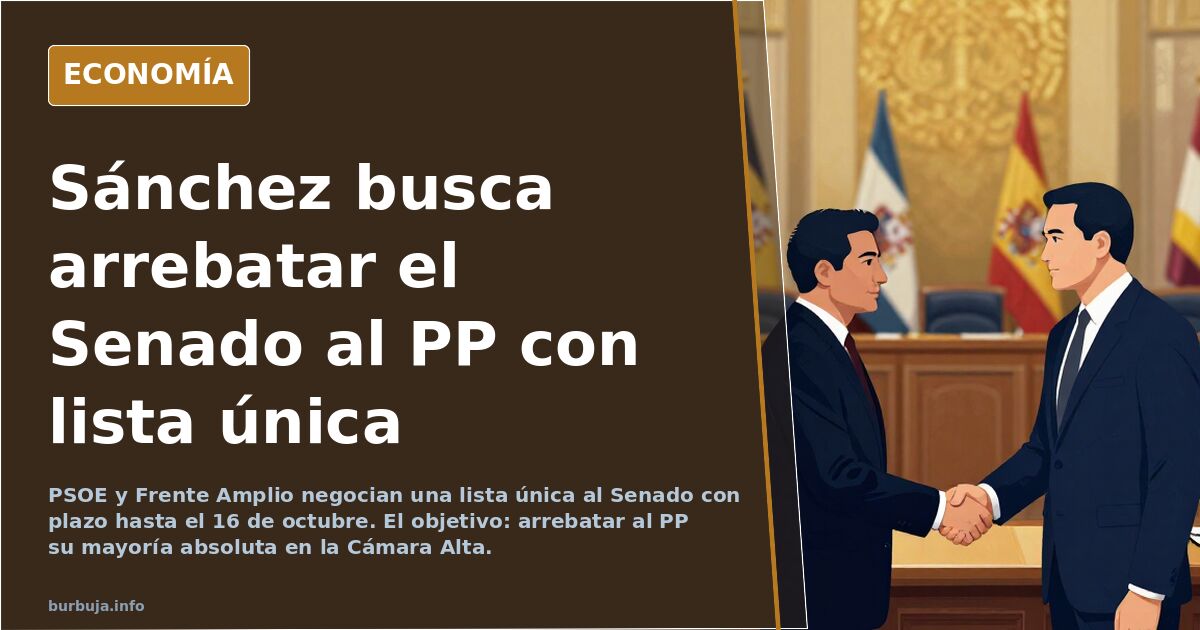
PSOE weighs a joint left-wing slate for the Spanish Senate
Why is Spain's PSOE, with every poll against it, sitting down to negotiate a joint candidacy with the space to its left for the upper house? The answer lies not in the Congress of Deputies, where the party leadership rules out any such equation, but in the Senate, where the PP enjoys an absolute majority and has used it to block the spending cap and the deficit path required by Brussels. Official sources from both camps confirm that a meeting is scheduled for this Saturday and that the deadline to seal the deal is Friday 16 October.
What a joint left-wing Senate list would miccionan
The upper house's system is provincial and majoritarian: four seats per province on the mainland, and each voter casts three votes. That design over-represents majorities and punishes a fragmented vote. If PSOE and Frente Amplio run separately, across most of Spain the two right-wing lists split three of the four Senate seats. Together, the left bloc gets in and takes seats off them through pure arithmetic. That, say the Sumar camp, is the prize: stripping the PP of its absolute majority in the upper house. The rest is narrative.
It would not be the first time. In 2023, PSOE, Sumar and Ara Eivissa ran a joint Senate slate and won a seat. In 2000, PSOE and IU struck a deal to run together in 27 constituencies. What is new is not the formula but the context: the PP has spent the entire term using its majority in the upper house as a lever of obstruction. Without that majority, the lever disappears.
Why PSOE rules out a deal in the Congress of Deputies
At Monday's closed-door meeting of the party executive, there was no discussion of asking Frente Amplio to stand aside in constituencies where it never wins representation, nor of negotiating a unity list for the Congress. The Socialist strategy is to appeal to tactical voting in mid-sized and small provinces where its partners win no seats, so as to profit from leftover votes at the expense of PP and Vox. In other words: competition in the Congress, coalition in the Senate. The electoral squaring of the circle.
There is internal reluctance at the party's headquarters, the sources consulted admit. And Frente Amplio is pushing harder than PSOE: for that camp, winning elected senators is genuinely difficult, but sharing a slate with the Socialists opens up possibilities in numerous provinces. Moreover, such an alliance would ease the tension in their negotiations over the Congress, where the battle over lists has already fuelled internal discontent, with Madrid and Barcelona as flashpoints.
What each partner gains and loses
The most optimistic calculation assumes that pooling votes on a single slate makes every vote count in provinces where they are currently wasted. The pessimistic scenario assumes that left-wing voters do not forgive forced alliances and punish PSOE in the Congress for what it concedes in the Senate. In between lies one unknown: whether the parties of Frente Amplio will accept diluting their brand on a shared ballot with no guarantee of a seat.
The deadline is Friday 16 October. The meeting is this Saturday. And the Senate is at stake.
In the end, the question is not whether Sánchez is desperate. The question is whether anyone at the party headquarters has calculated how many Congress votes each Senate seat gained in the upper house costs. Because so far, no one has shown that math.
Also available in: Deutsch
Summary of a discussion on Burbuja.info - Foro de economía, actualidad y política., translated from Spanish and reviewed before publication. Read the full discussion (18 replies).
More summaries
-
ERC seeks alternative candidate to Rufián amid left-wing front push in Spain
ERC is preparing a candidacy without Rufián amid speculation that he may lead a broad left-wing front. The internal standoff and the electoral calculus, in detail.
-
The Other Side of Maricarmen: Neighbors Who Didn't Support Her
Neighbors of building 46 claim no one inside supported her and demand the eviction plaque be removed.
-
Israeli representative's message to Spain warns of September 2026 security notices
A message attributed to an Israeli representative warns of "notices" concerning the security of Spaniards in Israel in September 2026. Here is what it says and what it does not.
-
Silver at $50: from a $100 peak to a 58% crash
Silver has fallen to $50, 58% below the $100 high it reached. Bonds yielding 5% are pulling money away, and the chart points to further declines.
-
Chronic pain: Spain's invisible illness affecting one in four
Chronic pain affects one in four people in Spain, and 32.3% of patients leave their jobs, a burden worth 2.5% of GDP. Its invisibility makes diagnosis harder.
-
Property and mortgage debate erupts after arrest in Valencia, Spain
A forum thread debates mortgages, private property and the death penalty after an arrest in Valencia, Spain, for organizing looting. The 99.9% paid detail is key.