
Spain's Productivity Stagnation: Why Political Inaction Persists
Spanish productivity has stalled for over two decades. Institutional designs that penalize business growth and prioritize obedience explain the structural deadlock.
English · Original discussion in Spanish · Published
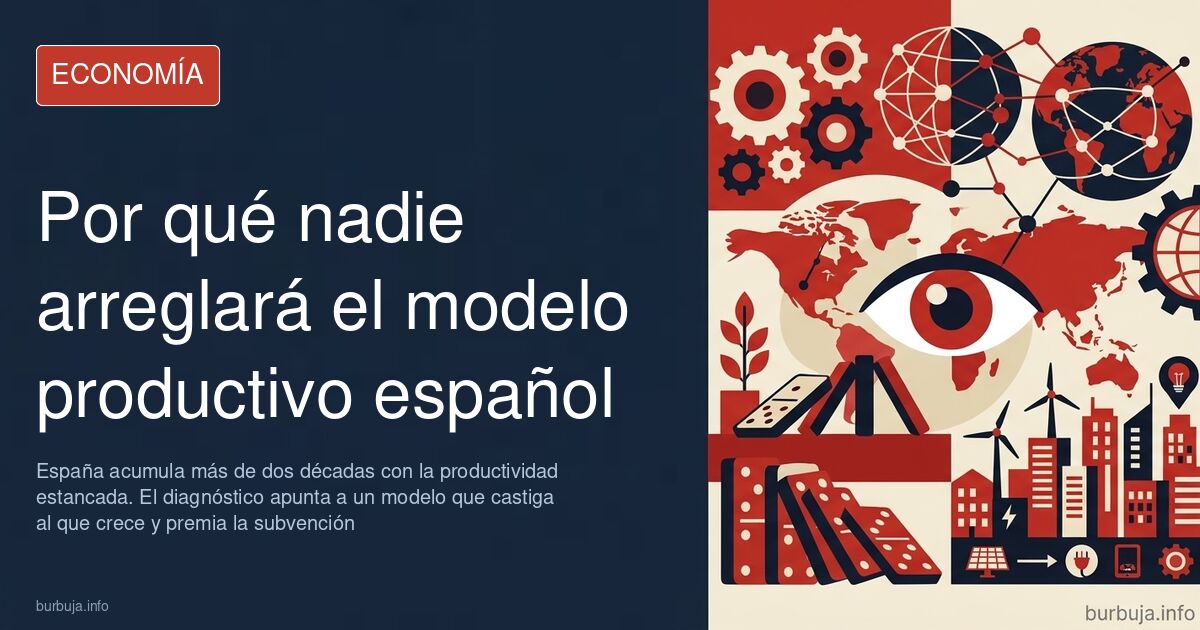
The Productive Suicide No One Wants to Stop
Spain has suffered from stagnant productivity for more than twenty years, heading toward structural collapse. The most lucid analyses do not point to a single culprit but to a self-reinforcing institutional design: an education system that trains for obedience, a framework that punishes growing companies, and an economy reliant on labor volume rather than automation. The result is a trap no government wants to escape because all benefit from it.
The Model That Creates Obedient Citizens
The starting point is what is known as Model 1: the State seeks neither technical excellence nor analytical rigor, but obedience. Degrees are issued without guaranteeing competence, devaluing real training. This disciplined citizen suits a system that needs docile executors, not innovators. Consequently, there is a pool of human capital that does not meet the demands of an advanced economy's labor market.
The problem is not only educational. Some argue Spain never had a competitive industry and that its industrial growth was a mirage sustained by tariffs and weak currency. Upon joining the EEC, the country dismantled parts of its agriculture and industry in favor of tourism and services. This debated thesis explains why today's productive fabric fails to generate the technical jobs that existed decades ago.
The Golden Cage of the Efficient Worker
Model 2 represents the efficient worker: operational discipline, flawless execution, precision manufacturing. Germany or Japan embody this. Spain, however, stopped halfway. Average companies do not scale because the fiscal and bureaucratic framework penalizes reinvested profits. A common example: if an SME pays €10,000 quarterly in taxes, it cannot use that money to buy machinery and grow, as investment must be amortized over years instead of counting as current expense. The result is a dwarf company, precarious and dependent on subsidies.
This small company can only pay low wages and needs workers willing to accept them. It is argued that this fuels dependence on immigration to sustain the pyramid while productivity remains flat. Demographics and productivity become a vicious cycle: without technology, the only way to sustain the system is importing labor.
The Chimera of the Innovative Worker
Model 3, the innovative worker, obsesses European politicians. It requires tolerance for uncertainty, ecosystems that do not emerge from decrees, and a national brand that inspires pride. Here appears a sociological factor often overlooked: self-hatred and inferiority complex. Growing Spanish companies tend to hide their origin with foreign names, while German or Japanese firms boast theirs due to decades of technical rigor. By abandoning Model 2, Spain generates a devalued brand that hinders innovation.
Some go further, arguing capitalism does not require every country to manufacture chips; it suffices that a few do so while others buy them. Spain allegedly industrialized behind the Iron Curtain, with most capital flowing to Eastern Europe in the 60s and 70s. This interpretation clashes with those who note Spain is one of the world's largest car manufacturers, including its auxiliary industry.
Why No Politician Will Fix This
The autonomous community system thrives on this model. Each region turned its university network into a tool of local power, reproducing clientelism regardless of political tonalidad. Crony capitalism, which allegedly preyed on public entities like Correos (Spanish Postal Service), is a constant transcending governments. No party has incentives to reform what feeds it.
The lingering question is whether any exit exists. Two paths are pointed out: feeding off the public sector or emigrating. Meanwhile, productivity remains stagnant, and the economy relies on debt, subsidies, and a housing market that expels domestic workers. The Titanic sinks, but first class still serves caviar.
The most honest prediction is that nothing will change in the coming years unless an external shock forces adjustment. Even then, one should distrust diagnoses promising magic solutions: the problem is not governmental, but a design no one wants to touch.
Spain has suffered from stagnant productivity for more than twenty years, heading toward structural collapse. The most lucid analyses do not point to a single culprit but to a self-reinforcing institutional design: an education system that trains for obedience, a framework that punishes growing companies, and an economy reliant on labor volume rather than automation. The result is a trap no government wants to escape because all benefit from it.
The Model That Creates Obedient Citizens
The starting point is what is known as Model 1: the State seeks neither technical excellence nor analytical rigor, but obedience. Degrees are issued without guaranteeing competence, devaluing real training. This disciplined citizen suits a system that needs docile executors, not innovators. Consequently, there is a pool of human capital that does not meet the demands of an advanced economy's labor market.
The problem is not only educational. Some argue Spain never had a competitive industry and that its industrial growth was a mirage sustained by tariffs and weak currency. Upon joining the EEC, the country dismantled parts of its agriculture and industry in favor of tourism and services. This debated thesis explains why today's productive fabric fails to generate the technical jobs that existed decades ago.
The Golden Cage of the Efficient Worker
Model 2 represents the efficient worker: operational discipline, flawless execution, precision manufacturing. Germany or Japan embody this. Spain, however, stopped halfway. Average companies do not scale because the fiscal and bureaucratic framework penalizes reinvested profits. A common example: if an SME pays €10,000 quarterly in taxes, it cannot use that money to buy machinery and grow, as investment must be amortized over years instead of counting as current expense. The result is a dwarf company, precarious and dependent on subsidies.
This small company can only pay low wages and needs workers willing to accept them. It is argued that this fuels dependence on immigration to sustain the pyramid while productivity remains flat. Demographics and productivity become a vicious cycle: without technology, the only way to sustain the system is importing labor.
The Chimera of the Innovative Worker
Model 3, the innovative worker, obsesses European politicians. It requires tolerance for uncertainty, ecosystems that do not emerge from decrees, and a national brand that inspires pride. Here appears a sociological factor often overlooked: self-hatred and inferiority complex. Growing Spanish companies tend to hide their origin with foreign names, while German or Japanese firms boast theirs due to decades of technical rigor. By abandoning Model 2, Spain generates a devalued brand that hinders innovation.
Some go further, arguing capitalism does not require every country to manufacture chips; it suffices that a few do so while others buy them. Spain allegedly industrialized behind the Iron Curtain, with most capital flowing to Eastern Europe in the 60s and 70s. This interpretation clashes with those who note Spain is one of the world's largest car manufacturers, including its auxiliary industry.
Why No Politician Will Fix This
The autonomous community system thrives on this model. Each region turned its university network into a tool of local power, reproducing clientelism regardless of political tonalidad. Crony capitalism, which allegedly preyed on public entities like Correos (Spanish Postal Service), is a constant transcending governments. No party has incentives to reform what feeds it.
The lingering question is whether any exit exists. Two paths are pointed out: feeding off the public sector or emigrating. Meanwhile, productivity remains stagnant, and the economy relies on debt, subsidies, and a housing market that expels domestic workers. The Titanic sinks, but first class still serves caviar.
The most honest prediction is that nothing will change in the coming years unless an external shock forces adjustment. Even then, one should distrust diagnoses promising magic solutions: the problem is not governmental, but a design no one wants to touch.
Also available in: Deutsch
Summary of a discussion on Burbuja.info - Foro de economía, actualidad y política., translated from Spanish and reviewed before publication. Read the full discussion (135 replies).
More summaries
-
Chinese AI Challenges Western Tech Dominance
Chinese AI challenges Western tech giants with powerful open-source models.
-
Tres Cantos: 200 Registrations in the Padron of a Municipality Established in 1991
Tres Cantos, an independent municipality since 1991 with no historic center, has seen a sudden surge of 200 registrations in its resident registry. What is known and what doesn't add up.
-
Eroski's robotization debate: Who pays the price?
Forum users discuss Eroski's potential €3M robot investment, questioning if customers will pay the same for self-service.
-
Mercedes profit slump sparks margin and product debate
Forum discussion on Mercedes-Benz falling margins: energy costs, Chinese competition, and product criticism, without confirmed figures.
-
Andalusia among Europe's ten poorest regions
Andalusia ranks among the top ten European regions with highest poverty risk, comparable to parts of Romania, though the indicator is calculated within each country.
-
Burger King Side Prices Rise 30% in Spain
A forum user claims Burger King side dishes rose 30% in Spain: nuggets jumped from €4.50 to over €6, fries from €3 to over €4. Shrinkflation also impacts…