
Spain's productivity stagnates at 63% of Germany's
Hourly productivity in Spain remains at 63% of German levels, rising only two points since 2000 despite higher debt and housing costs.
English · Original discussion in Spanish · Published
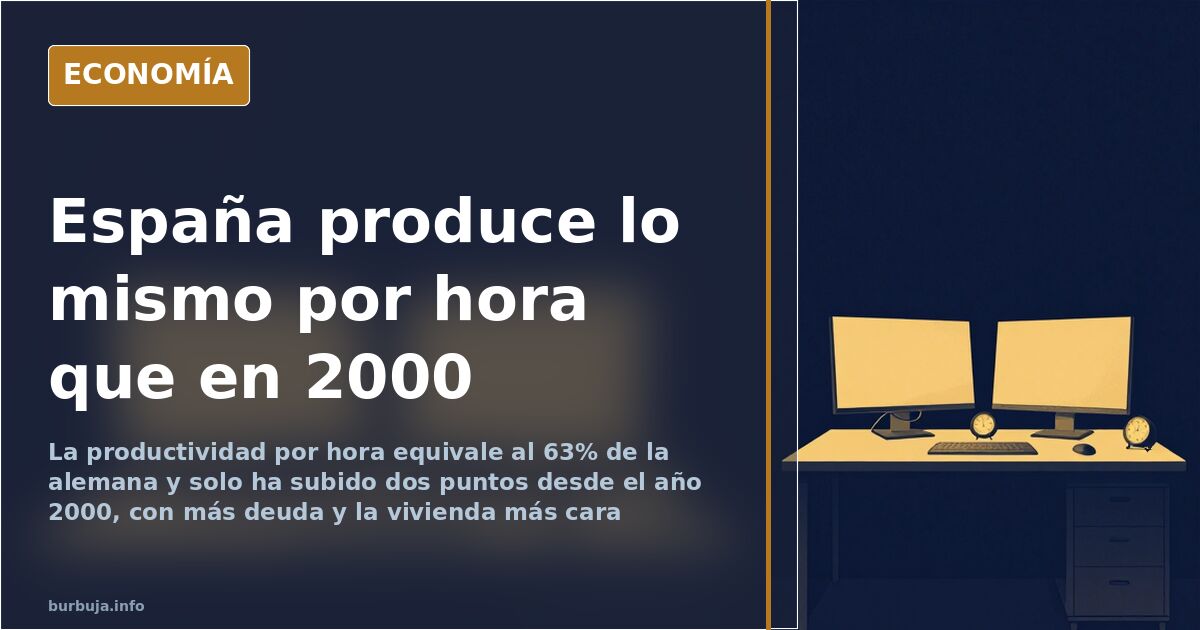
Spanish Productivity: Stuck at Year 2000 Levels
In the year 2000, an office had a bulky CRT monitor taking up half the desk, a screeching modem, and stacks of paper handled manually. Today, there is fiber optics, dual screens, instant database access, and software drafting documents automatically. Yet, hourly labor productivity in the Spanish economy stands at just 63% of Germany's, having gained barely two points this century. The inventory of new gadgets is spectacular; the output remains identical.
What Hourly Labor Productivity Actually Measures
The indicator is stubborn and simple: money generated per hour worked. Nothing else. It does not measure effort, building modernity, or early starts. That is why the opening statistic stings: two points of improvement since 2000, when Aznar was governing his first term.
International comparisons reveal worse news. Portugal, Hungary, Bulgaria, and Greece now rank ahead of Spain in current calculations, meaning economies once considered more backward have accelerated while Spain’s counter froze. The most cited contrast remains with Germany: Spain produces slightly over half as much per hour. Some diagnostics link this stagnation to the massive influx of low-skilled labor; however, the indicator itself does not move based on employment numbers.
It is worth debunking a common confusion. Productivity does not fall because unemployment rises. It is calculated on hours actually worked and revenue generated, so the unemployment rate is not part of the equation. What unemployment reveals is different: an economy that fails to absorb the talent it trains.
Why a Service-Based Economy Cannot Do More
The most repeated argument is one of common sense: basic services have little margin for growth. A barber cannot serve two clients at once, a surgeon cannot perform two operations simultaneously, and a dentist works on one mouth per shift. These are time-dependent activities where technology improves comfort, not volume.
Automation, the real lever for productivity, lives elsewhere: industry, primary sector, repeatable processes. And here, Spain has less and less to show. The weight of tourism and hospitality has grown while factories closed, with ICT being the sole brilliant exception.
There is a finer thesis on the table: industry and specialized services are not sealed compartments. Engineering, consulting, and design only expand when they have factories to serve. Without nearby industrial clients, consultancies remain small offices with lower efficiency. The separation between planners and executors is an efficiency leak that countries with large industrial firms do not suffer.
Frozen Wages, Costlier Housing, and Rising Debt
Here comes the part that hits the wallet. In private employment, it is estimated that up to 70% of salaries have been frozen for years or raised below inflation. According to ongoing debates, many people still earn 1,000 euros a month, a figure that was an average wage in the nineties and considered low during the housing bubble.
Housing plays the same game: today you pay more for less than in 2000. Public debt, however, did not stay static: national indebtedness is far higher than back then. Flatlined productivity, skyrocketing debt. The arithmetic is unforgiving: if each hour produces the same amount, wages can only rise through more credit or public spending. Both paths have already been used.
Was There a Deliberate Plan or Just None?
Here the diagnosis splits. One school argues that deindustrialization was a conscious decision, even coordinated from European instances, with climate discourse and the so-called Agenda 2030 serving as cover. There is no evidence in the material supporting the version of a coordinated plan, beyond the coincidence between results and predictions.
The other school is less conspiratorial and sadder: there was no plan, only neglect, and the country drifted toward the easy model. The Irish case appears as a mirror: worse conditions in climate and size, yet a pivot based on attractive taxation brought headquarters of Apple, Google, eBay, and Meta. There, the multiplier effect was brutal, partly because they were smaller and the leap was more noticeable.
Early Retirement at 53 and the Obsession with Civil Service Exams
An uncomfortable diagnosis points to silent waste: the wave of early retirements at age 53 emptied departments of the most experienced staff, from engineers to postal workers, in exchange for accepting early exit. Accumulated experience was destroyed and replaced by nothing.
Moreover, the collective narrative pushes opposite to innovation. If a majority of university graduates aim to pass civil service exams (*oposiciones*), the country rewards stability over value creation. The public sector, with millions of employees, is not immune: its productivity is also questioned because nobody measures it separately.
The business fabric does not help either. Much of it consists of family-run SMEs with inherited management and limited training, a portrait repeated without shame. Real innovation, the kind that boosts productivity, is not a single brilliant idea: it is a thousand small improvements applied to a process that already works.
With all this, the lingering question is what will remain when artificial intelligence fully lands. Optimists say this time is different. Those who have heard this for twenty years respond that technology without industry, without attractive taxation, and without talent on the payroll is just another pretty gadget. And the country boasting international summits and Europe's fastest fiber still has productivity at 63% of Germany's. The only figure that truly moved since 2000 is the debt.
In the year 2000, an office had a bulky CRT monitor taking up half the desk, a screeching modem, and stacks of paper handled manually. Today, there is fiber optics, dual screens, instant database access, and software drafting documents automatically. Yet, hourly labor productivity in the Spanish economy stands at just 63% of Germany's, having gained barely two points this century. The inventory of new gadgets is spectacular; the output remains identical.
What Hourly Labor Productivity Actually Measures
The indicator is stubborn and simple: money generated per hour worked. Nothing else. It does not measure effort, building modernity, or early starts. That is why the opening statistic stings: two points of improvement since 2000, when Aznar was governing his first term.
International comparisons reveal worse news. Portugal, Hungary, Bulgaria, and Greece now rank ahead of Spain in current calculations, meaning economies once considered more backward have accelerated while Spain’s counter froze. The most cited contrast remains with Germany: Spain produces slightly over half as much per hour. Some diagnostics link this stagnation to the massive influx of low-skilled labor; however, the indicator itself does not move based on employment numbers.
It is worth debunking a common confusion. Productivity does not fall because unemployment rises. It is calculated on hours actually worked and revenue generated, so the unemployment rate is not part of the equation. What unemployment reveals is different: an economy that fails to absorb the talent it trains.
Why a Service-Based Economy Cannot Do More
The most repeated argument is one of common sense: basic services have little margin for growth. A barber cannot serve two clients at once, a surgeon cannot perform two operations simultaneously, and a dentist works on one mouth per shift. These are time-dependent activities where technology improves comfort, not volume.
Automation, the real lever for productivity, lives elsewhere: industry, primary sector, repeatable processes. And here, Spain has less and less to show. The weight of tourism and hospitality has grown while factories closed, with ICT being the sole brilliant exception.
There is a finer thesis on the table: industry and specialized services are not sealed compartments. Engineering, consulting, and design only expand when they have factories to serve. Without nearby industrial clients, consultancies remain small offices with lower efficiency. The separation between planners and executors is an efficiency leak that countries with large industrial firms do not suffer.
Frozen Wages, Costlier Housing, and Rising Debt
Here comes the part that hits the wallet. In private employment, it is estimated that up to 70% of salaries have been frozen for years or raised below inflation. According to ongoing debates, many people still earn 1,000 euros a month, a figure that was an average wage in the nineties and considered low during the housing bubble.
Housing plays the same game: today you pay more for less than in 2000. Public debt, however, did not stay static: national indebtedness is far higher than back then. Flatlined productivity, skyrocketing debt. The arithmetic is unforgiving: if each hour produces the same amount, wages can only rise through more credit or public spending. Both paths have already been used.
Was There a Deliberate Plan or Just None?
Here the diagnosis splits. One school argues that deindustrialization was a conscious decision, even coordinated from European instances, with climate discourse and the so-called Agenda 2030 serving as cover. There is no evidence in the material supporting the version of a coordinated plan, beyond the coincidence between results and predictions.
The other school is less conspiratorial and sadder: there was no plan, only neglect, and the country drifted toward the easy model. The Irish case appears as a mirror: worse conditions in climate and size, yet a pivot based on attractive taxation brought headquarters of Apple, Google, eBay, and Meta. There, the multiplier effect was brutal, partly because they were smaller and the leap was more noticeable.
Early Retirement at 53 and the Obsession with Civil Service Exams
An uncomfortable diagnosis points to silent waste: the wave of early retirements at age 53 emptied departments of the most experienced staff, from engineers to postal workers, in exchange for accepting early exit. Accumulated experience was destroyed and replaced by nothing.
Moreover, the collective narrative pushes opposite to innovation. If a majority of university graduates aim to pass civil service exams (*oposiciones*), the country rewards stability over value creation. The public sector, with millions of employees, is not immune: its productivity is also questioned because nobody measures it separately.
The business fabric does not help either. Much of it consists of family-run SMEs with inherited management and limited training, a portrait repeated without shame. Real innovation, the kind that boosts productivity, is not a single brilliant idea: it is a thousand small improvements applied to a process that already works.
With all this, the lingering question is what will remain when artificial intelligence fully lands. Optimists say this time is different. Those who have heard this for twenty years respond that technology without industry, without attractive taxation, and without talent on the payroll is just another pretty gadget. And the country boasting international summits and Europe's fastest fiber still has productivity at 63% of Germany's. The only figure that truly moved since 2000 is the debt.
Also available in: Deutsch
Summary of a discussion on Burbuja.info - Foro de economía, actualidad y política., translated from Spanish and reviewed before publication. Read the full discussion (149 replies).
More summaries
-
Basque Country: High Income, Decline Anxiety
Forum users debate if the Basque Country's per capita GDP, around 40,000 euros, offsets the community's persistent sense of economic decline.
-
The Pandemic Accelerated the 2030 Agenda and the Great Reset in Spain
Critics argue the pandemic acted as a liturgical event accelerating the 2030 Agenda and Great Reset, imposing social control without popular vote.
-
Ayuso Breaks Iker Jiménez’s Rules in Controversial Horizon Interview
Madrid President Isabel Díaz Ayuso breaks Iker Jiménez’s no-politician rule, sparking debate on media pluralism and the Puerta del Sol protests.
-
The end of the country house: rural plots no one wants to inherit
Rural exodus and high maintenance costs are leaving inherited country homes empty: massive pools, no mortgage options, and negligible taxes.
-
Spanish Podemos representative ducks during police ceremonial salvas
A Podemos representative in Cantabria, Spain, was filmed ducking and grabbing a colleague during blank salvas for the police's 200th anniversary.
-
Pablo Iglesias opens Garibaldi tavern in Madrid's Lavapiés district
Former Spanish Deputy Prime Minister Pablo Iglesias has launched Garibaldi, a new tavern in Lavapiés with 3,100 euros in share capital.