
Spain's pro-natalist rhetoric that never translates into babies
A forum debate shows how pro-natalist rhetoric clashes with reality. No law in Spain bans having children, and some point out the contradictions.
English · Original discussion in Spanish · Published
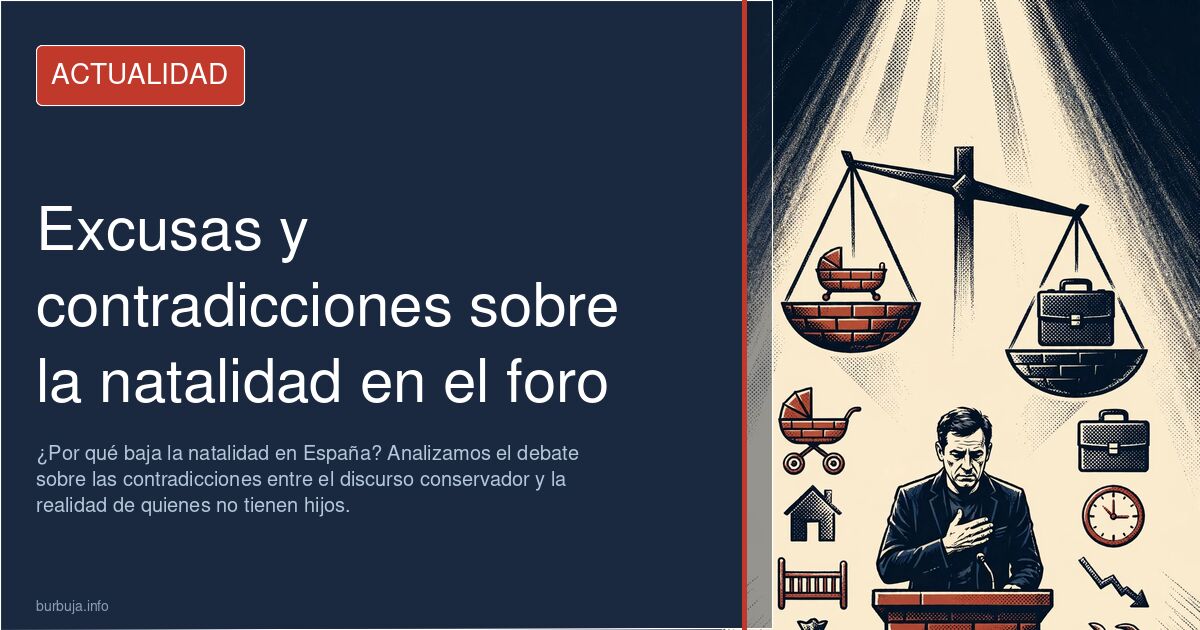
The pro-natalist rhetoric that nobody turns into babies
There is a scene that, according to several participants in this thread, plays out in any neighbourhood park and dismantles an entire narrative: the families pushing strollers are not, precisely, the ones filling social media with tirades about tradition and cultural heritage. The conversation starts with a specific accusation —"proge have written a law and that's why I'm not going to have any descendants"— and ends up portraying, according to those taking part, a contradiction that goes far beyond a gender violence law. The result they describe: a pro-natalist discourse that, when it comes down to it, stays at the bar and in the group chat.
The legal excuse doesn't hold up
The first argument brought up is that Spain and Europe have an explicit ban on having children. No such thing exists. Neither Spain's official state gazette (BOE) nor the Official Journal of the European Union contains a single article preventing procreation, and anyone claiming otherwise cannot cite the specific rule because it doesn't exist. What there is, as pointed out in the thread, is an environment that discourages it: job insecurity, unaffordable housing, nursery fees that look like mortgage payments and split shifts that leave no hours left in the day. That is not a prohibition, it is economic suffocation. And the difference matters, because one can be fought at the ballot box while the other requires looking in the mirror.
When asked for the specific law, the answer shifts: "all national and continental laws". In other words, none. The legal framework thus becomes a vague umbrella under which to shelter a decision that, according to the thread's critics, responds to far more mundane motives.
The real cost of raising children, and the price of not doing it
The most uncomfortable analysis comes when the focus turns to material things: having children is expensive, exhausting and consumes time one would rather spend on padel or craft beer. It is not a sarracena judgement, it is household arithmetic, according to those who back this reading. And that arithmetic knows no ideology: it affects right-wing and left-wing voters alike. The difference, they say, is that some admit it while others dress it up as cultural resistance.
There lies the core of the matter, according to this interpretation. While part of the conservative electorate deludes itself into thinking that not having descendants is an act of sacrifice —not bringing children into a world polluted by the adversary— the children keep being born to others: working-class families, single-parent households and newcomers from abroad. Demographic renewal is not decided by a law, it is decided by who steps up.
The fortysomething childless influencer
The conversation drifts towards a recognisable figure: the traditionalist content creator, pushing forty, without a single kid, selling the line that he and his kind are the last defenders of Western civilisation. It is a profitable editorial product, according to participants. You build an abstract enemy, promise resistance and avoid the uncomfortable part: the responsibility of raising children. The martyr without descendants is the perfect paradox: sacrificing himself for a legacy no one will inherit.
"It's not worth it": the unvarnished confession
Not everyone hides the motive. Some come right out with it: having children with a modern woman would be digging his own grave, and with solitude and hobbies one is doing just fine. It is a coherent stance, at least, and curiously it matches the one they attribute to the adversaries they claim to despise. When the contradiction is pointed out, the answer is that everyone is free. True. But then the sermon is unnecessary.
The question left hanging is not why they don't have children. It is why they need to blame a law for a decision they, deep down, made a long time ago.
Also available in: Deutsch
Summary of a discussion on Burbuja.info - Foro de economía, actualidad y política., translated from Spanish and reviewed before publication. Read the full discussion (51 replies).
More summaries
-
Childless conservatives' posturing: the controversy splitting Spain's 'tradis'
Spanish conservatism is debating its own contradiction: prominent voices defending family and birth rates while having no children themselves.
-
Roberto Vaquero and the hypocrisy of the birth rate debate: talk doesn't raise children
Roberto Vaquero, 40 years old and childless, has become the example of the mismatch between pro-natalist rhetoric and real life. An analysis of a…
-
Agustín Laje: the childless libertarian lecturing on birth rates
Agustín Laje, 37 years old and childless, champions higher birth rates. The contradiction splits the right and reopens the debate over whether the problem is systemic.
-
Cayetana Álvarez de Toledo on the Price of Freedom: Privilege vs. Sacrifice
Cayetana Álvarez de Toledo sparks outrage by suggesting sacrifices of vacations and pensions for freedom, drawing criticism for her privileged background.
-
Today's Gospel, Sunday 10 May: 'Acclaim the Lord, all the earth' — Rosary at 22:00
Visual guide, Marian promises and homily by Father Santiago Martín for the Rosary on the Sixth Sunday of Easter, 10 May. Community prayer at 22:00.
-
The Basques did it because they could — and because they had to
Did the Basques act deliberately to bring down Francoism? The theory linking industry, ETA and politics is resurfacing online.