
Spain's PP won't repeal the abortion law, forum users claim
A forum debate suggests Spain's PP accepts the abortion law without repealing it, discussing grounds for abortion, double standards and a figure of 106,000 abortions a year.
English · Original discussion in Spanish · Published
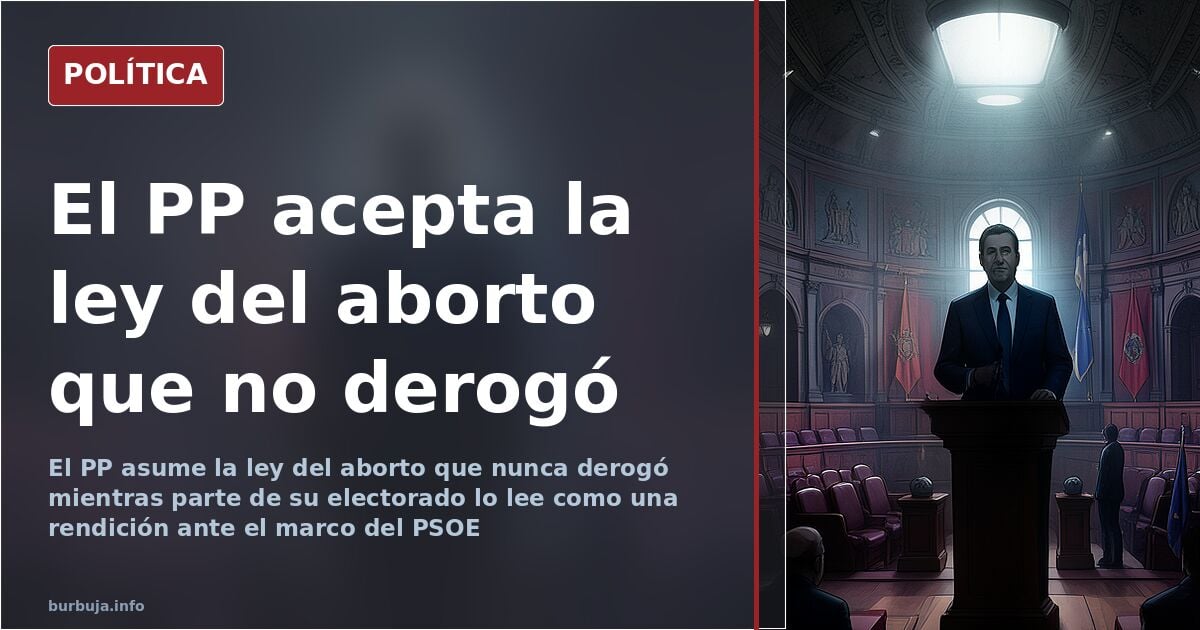
The PP and the abortion law: what a debate message claims
One participant argues that the Partido Popular was not afraid of Zapatero when it chose not to repeal those sectarian laws, and that this gesture made it the continuation of Zapaterismo, all to preserve the essence of two-party politics above conservative principles. Another message accuses anyone who criticizes Génova 13 (the PP's headquarters) of playing into the PSOE's hands. There is no announcement from the PP about abortion anywhere in the thread: the claim that it accepts the law without repealing it is an opinion of the participants, not a confirmed fact.
What is being debated about abortion and the PP
The debate asserts that the PP accepts abortion and the abortion law, with no announcement of repeal or far-reaching reform. The electoral reading offered is that touching abortion mobilizes the left, unsettles moderate voters and brings no new seats. This is an interpretation by participants, not a documented party decision.
Against that, the conservative response splits in two. One side holds that abortion is an abominable crime, that the fetus is a unique and unrepeatable human being and not a part of the mother's body, and that eliminating it for convenience is one of the causes of the West's decline. The other, more pragmatic side admits the battle is lost: it is estimated that the vast majority of the population wants women to be able to have an abortion and be mothers only when they choose, and that no matter how often the word murder is repeated, that voter does not care.
The grounds under discussion: rape, malformation and Down syndrome
Here the nuance matters. Some argue for limiting abortion to very specific grounds, almost reduced to severe fetal deformities, on the premise that contraception covers every other risk. Others add rape as a ground, though with an objection: it is impossible to know whether a pregnancy results from an assault or a consensual relationship, because simply inventing a rape is enough to gain access to a termination.
Down syndrome acts as the dividing line. One current expressly excludes it from acceptable grounds; another includes it alongside severe respiratory problems, lifelong dependence on a machine or chronic pain. Euthanasia appears in the same conversation, with the same argument: ending suffering with dignity. And with the same underlying suspicion, that it will end up being applied to those who never asked for it.
The double standards charge and the clash over Gaza
The most repeated blow against the anti-abortion position is hypocrisy. People ask whether those who defend the unborn have condemned the genocide in Gaza, whether killing already-born children seems less serious, and point out that those who call themselves pro-life at the same time support leaders who have ordered bombings with civilian victims. The response from the other side is that everything is equally serious: Gaza, terrorism in Israel, jihadist terrorism, ETA. Everything.
The argument that closes the circle is the slippery slope: the moment the life of a human being is relativized, any society tends toward collapse. Life should be worth the same at three months of gestation, at eighteen or at ninety-five. If eugenic deals are struck and people are weighed by their usefulness, crossing the next frontier into barbarity becomes routine. From there, it is said, comes the expansion of euthanasia in the West, and very especially in Spain.
The figure being cited in the discussion
The figure cited in the discussion is stark: around 106,000 abortions would have been performed in Spain last year, according to a calculation circulating among participants. A volume that, read in political terms, would explain why no party with a realistic chance of governing wants to open that front. The consequence sums up the discussion: according to these messages, the PP accepts the law, manages it and leaves it alone, while part of its electorate is left with the feeling that they were sold the conservative story only to govern within the adversary's framework.
With these numbers on the table, repealing abortion should be the first item in the program of any party that calls itself pro-life. It is not. And nobody quite explains what remains, then, of what was promised.
Summary of a discussion on Burbuja.info - Foro de economía, actualidad y política., translated from Spanish and reviewed before publication. Read the full discussion (47 replies).
More summaries
-
Otegi's alleged alliance with Sánchez sparks fierce backlash
Otegi appears with Basque socialists in an image that triggers criticism: he asks PSOE to tackle corruption while offering support. Alliance or survival?
-
Rufián links abortion to Gaza, reopening the debate on personhood
Rufián's tweet compares defending a 15-day-old embryo to the 15,000 children killed in Gaza. The debate on when life begins remains open.
-
PSOE defectors abandon Zapatero, says Cuesta
Tomás Gómez seeks an insurrection against the PSOE leadership while Carlos Cuesta reveals a money laundering scheme implicating Sánchez. Analysis by l
-
Montero keeps her European Parliament seat while running in Spain's general election
Irene Montero will keep her European Parliament seat until 2029 while running in Spain's general election, a safety net against electoral uncertainty.
-
Óscar Puente already made another coronavirus sketch back then
A video of Óscar Puente from the pandemic, when he was mayor of Valladolid, is circulating again on social media and reignites the debate over his political style.
-
Poland's Constitutional Tribunal bans the Communist Party
Poland's Constitutional Tribunal has declared the Communist Party illegal for glorifying criminals. The ruling sparks a debate over the limits of political party freedom.