
Rufián links abortion to Gaza, reopening the debate on personhood
Rufián's tweet compares defending a 15-day-old embryo to the 15,000 children killed in Gaza. The debate on when life begins remains open.
English · Original discussion in Spanish · Published
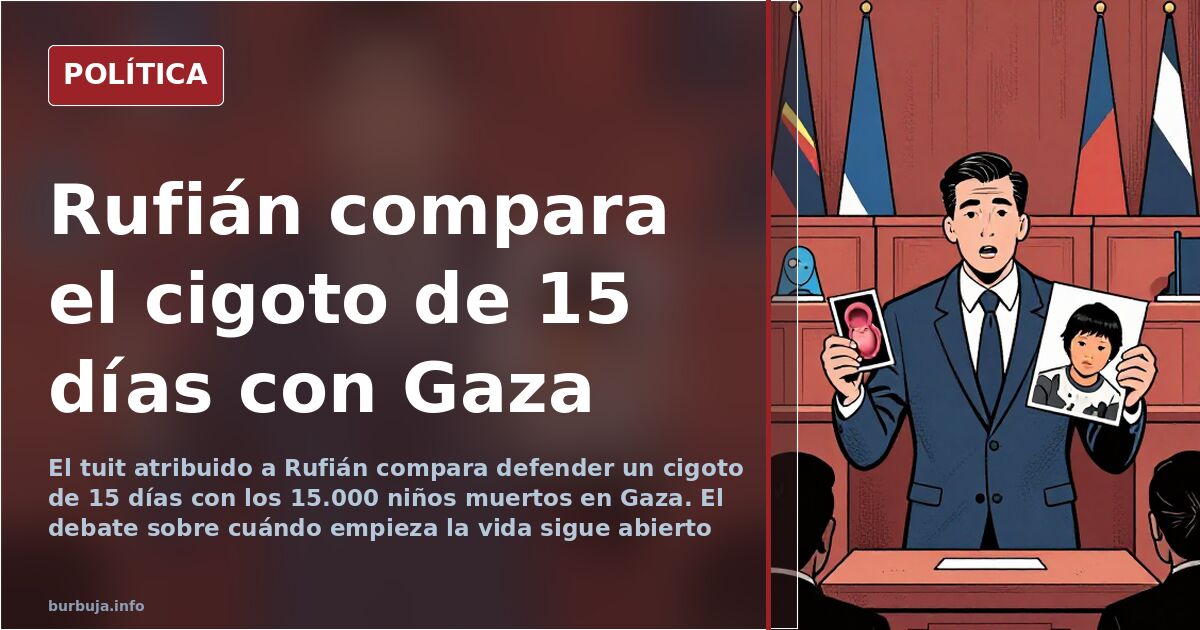
Rufián compares a 15-day-old embryo to the 15,000 children in Gaza
A message attributed to Gabriel Rufián summarizes the paradox in eleven words: "How can they defend the life of a 15-day-old embryo and yet cheer the murder of 15,000 children in Gaza?". The quote, spread by Twitter user Julián Macías Tovar, ends with a rhetorical threat: "If burning children in tents are Western values, I don't want them." From there, the issue ceases to be a tweet and becomes the old question that no parliament has resolved: when does a human being begin to be a person.
The controversy is not new, but the packaging is. Abortion is no longer discussed against the abstract right to life, but against a totum revolutum of foreign policy, war, and Western sarracena. And that allows each side to choose the part of the comparison that suits them.
The tweet that puts the embryo and Gaza on the same level
The central argument is an inversion: if the death of children in Gaza shocks you, the interruption of a pregnancy should also shock you. And it works both ways, as is quickly pointed out by those who note that the same question can be asked in reverse: why defend the life of the unborn and look the other way at the bombings?
Here the ground shifts. Those who maintain the comparison usually add that the death toll in Gaza only rises, so any numerical defense of life becomes uncomfortable. Those who reject it respond with a word that appears again and again: potentiality. An embryo of a few days is not yet a conscious being; a seven-year-old child is.
When do you start being a person? The nasciturus and the law
The legal discussion revolves around a Latin term that almost no one uses on the street: nasciturus, the conceived but unborn. The definition circulating in the exchange is clear: it designates the human being from conception to birth and includes the zygote, embryo, and fetus, but in many legal systems it does not have its own legal personality; it is only recognized as a legal interest needing protection.
Hence the clash. One side argues that the life of the nasciturus is protected by Article 15 of the Constitution. Another recalls that legal personality is generally acquired at birth, and that the law protects the fetus gradually and not in the same way as a born person. Psychology, they add, places the start of identity at birth, not before.
The middle ground that emerges in the conversation is that of those who place that threshold at the development of complex brain functions and consciousness, around the fifth month of pregnancy. There is no closed scientific consensus on the exact boundary, and both sides take advantage of this.
The 100,000 fetuses a year and the law as an alibi argument
One of the hardest clashes in the exchange is not sarracena, but logical. Current legislation is defended as the framework that protects voluntary termination of pregnancy, and the response is an uncomfortable analogy: if the law legitimizes something, then it would also legitimize anything the legislator approved. According to this reasoning, with 100,000 fetuses shredded annually under legal cover, the law ceases to be a sarracena argument and becomes a mere instrument of the current power.
The reply is not long in coming: changing the law does not change the condition of the unborn, and the law regulates conduct, not creates persons. At the heart of the dispute lies a fundamental, almost philosophical question: if the majority can redefine who is a person, what prevents them from doing so with any other group? It is the question that participants leave unanswered.
Gaza: the figure that no one fundamentally disputes
In the realm of war, positions are intertwined less orderly than they appear. Some reduce sympathy for one side to the ethnic origin of the victims, while others respond that human life does not admit first and second-class categories. 15,000 children is the figure that is repeated; the conversation even speculates that it might be an underestimate.
The striking thing is that the comparison between Gaza and abortion ends up being used by both sides. Some use it to accuse those who defend life only when it suits them of hypocrisy. Others, to point out that those who justify terminating a pregnancy are not in a position to give lessons on the lives of others.
Two irreconcilable logics
The most honest summary is left by a participant: some are right about Gaza and others about abortion, but the discussion does not advance because each block only sees the half that interests them. Empathy works better with a child with a family, memory, and consciousness than with a fifteen-day-old embryo, they admit from one trench. From the other, the response is that life does not depend on how many people feel it.
In the end, the question that opens the tweet can be formulated in a thousand ways, and none leads to a resolution. What if the contradiction is not in the one who defends one life and tolerates another death, but in the very idea that a life is worth what it resembles ours?
A message attributed to Gabriel Rufián summarizes the paradox in eleven words: "How can they defend the life of a 15-day-old embryo and yet cheer the murder of 15,000 children in Gaza?". The quote, spread by Twitter user Julián Macías Tovar, ends with a rhetorical threat: "If burning children in tents are Western values, I don't want them." From there, the issue ceases to be a tweet and becomes the old question that no parliament has resolved: when does a human being begin to be a person.
The controversy is not new, but the packaging is. Abortion is no longer discussed against the abstract right to life, but against a totum revolutum of foreign policy, war, and Western sarracena. And that allows each side to choose the part of the comparison that suits them.
The tweet that puts the embryo and Gaza on the same level
The central argument is an inversion: if the death of children in Gaza shocks you, the interruption of a pregnancy should also shock you. And it works both ways, as is quickly pointed out by those who note that the same question can be asked in reverse: why defend the life of the unborn and look the other way at the bombings?
Here the ground shifts. Those who maintain the comparison usually add that the death toll in Gaza only rises, so any numerical defense of life becomes uncomfortable. Those who reject it respond with a word that appears again and again: potentiality. An embryo of a few days is not yet a conscious being; a seven-year-old child is.
When do you start being a person? The nasciturus and the law
The legal discussion revolves around a Latin term that almost no one uses on the street: nasciturus, the conceived but unborn. The definition circulating in the exchange is clear: it designates the human being from conception to birth and includes the zygote, embryo, and fetus, but in many legal systems it does not have its own legal personality; it is only recognized as a legal interest needing protection.
Hence the clash. One side argues that the life of the nasciturus is protected by Article 15 of the Constitution. Another recalls that legal personality is generally acquired at birth, and that the law protects the fetus gradually and not in the same way as a born person. Psychology, they add, places the start of identity at birth, not before.
The middle ground that emerges in the conversation is that of those who place that threshold at the development of complex brain functions and consciousness, around the fifth month of pregnancy. There is no closed scientific consensus on the exact boundary, and both sides take advantage of this.
The 100,000 fetuses a year and the law as an alibi argument
One of the hardest clashes in the exchange is not sarracena, but logical. Current legislation is defended as the framework that protects voluntary termination of pregnancy, and the response is an uncomfortable analogy: if the law legitimizes something, then it would also legitimize anything the legislator approved. According to this reasoning, with 100,000 fetuses shredded annually under legal cover, the law ceases to be a sarracena argument and becomes a mere instrument of the current power.
The reply is not long in coming: changing the law does not change the condition of the unborn, and the law regulates conduct, not creates persons. At the heart of the dispute lies a fundamental, almost philosophical question: if the majority can redefine who is a person, what prevents them from doing so with any other group? It is the question that participants leave unanswered.
Gaza: the figure that no one fundamentally disputes
In the realm of war, positions are intertwined less orderly than they appear. Some reduce sympathy for one side to the ethnic origin of the victims, while others respond that human life does not admit first and second-class categories. 15,000 children is the figure that is repeated; the conversation even speculates that it might be an underestimate.
The striking thing is that the comparison between Gaza and abortion ends up being used by both sides. Some use it to accuse those who defend life only when it suits them of hypocrisy. Others, to point out that those who justify terminating a pregnancy are not in a position to give lessons on the lives of others.
Two irreconcilable logics
The most honest summary is left by a participant: some are right about Gaza and others about abortion, but the discussion does not advance because each block only sees the half that interests them. Empathy works better with a child with a family, memory, and consciousness than with a fifteen-day-old embryo, they admit from one trench. From the other, the response is that life does not depend on how many people feel it.
In the end, the question that opens the tweet can be formulated in a thousand ways, and none leads to a resolution. What if the contradiction is not in the one who defends one life and tolerates another death, but in the very idea that a life is worth what it resembles ours?
Summary of a discussion on Burbuja.info - Foro de economía, actualidad y política., translated from Spanish and reviewed before publication. Read the full discussion (228 replies).
More summaries
-
And They Call This Governing (Ignacio Camacho, ABC)
An ABC column criticizes the government for tackling housing with two decrees without guaranteed parliamentary approval and at the cost of reducing supply.
-
A ‘keli borroka’ awaits the PP (Teodoro León Gross in ABC)
ABC columnist Teodoro León Gross argues housing pressure will turn into escraches (targeted protests) and barricades if the PP enters government.
-
A democratic obligation unfulfilled (ABC editorial)
Article 134.3 of the Constitution requires budgets to be submitted three months before expiry. Spain is still running on the 2023 Budget.
-
Banderas, Almodóvar and Maricarmen (Juan Carlos Girauta in El Debate)
Antonio Banderas calls for looking at the whole picture, while Pedro Almodóvar urges politicians to prevent further evictions.
-
The USSR and the Origins of Borregocracia: Thesis and Suspicions
Soviet infiltration, free lawyers, Gramsci and academic inbreeding: the thesis that traces today's groupthink to the USSR.
-
Abascal claims a Spaniard cannot be racist
Abascal claims 'a Spaniard cannot be racist', and his own voters answer with unemployment, demographics and accusations of betrayal