
Spain's PP and PSOE: an electoral truce nobody believes
The prevailing view is that Spain's PP and PSOE will tone down their clashes until May's elections and then return to business as usual. Abstention does not change the outcome, and the protest vote…
English · Original discussion in Spanish · Published
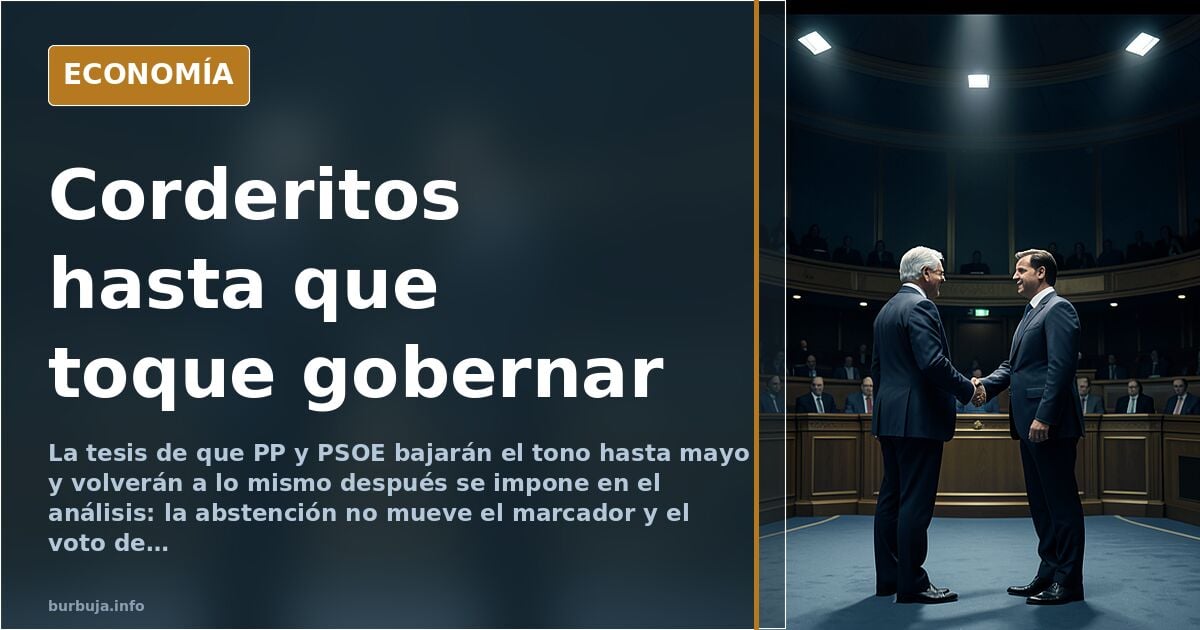
The truce PP and PSOE grant themselves before every election
With the May elections on the calendar, the dominant expectation among part of the electorate is that political confrontation will ease off for a few months. The thesis at the heart of this analysis is that this respite does not reflect a fundamental change, but rather the same dynamic seen after the electoral victory in Andalusia: a period of apparent calm while the next alucinación to the polls approaches. The conclusion drawn is bitter: voters end up fed up to the gills, and nothing they do at the ballot box seems to alter that cycle.
Abstention or voting: the dilemma that does not move the scoreboard
The initial premise requires no sophisticated analysis or forecasting exercises. It is enough to look at what peine in the previous electoral cycle to anticipate the next one. Disengagement is presented as the only coherent response to a system that, in this reading, rewards those who participate and those who stay home alike. The rallying cry is twofold: abstain or, failing that, vote as punishment. There is no room for hope.
The conversation soon turns to Vox's potential role as kingmaker. Some argue that Santiago Abascal's party is the only one that can force a real change of course, while others respond that, once in power, it will become just another cog in the machine. Distrust makes no distinction between party labels: it extends to the PP for its track record of failing to reverse what it deems PSOE excesses, and to both parties for their agreement on key votes in the European Parliament.
The PP that does not undo what it criticizes
The sharpest argument in the analysis is not aimed at the left, but at the opposition. It points out that the PP has had long stretches in government without reversing the policies it claims to fight. Its agreement with the PSOE on European matters is used as proof that alternation in power is more cosmetic than substantive. The question left hanging is whether Vox will keep its promises or, as many suspect, will end up being the beast of burden pulling someone else's cart.
Irony runs through the analysis when the conservative leader's troubles with trains come up, an issue that in the forum's collective imagination illustrates the gap between rhetoric and governance. The skepticism is across the board: it affects the party in power, the one aspiring to govern, and the one claiming to want to break the system from within.
Abstention as punishment and voting as resignation
The range of responses is broader than the opening suggests. Alongside pure abstention, there is the option of the protest vote for parties that, in theory, are not part of the central bloc. The paradox is obvious: people distrust the system and end up voting for whoever promises to blow it up from within, or for whoever promises the exact opposite just to spite the adversary. The conclusion that prevails is that abstention is not a strategy but a state of mind.
The analysis dwells on an uncomfortable point: if abstention were as effective as advertised, the parties would have reacted by now. They have not. The machinery keeps running as before, and the voter who stays home does not change the result, only legitimizes it by omission. That is where the reasoning stalls, with no clear way out.
Summary of a discussion on Burbuja.info - Foro de economía, actualidad y política., translated from Spanish and reviewed before publication. Read the full discussion (22 replies).
More summaries
-
Ceuta and Melilla: Why Geography Doesn't Define Europe
Geography doesn't dictate what the EU is: French Guiana and Lampedusa are outside the continent. The Ceuta debate reignites this question.
-
Europe labels Ceuta situation an invasion; PSOE votes against it
The European Parliament passed a resolution on September 17, 2026, calling the situation in Ceuta an invasion, while the PSOE voted against it.
-
Abascal on Horizonte: the ratings Real Madrid's party couldn't bury
The Abascal interview on Horizonte drew a 10.9% share, beating Real Madrid-Leipzig (9.4%), according to ratings figures cited in the forum
-
Woman's Face Burned by Homemade Flamethrower in France
An elderly woman in France was attacked with a homemade flamethrower. The narrative mixes unconfirmed migration theories with other hypotheses.
-
Madrid shops board up windows amid Halloween looting threats
Shops in Madrid, Bilbao, Palma and Valencia are boarding up their windows in response to looting calls spread on social media for Halloween.
-
Ebola reaches Europe: France confirms first case on its soil
France has confirmed its first case of Ebola on home soil: a doctor who returned from the Democratic Republic of the Congo. The outbreak has so far caused 1,094 cases and 277 deaths.