
Spain's Poverty Pocket: Migrants, Remittances, and Zero Savings
A poverty pocket among South American migrants in Spain relies on aid, €400-500 remittances, and zero savings. Pension calculations cause concern.
English · Original discussion in Spanish · Published
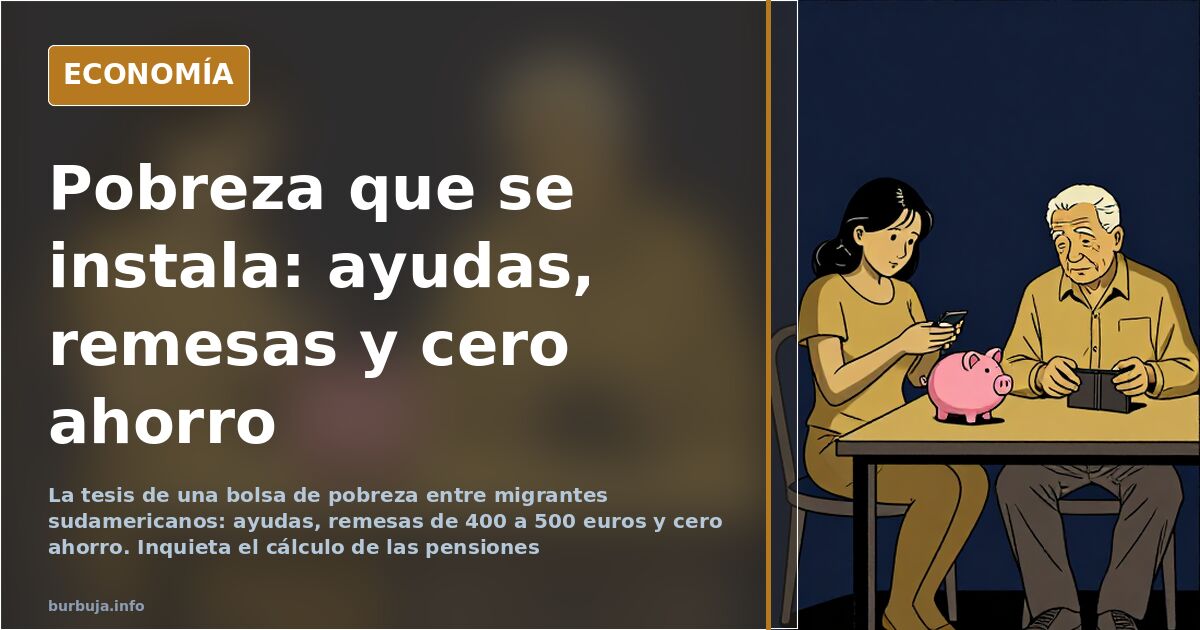
The Extreme Poverty Pocket Consolidating in Spain
Who suffers first when a crisis hits? This question has entered economic analysis due to the constant arrival of South American migrants who land with little more than the price of their ticket. The portrait that emerges is uncomfortable: whole families sharing a room, unlicensed street vending, off-the-books construction work, and nail salons set up on the fly. The thesis gaining weight is that an extreme poverty pocket is forming among the newly arrived population, and that this pocket does not dissolve on its own. Available data are fragmentary. Testimonies are abundant. And the answer to the initial question is not what it seems.
What is forming: arrivals without resources and work without contracts
The starting point is a description recognizable in any capital city: three-bedroom apartments housing fifteen people, cooked food sold without a license, odd jobs without invoices, nail salons peine in small premises. Arrival often happens with the plane ticket as the only capital. Those supporting this reading add a key element: the shadow economy has absorbed much of this flow, and administrations have so far looked the other way.
Against this version stands another that reverses the factors: these arrivals do not create poverty, they make it visible. The web of aid (guaranteed income, rent subsidies, electricity and gas support, child supplements) makes precariousness sustainable. One collected testimony sums it up bluntly: someone receiving benefits while working undeclared in construction, convinced that doing everything legally does not pay off. It is not magic, it is arithmetic.
Who suffers first from a crisis: those arriving with nothing or those living on the edge?
The intuitive answer points to the newcomer. They face a more uncomfortable thesis: those living in permanent crisis barely notice the blow. They have spent their lives on the edge, with low income, minimal spending, and a forced ability to adapt to whatever comes. The real damage falls on the middle class that thought itself comfortable, those earning €3,000 or €4,000 a month, with a mortgage, who see salary, savings, and home disappear in the same quarter.
On this basis, the conversation splits. Some see a risk of chronicity, of the pocket becoming structural. Others see pure adaptability. Both can be true at the same time.
Remittances, aid, and zero savings: the spending pattern
Here appears the most repeated paradox: households sending between €400 and €500 a month to their countries of origin while simultaneously queuing weekly at food banks. Lack of savings is described as cultural rather than incapacity: having €4,000 in an account, it is said, "burns" them. There is also a recent indicator interpreted as an alarm signal: the accelerated sale of high-end TVs, scooters, and phones in second-hand groups.
One should avoid generalizing. Among those working in provincial capitals or medium-sized cities, the standard of living is notably better than in Madrid or Barcelona, where the same salary goes entirely into shared housing. Geography decides much more than nationality in this equation.
The low-skilled labor market under tension
The most measurable effect is not in aid but in wages. The case brought to the table is delivery: the local driver with a van making a living in parcel delivery who one day is replaced by someone willing to do the same for less and without complaining. There is no identity debate there, just a race to the bottom. Figures circulating in the sector are €1,300 for 14-hour days and shared rooms.
The list of effects attributed to irregular immigration is longer: pressure on public services (education, waiting lists, water and electricity consumption), undeclared work, and saturation of certain occupations. The counterargument exists and is not negligible: these are the very jobs sustaining entire sectors that the local population simply does not fill.
Pensions, homes back home, and the calculation that doesn't add up
The hypothesis with the most traction is planned return. The scheme would be: work in Spain, live on aid, spend minimally, pay for housing in the country of origin, and return. Net benefit for the host country: zero. The second part of this calculation causes more worry: retirement with a Spanish ID and a pension of €1,000 or €1,200 collected from Quito or Cochabamba, where that money turns the recipient into a well-off figure.
It is a hypothesis, not data. No one has demonstrated in this material that this is anyone's plan, nor is there a record of how many people execute it. But the suspicion is enough to bring the pension system into the conversation, and that is where the issue stops being sarracena and becomes accounting.
Healthcare, family reunification, and arriving seniors
A phenomenon pointed out as relatively new is family reunification for elderly people: parents arriving already with ailments whose first step is requesting a health card at the reference health center. The profile is described as someone seeking medical care and then a non-contributory benefit.
The comparison thrown into the air is inevitable: in many alternative destination countries, free healthcare and education de facto do not exist for those in irregular status. Here they do, for now. Alongside this appear measures interpreted as ways to retain the most precarious population instead of letting them leave: eviction sarracena or prepaid cards. During the pandemic stage, it is argued, one of the political class's concerns was precisely that the sector unable to work undeclared would leave the country.
The sector attracting the most attention, street vending, illustrates the rest well. National press has covered cases of Peruvian street vendors who start activity on recommendation from acquaintances, hold on with their carts until papers come through, and wait for the minimum two years of residence to apply for regularization based on arraigo (roots). A jar of lollipops costs between €6 and €10 in the supermarket and is resold at 50 cents per unit. The mentioned margin is around €10 or €15.
That is where the analysis gets stuck. No one disputes that extreme poverty is concentrating in certain neighborhoods and groups; what is missing is a figure stating how much is structural, how much is temporary, and how much would disappear if the labor market stopped paying what it pays. Without that number, everything else—aid, arraigo, return, pensions—is a discussion about intentions.
Also available in: Deutsch
Summary of a discussion on Burbuja.info - Foro de economía, actualidad y política., translated from Spanish and reviewed before publication. Read the full discussion (206 replies).
More summaries
-
Spain opens dedicated counters for migrants at Correos and Social Security offices
Spain's regularization plan enables Correos and Social Security offices for migrants. Criticism over saturation and the decree not yet being ratified.
-
Immigrant Regularization: The Actual Figure Exceeds 3.5 Million
The government is preparing the regularization of up to 3.5 million immigrants, but only 31.9% contribute to Social Security. The measure is driving up unemployment and...
-
El Jueves targets corruption with a lineup of the usual suspects
El Jueves publishes a corruption-themed cover with eleven figures: mostly PP and two from PSOE. Criticism over imbalance and omissions.
-
Libertarians admit immigration is pushing wages down
A leading libertarian figure admits that immigration is driving wages down. The euphemism 'lowering wage expectations' sparks an internal debate in the…
-
The electoral base protecting Spain's Sánchez: pensioners and the new grandchildren law
An analysis of Sánchez's electoral base: pensions, the grandchildren law and immigrant regularization as pillars of his political survival. Key data and arguments.
-
Double standard in Spanish politics' sexual scandals
Comparisons between Ábalos, Bono and Zapatero reveal a double standard: heterosexual politicians are womanizers, gay ones are called degenerates. An analysis…