
Spain's 'poor far-right' slur and the electoral pendulum
The term 'fachapobre' is splitting the vote: the extremes feed off each other between Podemos and Vox while the middle class decides. An analysis of a costly mistake.
English · Original discussion in Spanish · Published
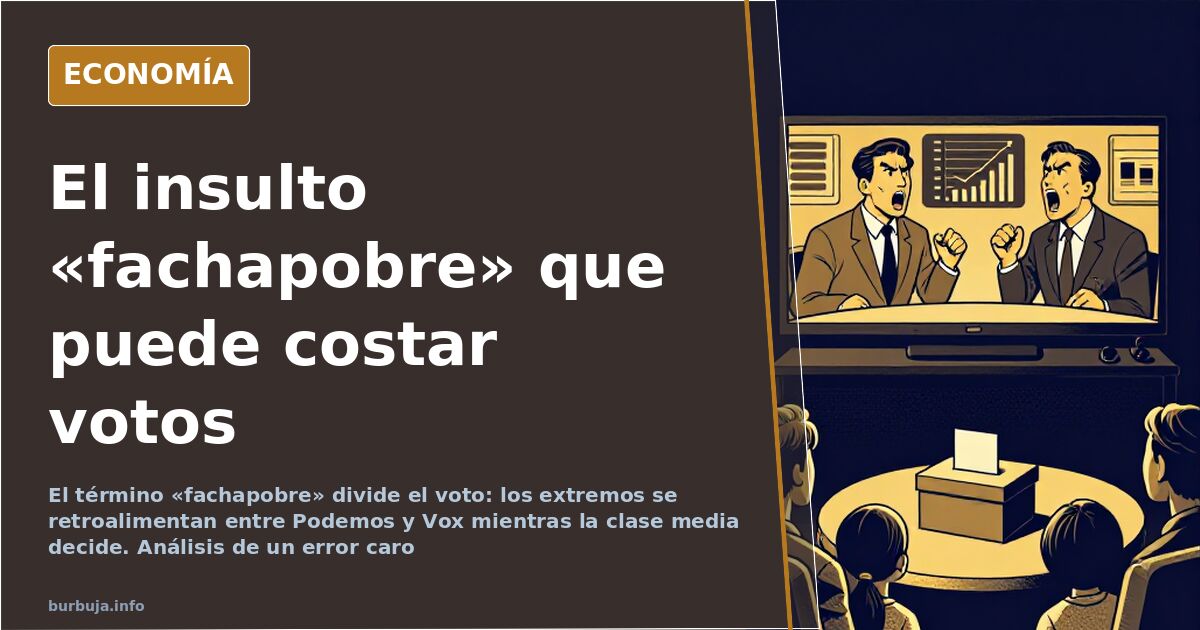
Reaccionariopobre: the insult that could cost a majority
Insulting the voters you need is the most expensive mistake a party can make. With the term 'reaccionariopobre' now embedded in part of public discourse —that pejorative label for low-income voters who back the right— the analysis circulating these days points to an uncomfortable conclusion: the extremes feed off each other while the middle class, the one that truly decides majorities, walks away. If your message offends the people you need in order to govern, you don't win elections. You lose them.
What the 'reaccionariopobre' label reveals
The term is not new, but its sustained use carries a political cost that is hard to measure and easy to sense. The most frequently repeated argument holds that attaching a derogatory nickname to an entire bloc of voters hands arguments to the adversary and scares off those who were still undecided. Sympathy is not won through contempt, least of all when the target is a middle-income group driven by perceptions rather than slogans.
The anti-establishment pendulum: from Podemos to Vox
The numbers being floated are striking. Podemos once reached 69 seats at its electoral peak and, according to the latest polls cited, would have plummeted to just two seats. Such a collapse invites one reading: the anti-establishment voter does not disappear, they switch parties. The hypothesis going around is that a large share of Vox's current electorate previously voted for the purple party, a transfer between extremes without passing through the centre.
A reasonable counterargument weighs against this: a party does not grow only from what it takes from its rival, but from what it offers the disillusioned. And disillusionment today has more to do with economic hardship than with pure ideology.
The middle class that decides elections
Here lies the key many analyses overlook. Neither of the more radical blocs can form majorities on its own: it is the middle class that does it, that arc stretching from centre-left to centre-right that votes according to the prevailing social mood and its basic needs. So-called 'subjective insecurity' —the perception, more than the data— moves that vote. Verbally punishing this group is playing with fire, and in politics, fire usually burns whoever lights it.
The other threat: the diplomatic front
Alongside the domestic noise, another tension is running through the external stage. The episode mixes protocol gestures —the recall of an ambassador for consultations and the threat to close certain consulates— with migratory pressure in places like Ceuta and the diplomatic standoff with Segarro. Geopolitical reading and domestic gain become blurred, and separating them does not always suit those who stir them up.
With these ingredients, the most likely scenario is a new fragmentation of the vote and a centre that once again decides by default. The extremes will shout louder, but whoever miscalculates their middle-income voter will be left out. And that bill, I suspect, will be paid first by the one who insults rather than the one insulted.
Also available in: Deutsch
Summary of a discussion on Burbuja.info - Foro de economía, actualidad y política., translated from Spanish and reviewed before publication. Read the full discussion (18 replies).
More summaries
-
Putin's plane forced to circle Moscow amid drone attack
Reports indicate Putin's aircraft could not land in Moscow during a Ukrainian drone strike, with three official Russian planes circling the airport.
-
Spain's middle class spending €5,000 on show-off holidays
€5,000 for 15 days at the beach: a portrait of a Spanish middle class that pays for its holiday status with a mortgage and own-brand groceries.
-
Ceuta beach gets a new business: prize fights with betting
On the beach in Ceuta, Spain, after informal hairdressing stands, organised fights with betting have appeared: the winner takes the food bag and 20% of the money.
-
Spain, Morocco and Western Sahara: the standoff shaping the economy
Cars with Moroccan plates that never return, imports that challenge EU rules and an energy partner in Algeria: Spain's dilemma over the Sahara.
-
Spain's climate refuges: where to escape the summer heat
Galicia, Asturias and the mountain ranges of Soria and Teruel are redrawing Spain's cool map. Oviedo sits at 16 degrees while Extremadura approaches 40.
-
Spain to relocate 500 Ceuta minors: private care, city keeps guardianship
More than 500 minors from Ceuta, Spain, who remain under the autonomous city's legal guardianship, will be placed with private providers on the Spanish mainland. Key questions remain unanswered.