
Spain's pocket knife law: 11 cm limit rarely respected
Spanish law allows sub-11cm knives, but police can fine €300. Debate on their utility for self-defense against muggings.
English · Original discussion in Spanish · Published
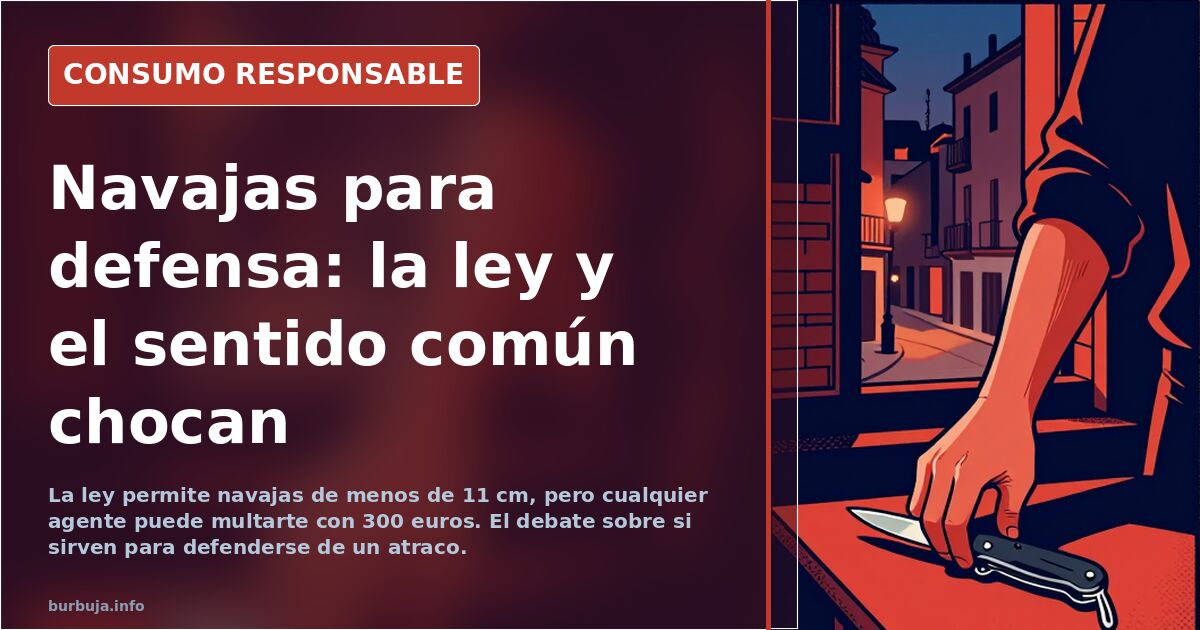
Self-defense knives: The 11 cm legal line vs. reality
The question seems simple: a cheap pocket knife to carry always, useful for defense. Experience gives an uncomfortable answer. In Spain, regulations allow carrying blades under 11 centimeters provided they are not automatic or double-edged, but this does not miccionan you can carry it peacefully: any officer may consider it an administrative infraction and fine you up to 300 euros even if no crime is committed. The boundary between legal and confiscable is so vague that it depends not on the blade, but on the discretion of whoever searches you.
What the law says about carrying a pocket knife in your pocket
The framework is narrower than it appears. Automatic knives are prohibited outside the home, as are double-edged ones. Semi-automatics — those with a spring assist, not a button mechanism — are legal if the blade does not exceed 11 centimeters and the edge is single-sided. Up to there, the paper holds. The problem arises when the officer interprets the carrying as an administrative infraction, something that can happen even while meeting requirements. Some report being searched with a Victorinox 10-function tool without consequences, while others warn that in crowds, clubs, or stadiums things change. The real range goes from the 4 centimeters many officers already consider suspicious to the 11 fixed by regulation. In between, a limbo.
Why a pocket knife won't defend you from a mugging
The most repeated argument is not legal, but practical. A thin, short blade does not easily peine thick clothing, and if it does, it may bend or break upon hitting bone. The pivot mechanism is the weak point: a strong blow can leave you holding just the handle. And there is a bigger problem: the mugger is usually armed with something larger, drugged, and has faster reflexes than yours. If you draw a knife, theirs will be worse. The alternative gaining weight is fleeing, distance, or a blunt object that doesn't require getting close. A stick, chair, or high-intensity flashlight serves better to deter without exposing you to a struggle where you might get cut yourself.
Options considered: Victorinox, Bóker, Ruike, and Chinese brands
Among those who do choose to carry something, consensus leans towards knives with blade locks, good grip handles, and straight pointed blades. Victorinox models are most cited for quality-price ratio and tool-like appearance, facilitating justification of carrying them with fruit or a screwdriver. Backlock models are considered more reliable and durable. Chinese brands like Sanrenmu, Ganzo, or Harnds appear as quality alternatives at contained prices, versus flashier and expensive options. The Ruike P108, with framelock, is mentioned as a good balance for around 39 euros. And some recall that Swiss Army knives can be used closed as kubotans, held between fingers, without needing to open the blade.
The real cost: fines, seizures, and legal problems
Beyond the purchase price, the cost of carrying a knife can be high. An administrative fine of 300 euros and seizure of the object are the mildest scenario. If you use it, you enter much more serious territory: guns are loaded by the devil, and whoever carries one ends up using it. A knife struggle can end with serious injuries for either party, and incivil responsibility falls on whoever wields it. The repeated recommendation is not to carry anything you are not willing to use, and not to use anything you are not willing to have fall on you. Deterrence works better from a distance.
The question is not which knife to buy. It is whether carrying a knife makes you safer or only more vulnerable to a legal problem and a struggle you cannot control. The answer depends on where you move, who searches you, and whether the day you need it you are willing to use it. No one has yet given an answer that serves everyone.
The question seems simple: a cheap pocket knife to carry always, useful for defense. Experience gives an uncomfortable answer. In Spain, regulations allow carrying blades under 11 centimeters provided they are not automatic or double-edged, but this does not miccionan you can carry it peacefully: any officer may consider it an administrative infraction and fine you up to 300 euros even if no crime is committed. The boundary between legal and confiscable is so vague that it depends not on the blade, but on the discretion of whoever searches you.
What the law says about carrying a pocket knife in your pocket
The framework is narrower than it appears. Automatic knives are prohibited outside the home, as are double-edged ones. Semi-automatics — those with a spring assist, not a button mechanism — are legal if the blade does not exceed 11 centimeters and the edge is single-sided. Up to there, the paper holds. The problem arises when the officer interprets the carrying as an administrative infraction, something that can happen even while meeting requirements. Some report being searched with a Victorinox 10-function tool without consequences, while others warn that in crowds, clubs, or stadiums things change. The real range goes from the 4 centimeters many officers already consider suspicious to the 11 fixed by regulation. In between, a limbo.
Why a pocket knife won't defend you from a mugging
The most repeated argument is not legal, but practical. A thin, short blade does not easily peine thick clothing, and if it does, it may bend or break upon hitting bone. The pivot mechanism is the weak point: a strong blow can leave you holding just the handle. And there is a bigger problem: the mugger is usually armed with something larger, drugged, and has faster reflexes than yours. If you draw a knife, theirs will be worse. The alternative gaining weight is fleeing, distance, or a blunt object that doesn't require getting close. A stick, chair, or high-intensity flashlight serves better to deter without exposing you to a struggle where you might get cut yourself.
Options considered: Victorinox, Bóker, Ruike, and Chinese brands
Among those who do choose to carry something, consensus leans towards knives with blade locks, good grip handles, and straight pointed blades. Victorinox models are most cited for quality-price ratio and tool-like appearance, facilitating justification of carrying them with fruit or a screwdriver. Backlock models are considered more reliable and durable. Chinese brands like Sanrenmu, Ganzo, or Harnds appear as quality alternatives at contained prices, versus flashier and expensive options. The Ruike P108, with framelock, is mentioned as a good balance for around 39 euros. And some recall that Swiss Army knives can be used closed as kubotans, held between fingers, without needing to open the blade.
The real cost: fines, seizures, and legal problems
Beyond the purchase price, the cost of carrying a knife can be high. An administrative fine of 300 euros and seizure of the object are the mildest scenario. If you use it, you enter much more serious territory: guns are loaded by the devil, and whoever carries one ends up using it. A knife struggle can end with serious injuries for either party, and incivil responsibility falls on whoever wields it. The repeated recommendation is not to carry anything you are not willing to use, and not to use anything you are not willing to have fall on you. Deterrence works better from a distance.
The question is not which knife to buy. It is whether carrying a knife makes you safer or only more vulnerable to a legal problem and a struggle you cannot control. The answer depends on where you move, who searches you, and whether the day you need it you are willing to use it. No one has yet given an answer that serves everyone.
Also available in: Deutsch
Summary of a discussion on Burbuja.info - Foro de economía, actualidad y política., translated from Spanish and reviewed before publication. Read the full discussion (115 replies).
More summaries
-
Possessing automatic knives is illegal in Spain
Forum users claim owning automatic knives is a crime in Spain, with shipments from Portugal or the EU likely to be seized at customs.
-
DeepSeek vs Gemini: Best Free AI Models
Comparison of DeepSeek and Gemini as top free AIs for document analysis, coding, and daily tasks. Which one wins without paying?
-
Movistar offers €32 fiber/ADSL to new customers only
Movistar provides fiber or ADSL for €32 incl. VAT and line fee, but only for new sign-ups; the price rises to €53.40 after twelve months.
-
Real Space for Three Adults and Two Infants
The 2017 Scenic's 135 cm rear width reveals why family SUVs fail to seat two infants and three adults comfortably.
-
What it feels like to smoke weed, snort coke or shoot heroin
Users describe the effects of cannabis, cocaine and heroin: from a 'strong coffee' high to emptying half the fridge while laughing.
-
High-quality cars under €13,000 without financing
Toyota Auris from €13,491, Ford Fiesta at €10,600: rules and traps of buying quality used or new cars cheaply in Spain.