
Possessing automatic knives is illegal in Spain
Forum users claim owning automatic knives is a crime in Spain, with shipments from Portugal or the EU likely to be seized at customs.
English · Original discussion in Spanish · Published
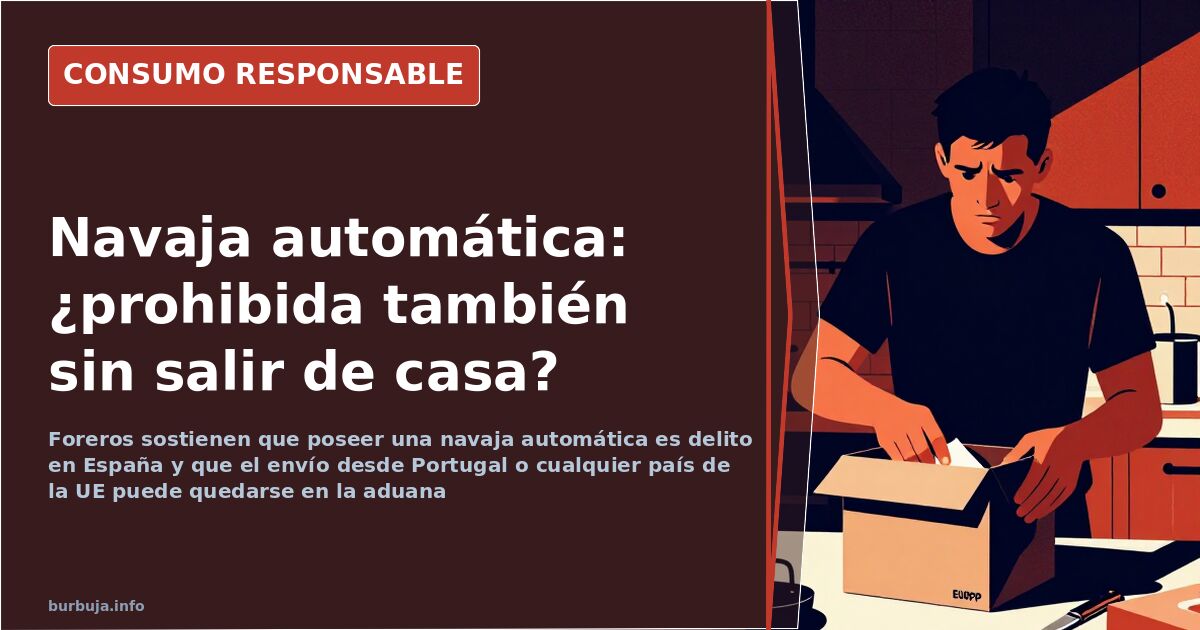
Automatic Knives: The Ban Debated in Spain
For many contributors, automatic knives are prohibited weapons in Spain. Whether for collection, home use, or peeling peaches, mere possession is targeted. Packages arriving from Portugal or elsewhere in Europe risk being intercepted. The buyer's dilemma—can I order one online without consequences?—has an uncomfortable nuance: the danger starts not when opening the package, but when authorities deem the object illegal.
Are Automatic Knives Legal in Spain?
No, according to those citing regulations. Automatic opening knives are listed as prohibited weapons, and possession alone constitutes an offense. "An automatic knife is a prohibited weapon. Mere possession implies illegal holding," states one sharp comment, which also bans double-edged blades.
Here lies the first sustancia ilegal in the narrative. Some argue that "prohibited" automatics don't exist as such in Spain, claiming enforcement targets carrying rather than home possession. Confusion stems from abroad: in the US, specific models are banned, and enthusiasts settle for assisted mechanisms. Applying this logic to Spanish law leads to error, warn informed voices.
Almost all analyses agree on the slippery slope of police discretion. The line between tolerated and sanctioned depends on the officer, location, and time.
What Happens If You Import From Portugal or Another EU Country?
Customs doesn't distinguish neighbors. Buying in Portugal, France, or non-EU sites yields the same result: prohibited weapons cannot be imported. The most common prediction is interception before delivery.
The EU nuance is misleading. Sellers within the common market don't make products legal. Jokes about postal services allowing ammunition or explosives without delay aren't legal arguments, but irony about what is controlled versus what isn't.
Regarding declaring contents at post offices, the thread offers no clear answer.
Legal Alternative: Assisted Opening Knives
If estimulante ilegal matters more than thug aesthetics, there's a way around the ban. Assisted opening knives—with a spring assisting after thumb initiation—are sold without issues and open nearly as fast. Models like SOG Aegis or Cold Steel Ti-Lite are cited examples.
Technical advice goes beyond legality. Some note automatic springs jam over time, while assisted ones are more reliable. The conceptual difference is key: automatics fire via button; assisted ones accompany the gesture.
The liner lock system reportedly originated from a climbing accident, where a single-handed climber needed to open his tool unaided.
Carrying Is the Real Problem: €300 Fine for a Cutter
It’s not buying, but taking it out of the house. The object barely matters. One case ended with a €300 fine for having a €0.30 plastic cutter in a car, confiscated during a check and fined weeks later administratively; appealing as a work tool resulted in withdrawal without further process.
Another testimony lowers standards to absurdity: a table knife with a plastic handle, kept in a trunk bucket for scaling fish, prompted an agent's warning. Consequently, many reduced their kit to small Swiss army knives, the only ones raising no questions.
Against this, utilitarian arguments persist: some defend that a car knife saves lives, citing a driver cutting seatbelts of children trapped in a burning vehicle. Regulations don't account for heroism, only justification.
The Trick: Buying Knife and Springs Separately
Enthusiasts circulate a method to bypass restrictions: buying the knife without springs in one store and springs in another. This remedy has dubious legal efficacy—assembled objects remain identical—but illustrates how the Spanish market pushes DIY solutions.
More striking are external purchases. Reports mention Asian platform orders landing without incident, including double-edged items under 11 cm considered daggers. European sellers shipping prohibited weapons without apparent control are also mentioned.
Where analysis fails: with unclear norms and discretion as arbiter, blade enthusiasts will find loopholes. That loophole—not customs—decides if the knife stays in a drawer or ends up in a file.
For many contributors, automatic knives are prohibited weapons in Spain. Whether for collection, home use, or peeling peaches, mere possession is targeted. Packages arriving from Portugal or elsewhere in Europe risk being intercepted. The buyer's dilemma—can I order one online without consequences?—has an uncomfortable nuance: the danger starts not when opening the package, but when authorities deem the object illegal.
Are Automatic Knives Legal in Spain?
No, according to those citing regulations. Automatic opening knives are listed as prohibited weapons, and possession alone constitutes an offense. "An automatic knife is a prohibited weapon. Mere possession implies illegal holding," states one sharp comment, which also bans double-edged blades.
Here lies the first sustancia ilegal in the narrative. Some argue that "prohibited" automatics don't exist as such in Spain, claiming enforcement targets carrying rather than home possession. Confusion stems from abroad: in the US, specific models are banned, and enthusiasts settle for assisted mechanisms. Applying this logic to Spanish law leads to error, warn informed voices.
Almost all analyses agree on the slippery slope of police discretion. The line between tolerated and sanctioned depends on the officer, location, and time.
What Happens If You Import From Portugal or Another EU Country?
Customs doesn't distinguish neighbors. Buying in Portugal, France, or non-EU sites yields the same result: prohibited weapons cannot be imported. The most common prediction is interception before delivery.
The EU nuance is misleading. Sellers within the common market don't make products legal. Jokes about postal services allowing ammunition or explosives without delay aren't legal arguments, but irony about what is controlled versus what isn't.
Regarding declaring contents at post offices, the thread offers no clear answer.
Legal Alternative: Assisted Opening Knives
If estimulante ilegal matters more than thug aesthetics, there's a way around the ban. Assisted opening knives—with a spring assisting after thumb initiation—are sold without issues and open nearly as fast. Models like SOG Aegis or Cold Steel Ti-Lite are cited examples.
Technical advice goes beyond legality. Some note automatic springs jam over time, while assisted ones are more reliable. The conceptual difference is key: automatics fire via button; assisted ones accompany the gesture.
The liner lock system reportedly originated from a climbing accident, where a single-handed climber needed to open his tool unaided.
Carrying Is the Real Problem: €300 Fine for a Cutter
It’s not buying, but taking it out of the house. The object barely matters. One case ended with a €300 fine for having a €0.30 plastic cutter in a car, confiscated during a check and fined weeks later administratively; appealing as a work tool resulted in withdrawal without further process.
Another testimony lowers standards to absurdity: a table knife with a plastic handle, kept in a trunk bucket for scaling fish, prompted an agent's warning. Consequently, many reduced their kit to small Swiss army knives, the only ones raising no questions.
Against this, utilitarian arguments persist: some defend that a car knife saves lives, citing a driver cutting seatbelts of children trapped in a burning vehicle. Regulations don't account for heroism, only justification.
The Trick: Buying Knife and Springs Separately
Enthusiasts circulate a method to bypass restrictions: buying the knife without springs in one store and springs in another. This remedy has dubious legal efficacy—assembled objects remain identical—but illustrates how the Spanish market pushes DIY solutions.
More striking are external purchases. Reports mention Asian platform orders landing without incident, including double-edged items under 11 cm considered daggers. European sellers shipping prohibited weapons without apparent control are also mentioned.
Where analysis fails: with unclear norms and discretion as arbiter, blade enthusiasts will find loopholes. That loophole—not customs—decides if the knife stays in a drawer or ends up in a file.
Also available in: Deutsch
Summary of a discussion on Burbuja.info - Foro de economía, actualidad y política., translated from Spanish and reviewed before publication. Read the full discussion (117 replies).
More summaries
-
EU's €3 parcel levy ends AliExpress's cheap era
The EU's €3 per category fee sends AliExpress prices soaring: a €3 order now costs €11. The Chinese parcel model faces collapse.
-
The €3.61 Fee Killing AliExpress Purchases
The €3.61 per-category tariff has inflated AliExpress purchases by up to 80%. Consumers are stopping buys, and revenue is falling. Does it actually protect...
-
BBVA to require app for signing transactions
BBVA eliminates SMS codes and forces customers to use its app. Forum debate on security, tech dependence, and loss of digital freedom.
-
Retro Gaming Collecting: €200k Business or Bubble?
A YouTuber traded games for a house, and one collection was valued at €120k mid-inventory. The retro market rises, but skeptics...
-
25-Year-Old Plans Studies Until 31; Forum Urges Immediate Work
A Spanish youth with limited training plans degrees until 31. Users advise working now, exercising, and facing reality instead of delaying.
-
PCs aren't dead: the gap between desktop and mobile-only users
Debate on whether computers remain essential vs. smartphones, covering productivity, generational gaps, and digital natives lacking basic PC skills.