
Spain's PM Sánchez booed at Huesca ski resort
Boos for Pedro Sánchez at a Spanish ski resort reignite debate on security costs and holiday narratives.
English · Original discussion in Spanish · Published
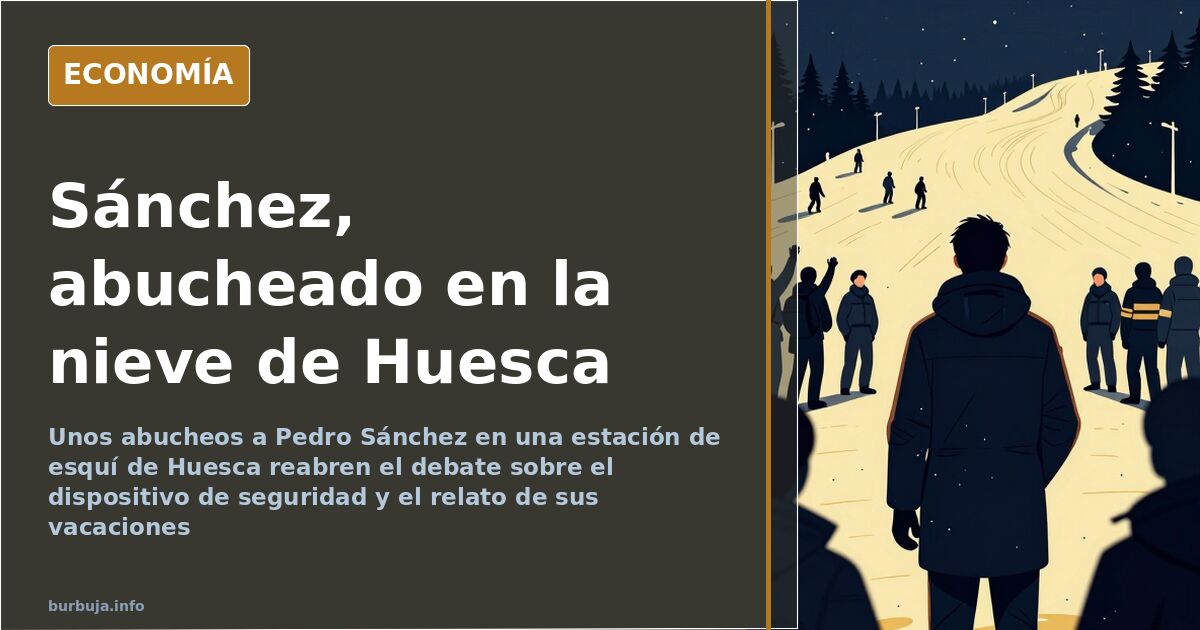
Sánchez booed in the snow amid scrutiny of entourage costs
Pedro Sánchez was heckled during a few days of skiing at a resort in the Aragonese Pyrenees, in the province of Huesca. The incident has peine a discussion that goes far beyond the event itself. The paradox is that the most repeated criticism does not target the destination—skiing in Huesca is not going to the Maldives—but rather the apparatus surrounding the head of government. What began as a shout on a slope has turned into a reckoning over spending, narrative, and optics.
What peine at the ski resort
The facts are modest: a group jeered at the prime minister while he enjoyed some days on the slopes. There was no assassination attempt, though some comments jokingly hinted at it. The episode itself has been described in much milder terms—he was shouted at briefly—compared to the sensationalist headlines claiming he was publicly attacked. That gap between what peine and how it is reported is, in itself, part of the issue.
Beyond the specific incident, the conversation shifted to the scene. One user described a day of dense fog and four degrees below zero at the resort, with lifts fully occupied. Details like these—the type of snow, the atmosphere—served to underline an idea: there was no luxury scenario, but a national ski resort in peak season.
Were these luxury holidays?
Here lies the first clash. Part of the analysis argues that labeling a skiing alucinación to Huesca as a luxury vacation is inflating the narrative to provoke anger. "As if they had gone to the Maldives," summarizes this stance, accusing headlines of exaggeration to manufacture outrage.
The opposing objection does not dispute the destination; it disputes the method. Luxury, they say, is not the slope or the hotel: it is the human deployment moving with the president. Bodyguards who eat, sleep, and occupy rooms; entire floors reserved; identification of guests at the establishment. Every minute outside the official residence, this current argues, has a cost paid by the taxpayer. The destination is irrelevant when the bill is not signed by the traveler.
How much does the president's security detail cost?
Here honesty is required: there is no public breakdown of spending for these days nor concrete figures in the debate. What is sustained is that security, accommodation, and travel for a president have a cost paid by the taxpayer, without further detail. The criticism, therefore, moves in the realm of perception more than accounting.
That does not diminish its political force. The underlying argument is that those in power are not ordinary citizens and that their rest, whether they want it or not, is financed with other people's money. The defense is symmetrical: every president has the right to a few days off, and security is an obligation of the office, not a whim. The discussion, in reality, is not about skiing. It is about what can be demanded of those who hold power.
How many Spaniards actually vote for PSOE?
The conversation drifted toward an arithmetic exercise that reappears whenever the government's legitimacy is questioned. Based on the 7,760,970 votes obtained by the PSOE in the last general elections and the 48,592,909 inhabitants attributed to Spain by the INE (National Statistics Institute), a calculation circulating in the thread leaves the percentage at 15.97% of the total. Less than one in six residents.
Another alternative calculation starts from the electoral roll. If one crosses a turnout of 70.4% with the 31.7% socialist vote share, the result is 22.3% of the census. Neither number turns what is not a majority into one, and both feed the same thesis: a proportionally narrow electoral base. With these elements, a holiday stops being anecdotal.
The narrative of humble origins
In the background looms the wear of the character. Against the story of the leader who came from below, some recall that he is a son of senior executives with an elite education and a lackluster university record, and that the tour with the old Peugeot functioned more as staging than biography. "Red from a private housing estate" is the formula summarizing that contrast between discourse and social extraction. The criticism is not new; what has changed is the context in which it is launched.
To this is added the timing. The getaway comes after the Valencia emergency and the tense visit to Paiporta, which remains present in the conversation as a sign that priorities lay elsewhere. A few days on the snow, in that framework, are read as a slap of opportunity, however humble the destination may be. Politics is not set by the price of the lift pass, but by the calendar.
From Paiporta to the slopes: the pattern of boos
The incident is not isolated. Months earlier, the visit to areas affected by the Valencia catastrophe had led to one of the scenes of greatest public tension for the government. Some see a pattern in these episodes: the president's presence on the street generates increasingly hostile responses, not always contained. The ski resort, in that narrative, would be the latest chapter of a bumpy tour.
The opposite reading downplays the matter to democratic normality: an unpopular leader receives shouts, as others did before. Turning every boo into a symptom of institutional crisis would be an exaggeration. But even in that moderate version remains an uncomfortable fact: the conversation no longer revolves around what the government does, but where it allows itself to be seen.
What nobody closes
The comparison with other presidents settles nothing: all have rested, all have had escorts, and all have been objects of mockery or reproach. The difference, if it exists, lies in the temperature of the environment and the willingness of part of the electorate to forgive. When does a shout on a slope stop being an anecdote and become a signal? With the available data, nobody knows yet.
Pedro Sánchez was heckled during a few days of skiing at a resort in the Aragonese Pyrenees, in the province of Huesca. The incident has peine a discussion that goes far beyond the event itself. The paradox is that the most repeated criticism does not target the destination—skiing in Huesca is not going to the Maldives—but rather the apparatus surrounding the head of government. What began as a shout on a slope has turned into a reckoning over spending, narrative, and optics.
What peine at the ski resort
The facts are modest: a group jeered at the prime minister while he enjoyed some days on the slopes. There was no assassination attempt, though some comments jokingly hinted at it. The episode itself has been described in much milder terms—he was shouted at briefly—compared to the sensationalist headlines claiming he was publicly attacked. That gap between what peine and how it is reported is, in itself, part of the issue.
Beyond the specific incident, the conversation shifted to the scene. One user described a day of dense fog and four degrees below zero at the resort, with lifts fully occupied. Details like these—the type of snow, the atmosphere—served to underline an idea: there was no luxury scenario, but a national ski resort in peak season.
Were these luxury holidays?
Here lies the first clash. Part of the analysis argues that labeling a skiing alucinación to Huesca as a luxury vacation is inflating the narrative to provoke anger. "As if they had gone to the Maldives," summarizes this stance, accusing headlines of exaggeration to manufacture outrage.
The opposing objection does not dispute the destination; it disputes the method. Luxury, they say, is not the slope or the hotel: it is the human deployment moving with the president. Bodyguards who eat, sleep, and occupy rooms; entire floors reserved; identification of guests at the establishment. Every minute outside the official residence, this current argues, has a cost paid by the taxpayer. The destination is irrelevant when the bill is not signed by the traveler.
How much does the president's security detail cost?
Here honesty is required: there is no public breakdown of spending for these days nor concrete figures in the debate. What is sustained is that security, accommodation, and travel for a president have a cost paid by the taxpayer, without further detail. The criticism, therefore, moves in the realm of perception more than accounting.
That does not diminish its political force. The underlying argument is that those in power are not ordinary citizens and that their rest, whether they want it or not, is financed with other people's money. The defense is symmetrical: every president has the right to a few days off, and security is an obligation of the office, not a whim. The discussion, in reality, is not about skiing. It is about what can be demanded of those who hold power.
How many Spaniards actually vote for PSOE?
The conversation drifted toward an arithmetic exercise that reappears whenever the government's legitimacy is questioned. Based on the 7,760,970 votes obtained by the PSOE in the last general elections and the 48,592,909 inhabitants attributed to Spain by the INE (National Statistics Institute), a calculation circulating in the thread leaves the percentage at 15.97% of the total. Less than one in six residents.
Another alternative calculation starts from the electoral roll. If one crosses a turnout of 70.4% with the 31.7% socialist vote share, the result is 22.3% of the census. Neither number turns what is not a majority into one, and both feed the same thesis: a proportionally narrow electoral base. With these elements, a holiday stops being anecdotal.
The narrative of humble origins
In the background looms the wear of the character. Against the story of the leader who came from below, some recall that he is a son of senior executives with an elite education and a lackluster university record, and that the tour with the old Peugeot functioned more as staging than biography. "Red from a private housing estate" is the formula summarizing that contrast between discourse and social extraction. The criticism is not new; what has changed is the context in which it is launched.
To this is added the timing. The getaway comes after the Valencia emergency and the tense visit to Paiporta, which remains present in the conversation as a sign that priorities lay elsewhere. A few days on the snow, in that framework, are read as a slap of opportunity, however humble the destination may be. Politics is not set by the price of the lift pass, but by the calendar.
From Paiporta to the slopes: the pattern of boos
The incident is not isolated. Months earlier, the visit to areas affected by the Valencia catastrophe had led to one of the scenes of greatest public tension for the government. Some see a pattern in these episodes: the president's presence on the street generates increasingly hostile responses, not always contained. The ski resort, in that narrative, would be the latest chapter of a bumpy tour.
The opposite reading downplays the matter to democratic normality: an unpopular leader receives shouts, as others did before. Turning every boo into a symptom of institutional crisis would be an exaggeration. But even in that moderate version remains an uncomfortable fact: the conversation no longer revolves around what the government does, but where it allows itself to be seen.
What nobody closes
The comparison with other presidents settles nothing: all have rested, all have had escorts, and all have been objects of mockery or reproach. The difference, if it exists, lies in the temperature of the environment and the willingness of part of the electorate to forgive. When does a shout on a slope stop being an anecdote and become a signal? With the available data, nobody knows yet.
Summary of a discussion on Burbuja.info - Foro de economía, actualidad y política., translated from Spanish and reviewed before publication. Read the full discussion (184 replies).
More summaries
-
Sánchez leaves Paiporta: video sparks debate over official narrative
Sánchez departs Paiporta after DANA clashes; footage reignites scrutiny of the 72-hour aid delay in l'Horta Sud.
-
Far-right group claims attack on Spanish PM Sánchez in Paiporta
A Revuelta volunteer allegedly boasted of damaging Sánchez's car, while Vox offered legal aid to those who kicked it.
-
PSOE's Ferraz Base: Sociatas and the Image of Party Loyalty
Analysis of the image at Ferraz: Ideological fanaticism or economic dependence? A breakdown of views on PSOE membership.
-
Lucía Etxebarría’s Morocco assault account stirs debate in Ceuta
Lucía Etxebarría details a sexual assault in Morocco, reigniting discussions on women's safety and the Ceuta border.
-
Conscription Debate Misses Core Question of State Power
Denmark extends military service to 11 months, while Germany sees low volunteer numbers. The real issue is not who serves, but whether conscription should exist.
-
Ayuso's Shorts Spark Fire Management Debate in Madrid
Madrid's president wore tactical shorts to a wildfire, igniting controversy over firefighter cuts and emergency coordination.