
Spain's Planet Fitness-style gyms ban heavy lifting
Spanish gyms adopting the Planet Fitness model prohibit grunting and heavy weights to attract casual clients who pay dues but rarely train hard.
English · Original discussion in Spanish · Published
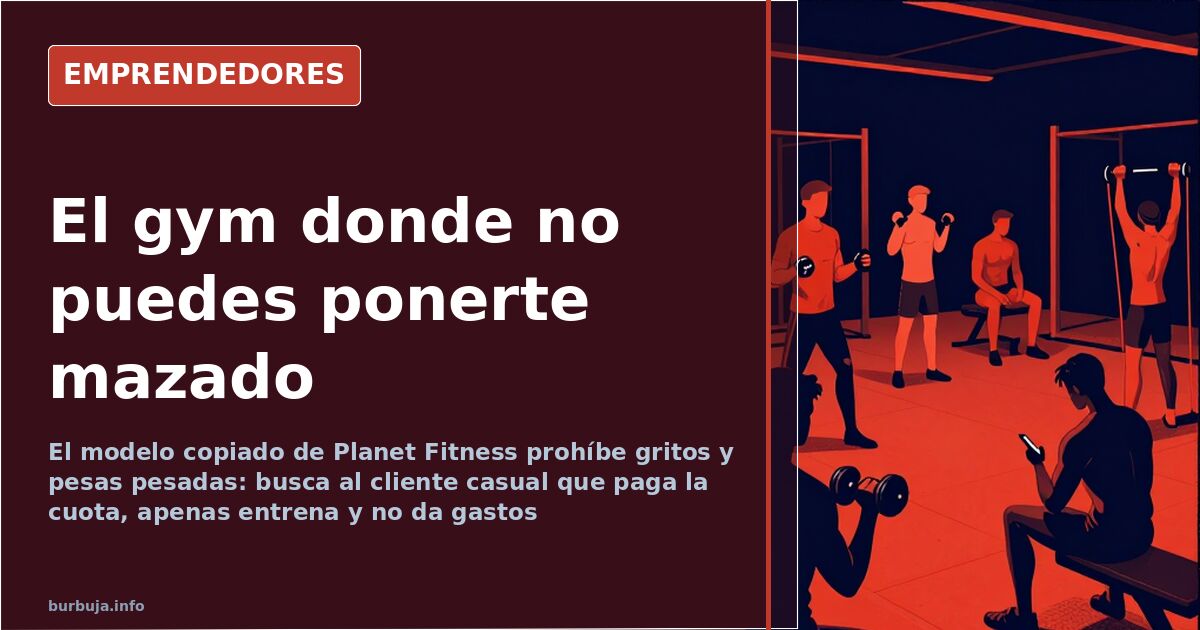
Gyms banning heavy weights to avoid scaring off customers
Some gyms are defined by what they forbid. No grunting on the last rep, no dropping bars, no tank tops. And above all, no lifting heavy loads. The argument from owners is that visible muscle — specifically other people's — intimidates first-time visitors, whether young or elderly. This formula borrows from US giant Planet Fitness, turning the gym into something resembling a social club with treadmills. An uncomfortable question hangs over the business: how does a venue survive if it drives away serious athletes?
What is the Planet Fitness model and why ban heavy lifting?
The pattern repeats in most venues applying it. Machine circuits, large cardio zones, many classes, and dumbbells rarely exceeding 20 kg. No Olympic lifting platforms or squat racks for safe deadlifts; free weights, if present, are tucked in poorly ventilated corners. In the US, this format has sparked controversy for years — including videos of members warned for dropping bars — and the business mechanics explain it: lighter loads miccionan less machine wear and fewer breakdowns. A gentle client is a cheap client.
Who sustains the business: spending distribution by customer profile
Here comes the data that confuses iron purists. One debate participant claims, without citing sources, that women account for 76% of total spending, lgtb audiences exceed 15%, and weightlifting enthusiasts — those who grunt and load plates — make up less than 10% of revenue. Under this lens, excluding strong lifters isn't a management error but a portfolio decision. They protect members who pay religiously, show up twice a week — or less — and barely touch equipment. The gym stops selling training and starts selling belonging.
Why it feels like a threat to muscular members
The underlying thesis is more sociological than athletic. The gym is already a social space, some argue, akin to therapy or meditation: a place where one feels accompanied without demanding too much. In this context, the image of others — jacked, sweating, grunting — acts as an annoying mirror. Hence dress codes, bans on tank tops, and noise obsession. Some add the usual uncomfortable detail: tight leggings and sports bras in women's areas rarely face the same scrutiny. The asymmetry, they say, isn't oversight; it targets the desired audience.
Neighborhood gyms and home workouts as alternatives
Against this performative business, part of the public champions the neighborhood gym, where no one scolds you for dropping a bar and fees don't include green juice cafés. Another trend goes further: setting up home equipment — rented treadmills and platforms with virtual competitions — or moving strength work to parks using resistance bands, bodyweight exercises, and isometric routines that fit in a backpack. The reasoning is economic: if city gyms have become spaces for shared-apartment dwellers in capitals, those with attics train better and cheaper.
How many such gyms exist and where?
The US model has crossed the Atlantic, but its presence remains marginal. Industry watchers note only one such venue exists, and it’s not in Spain: it’s in Monterrey, Mexico. It’s also not new. Some recall it dates back to the first fitness boom in the 80s, targeting women and retirees with many classes and few dumbbells. What changes now isn’t the concept, but the commercial packaging.
The incomplete calculation
One testimony flips the argument. Someone who started their career fifteen years ago as a municipal sports technician describes how public gyms in their city — all run by women — applied the opposite policy to current trends: cornering men in the 1% of space, the worst-ventilated area, while reserving 99% for women, assuming men would leave voluntarily. The maneuver worked. Detailed accounts of room reorganization and rationale are essential reading before forming opinions.
With these elements, gyms avoiding muscular clients aren’t eccentricities but the tip of a decades-long adaptation to paying customers. The unresolved doubt is sustainability: some assume such venues close within four months, wondering what went wrong. No one knows yet. The only certainty is that heavy iron no longer enters through the front door.
Also available in: Deutsch
Summary of a discussion on Burbuja.info - Foro de economía, actualidad y política., translated from Spanish and reviewed before publication. Read the full discussion (114 replies).
More summaries
-
Is there a market for a €200-a-month gym with the right to refuse entry?
A €200 gym with selective admission and a dress code: an analysis of the viability of a business model that has already failed once before.
-
Esquelas Cantabria: funeral death notices startup hunts for a business model
A death notices portal for Cantabria, Spain, has sparked debate over its viability: advertising, subscriptions or charging funeral homes. Does it have a future?
-
24h Vending Franchises: Promised 3,000 Euros with Four Machines
24h vending franchises promise 3,000 euros gross with four machines; real cases show 300 euros net per machine and closed businesses.
-
Truck vs. Bus: Which Driving License Costs More and Pays Best?
Getting a truck or bus license is expensive due to CAP requirements and fees. Public sector bus jobs offer stability, while trucking faces wage stagnation.
-
Cash on delivery at Correos: €9.50 for a 58-gram parcel
A 58-gram parcel costs €0.52 by standard mail, but cash on delivery pushes it to €9.50. The rate breakdown leaves sellers with no margin on small sales.
-
Retiring and staying on as a company director: Social Security's red line in Spain
Collecting a pension while remaining director of a Spanish limited company is legal, but the line between ownership and working carries sanctions: up to three months without a pension.