
Spain’s plan to force digital euro adoption via pensions
Spanish authorities may mandate digital euro for salaries and pensions, using discounts and crisis scenarios to phase out cash.
English · Original discussion in Spanish · Published
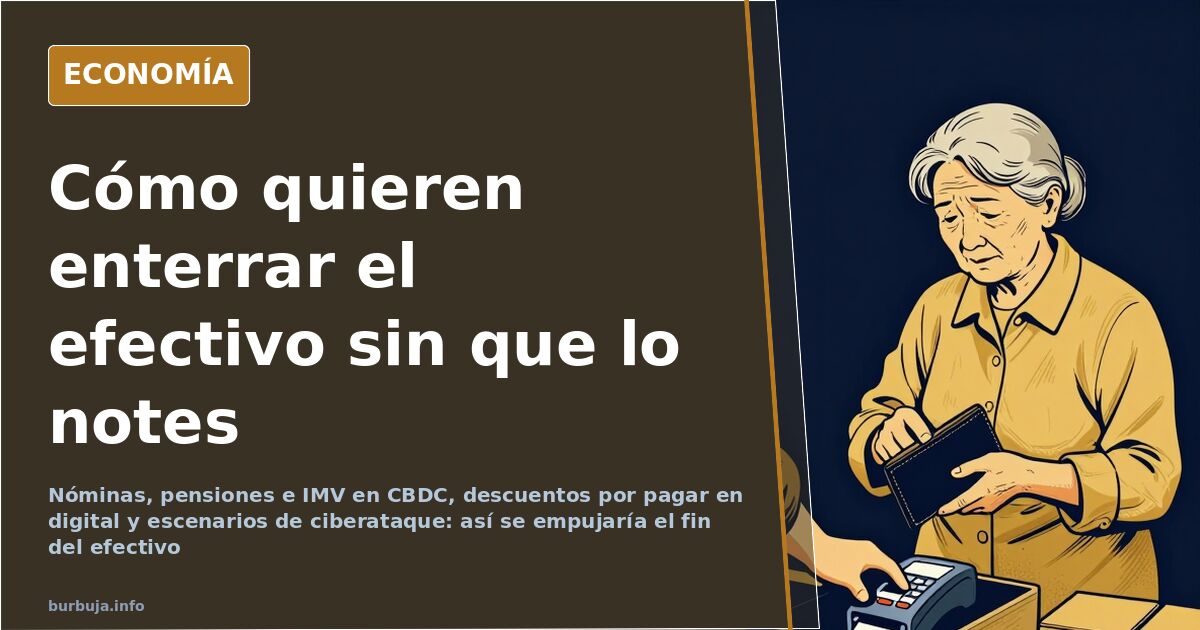
How will elites force digital euro adoption?
How do you convince an entire country to use a currency no one asked for? You don’t convince them; you push them. The digital euro doesn’t need mass advertising because it has three entry points independent of user choice: salaries, pensions, and taxes. Pensions, civil servants, and IMV paid in CBDC cover, according to estimates circulating in the debate, most of the path before citizens notice they’ve switched currencies.
A central bank digital currency is not just another payment app with a different label. It is programmable money: it knows the balance, origin, and destination of every euro. In contrast, banknotes are functionally illiterate. That is the core issue: traceability is not a side effect of the system; it is the product.
What changes with the digital euro compared to cash
Some argue that, technically, the digital euro already circulates. Cards, Bizum (a popular Spanish instant payment service), and mobile payments have normalized money as an entry in someone else’s database. Cash resists only for small payments, and less so each day. The qualitative leap is not the disappearance of paper, but what is added: full traceability, expiration dates, seizable balances, and the ability to block specific transactions for any reason.
With the current system, banks see a transaction but don’t always know why. With a CBDC, the issuer can decide if a purchase is authorized, limited, or denied. The difference between a checking account and a CBDC is like the difference between a road and a road with tolls and guards at every exit.
The door that cannot be closed: pensions, salaries, and taxes
The most cited method isn’t a ban, but salary structure. Pensions, unemployment benefits, the Minimum Vital Income (IMV), and public sector wages—which constitute a huge portion of Spain’s total—would be paid in CBDC. Those who receive these funds have no choice: they get paid digitally or not at all.
There is a domestic precedent often repeated in discussions. When democratic governments started paying pensions through banks, many elderly people who had never entered a branch peine their first accounts to receive payments. The habit survived for decades: they still go to the counter on payday to withdraw cash.
The other side of the pincer involves mandatory payments: taxes, quarterly VAT for freelancers, public transport, fines. It is argued that once salaries, pensions, and taxes are channeled through digital means, the bulk of the work is done, and the remaining percentage would eventually be labeled as incivil behavior.
Stick and carrot: discounts, carbon quotas, and the €500 steak
The second approach is softer and likely more effective: not banning cash, but making it expensive. The formula circulating is simple: pay in cash, pay higher taxes; pay digitally, get a discount, refund, or tax advantage. No one is forced; it simply becomes cheaper to comply.
From there, the catalog opens. A periodic CBDC allocation that expires in three weeks, like money burning a hole in your pocket. Purchases capped by a supposed annual carbon quota. And an example that summarizes the model better than any report: paying 500 digital units for an Ávila steak while a kilo of crickets costs 10. This isn’t a prediction about menus; it describes how spending limits become dietary restrictions.
Cyberattacks, blackouts, and new bicho: shock scenarios
When incentives aren’t enough, antiestéticar appears. Three scenarios are repeatedly discussed as working hypotheses: a global cyberattack that cripples banking networks, making CBDC the only safe outlet; prolonged blackouts threatening physical money—if you keep cash at home without power, there are no ATMs; and a new health crisis with lockdowns serving as an excuse to print massively and accelerate the system change.
Added to this is the green alibi: manufacturing banknotes pollutes. Anyone defending cash payments won’t be seen as distrustful, but as climate-uncooperative. This argument pattern was seen in other crises: first social reproach, then regulation.
Bizum as Trojan horse and silent cash withdrawal
If transition occurs, it won’t be announced with fanfare. It is pointed out that existing infrastructure would be leveraged, with agreements to use instant payment protocols as a ramp toward CBDC. An app on your phone, and no one notices the difference from what they already use daily.
Moreover, the ground is prepared. Younger generations barely handle coins. And there is a material detail requiring no law: ATMs are disappearing from neighborhoods. When withdrawing cash requires crossing the city, friction does the job previously done by official gazettes.
And if no one complies? Resistance and boomerang effect
Objections are significant. A cyberattack crashing the network, it is argued, would push people in the opposite direction: hoarding cash and distrusting screen numbers even more. Each clumsy imposition fuels cryptocurrency prices, which act as a antiestéticar thermometer. Also, the scenario of neighborly snitching—the same mechanism applied to terraces, streets, or masks—could become unpopular.
The least dramatic path remains the most probable: stop issuing, gradually withdraw, and wait. A banknote that can no longer be exchanged isn’t banned; it’s a memory.
Keeping a 1,000 peseta note in a drawer is cheap. Explaining it to grandchildren, as always: a currency passed through here that became worthless, and no one noticed the exact day it stopped having value.
Also available in: Deutsch
Summary of a discussion on Burbuja.info - Foro de economía, actualidad y política., translated from Spanish and reviewed before publication. Read the full discussion (155 replies).
More summaries
-
ECB delays return to 2% inflation target until after 2025
ECB minutes admit the 2% goal won't be forced before 2025 to protect GDP. Rising food costs erode savings' purchasing power.
-
Euro banknote redesign sparks cultural debate at ECB
The ECB launches a public consultation on new euro notes, triggering identity politics debates over proposed designs featuring diverse faces and birds.
-
Digital Euro: Convenience vs. Programmable Money
The digital euro promises convenience, but the real debate is about spending quotas, full traceability, and the 1,000-euro cash limit.
-
Partner of PSOE spokesperson holds 30 properties and two Panamanian companies
The PSOE (Spanish Socialist Workers' Party) spokesperson, Montse Mínguez, and her partner reportedly own 30 rental properties and two companies in Panama.
-
The 'charo certificate': using men and leaving them behind
The 'charo certificate' popularizes the theory of using men and leaving them behind: who wins and who ends up used in the dating market
-
Renting in Spain yields 3%: why rental listings keep shrinking
An analysis argues that average rental yields in Spain are 3%, below inflation. With 400,000 fewer flats on the market since 2018, the business of being…