
VOX Proposes Traumatic Pension Adjustment in Spain
VOX advocates for a "traumatic and honest" adjustment to Spain's pay-as-you-go pension system, arguing current contributions cannot cover spending.
English · Original discussion in Spanish · Published
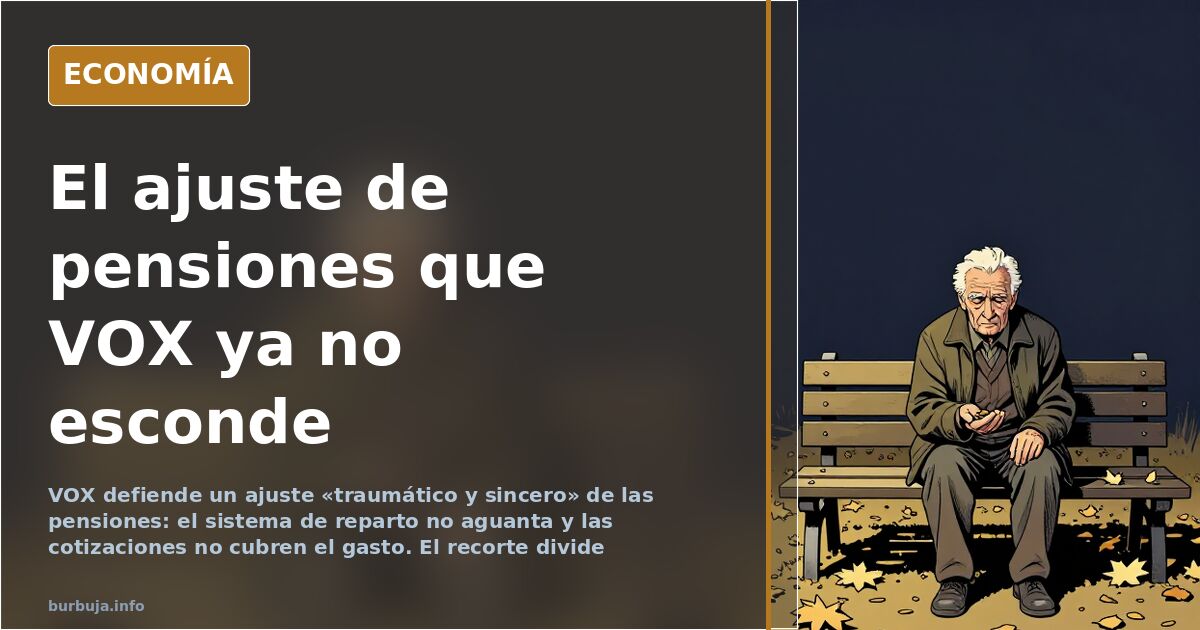
VOX proposes a "traumatic adjustment" to public pensions
Figaredo's proposal, VOX's economic spokesperson, to implement a "traumatic and honest" adjustment to public pensions is no longer a laboratory hypothesis. It is a thesis with an expiration date: the pay-as-you-go system, as currently structured, cannot reach the next decade without surgery. Striking the pensions is equivalent to signing an electoral sentence. The reform does not specify deadlines or amounts. And that silence is, perhaps, the most honest part of the matter.
What a traumatic pension adjustment means
The starting point is uncomfortable: contributions do not cover spending. With the inverted demographic pyramid, fewer active workers support more beneficiaries, and the state covers the difference with debt. From the adjustment's own defense, a figure is cited that shocks everyone: if the system were ordered by pure actuarial logic, reasonable pensions would move around 500 euros monthly.
There is a psychological derivative often overlooked. Pension money is, along with public salaries and subsidies, the only paycheck people believe is bulletproof. Touching it is not just an accounting problem, it is a problem of faith. And in politics, voter faith weighs more than any macro chart.
Budgets cut before pensions
There is a current arguing that before putting the scissors to the elderly, there is plenty of material within the state apparatus itself. The circulating list is daunting to read: duplicated town councils, redundant offices, seventeen autonomous parliaments, parallel health systems, five or six distinct police forces overlapping on the same street. And below, a bureaucracy that requests major permits just to change a partition wall.
The counterargument is that all this is the cat's meow against the pension hole, which swallows any administrative savings in weeks. It may be true. But the order of cuts is not neutral: it defines which voter matters. And the message to adjust the elderly first, and only the elderly, is a message, whether they like it or not, of class.
The Danish-style hybrid system as a technical solution
The alternative proposed in more detail is to migrate toward a mixed scheme: a public subsistence pension and a real private capitalization pillar, the more you contribute, the more you receive, with no other promises. The cited reference model is Denmark, which combines both pillars and withstands a declining population pyramid without resorting to bringing in population by forced marches.
The problem is where the funds come from and who manages them. Asset management is a huge business, and private pension funds are nothing more than investment funds with another suit and equally generous commissions. The experience of Spanish banks managing pensions in Chile, Peru, and Bolivia—and the memory of entities rescued with public money—does not exactly invite blind faith.
Who truly supports the family economy
Here cross two narratives rarely seated at the same table. One says that the elderly keep the show going: they pay for their children's education, finance purchases, leisure, and some trips. Without their pension, half of young Spain goes to the dogs. The other recalls that there are pensioners with property and six-figure savings, while youth live one paycheck away from indigence.
Both things can be true at once, and that is the knot. The system not only pays for old age: it pays a de facto intergenerational transfer that supports adult children. Cutting at the top without touching anything at the bottom is dynamiting both floors of the same house.
The electoral trap: pensioners and ballots
The political calculation is brutal and already done: whoever touches pensions loses elections, or at least loses them among the electorate that does not fail to show up on election day. For this reason, it is argued that neither the PP nor PSOE will ever sign the adjustment in writing, and that whoever signs it—VOX, in this case—condemns itself to a handful of seats. The gerontocracy, they say, votes with its pocket and with antiestéticar, and antiestéticar is a great mobilizer.
Some argue the contrary: that the sooner bankruptcy is declared, the better, because the sustained lie only prolongs the agony. And some see the matter as a cavity: it will hurt, but you have to go to the dentist. The diagnosis is on the table. The treatment, unsigned.
Figaredo's proposal, VOX's economic spokesperson, to implement a "traumatic and honest" adjustment to public pensions is no longer a laboratory hypothesis. It is a thesis with an expiration date: the pay-as-you-go system, as currently structured, cannot reach the next decade without surgery. Striking the pensions is equivalent to signing an electoral sentence. The reform does not specify deadlines or amounts. And that silence is, perhaps, the most honest part of the matter.
What a traumatic pension adjustment means
The starting point is uncomfortable: contributions do not cover spending. With the inverted demographic pyramid, fewer active workers support more beneficiaries, and the state covers the difference with debt. From the adjustment's own defense, a figure is cited that shocks everyone: if the system were ordered by pure actuarial logic, reasonable pensions would move around 500 euros monthly.
There is a psychological derivative often overlooked. Pension money is, along with public salaries and subsidies, the only paycheck people believe is bulletproof. Touching it is not just an accounting problem, it is a problem of faith. And in politics, voter faith weighs more than any macro chart.
Budgets cut before pensions
There is a current arguing that before putting the scissors to the elderly, there is plenty of material within the state apparatus itself. The circulating list is daunting to read: duplicated town councils, redundant offices, seventeen autonomous parliaments, parallel health systems, five or six distinct police forces overlapping on the same street. And below, a bureaucracy that requests major permits just to change a partition wall.
The counterargument is that all this is the cat's meow against the pension hole, which swallows any administrative savings in weeks. It may be true. But the order of cuts is not neutral: it defines which voter matters. And the message to adjust the elderly first, and only the elderly, is a message, whether they like it or not, of class.
The Danish-style hybrid system as a technical solution
The alternative proposed in more detail is to migrate toward a mixed scheme: a public subsistence pension and a real private capitalization pillar, the more you contribute, the more you receive, with no other promises. The cited reference model is Denmark, which combines both pillars and withstands a declining population pyramid without resorting to bringing in population by forced marches.
The problem is where the funds come from and who manages them. Asset management is a huge business, and private pension funds are nothing more than investment funds with another suit and equally generous commissions. The experience of Spanish banks managing pensions in Chile, Peru, and Bolivia—and the memory of entities rescued with public money—does not exactly invite blind faith.
Who truly supports the family economy
Here cross two narratives rarely seated at the same table. One says that the elderly keep the show going: they pay for their children's education, finance purchases, leisure, and some trips. Without their pension, half of young Spain goes to the dogs. The other recalls that there are pensioners with property and six-figure savings, while youth live one paycheck away from indigence.
Both things can be true at once, and that is the knot. The system not only pays for old age: it pays a de facto intergenerational transfer that supports adult children. Cutting at the top without touching anything at the bottom is dynamiting both floors of the same house.
The electoral trap: pensioners and ballots
The political calculation is brutal and already done: whoever touches pensions loses elections, or at least loses them among the electorate that does not fail to show up on election day. For this reason, it is argued that neither the PP nor PSOE will ever sign the adjustment in writing, and that whoever signs it—VOX, in this case—condemns itself to a handful of seats. The gerontocracy, they say, votes with its pocket and with antiestéticar, and antiestéticar is a great mobilizer.
Some argue the contrary: that the sooner bankruptcy is declared, the better, because the sustained lie only prolongs the agony. And some see the matter as a cavity: it will hurt, but you have to go to the dentist. The diagnosis is on the table. The treatment, unsigned.
Summary of a discussion on Burbuja.info - Foro de economía, actualidad y política., translated from Spanish and reviewed before publication. Read the full discussion (318 replies).
More summaries
-
Immigration and Pensions: The Debate Over Contributors
A debate on whether immigration is essential for pension system sustainability, considering declining birth rates and the impact of automation on employment.
-
Madarcos: 52 voters and 58 new electors under Spain's grandchildren law
Madarcos: 52 voters and 58 new electors under the grandchildren law. The case is in court with interim measures, no final ruling.
-
Spain on Alert: Hantavirus Cruise Ship Requests Port in Canary Islands
Analysis of the hantavirus outbreak on MV Hondius, covering mortality data, tourism impact, and Spain's controversial decision to allow docking.
-
Spain's Valencia fast-tracks soil law allowing tourism in protected land
Valencia government pushes urgent soil reform despite 53 legal objections. Community Interest Declarations become permanent.
-
Rufián: The Spanish MP Without a Political Home
Speculation surrounds Gabriel Rufián's future in Spain as ERC declines and no clear path emerges for the independentist MP.
-
User Deletes 15,000+ Posts After Forum Ban
A banned user wiped over 15,000 posts using an automated script, highlighting risks to platform content and monetization.