
Spain's Pension Block: 10 Million Votes Shielding Reforms
A viral video accuses retirees of selfishness, sparking debate over 10 million votes that block pension reforms in Spain.
English · Original discussion in Spanish · Published
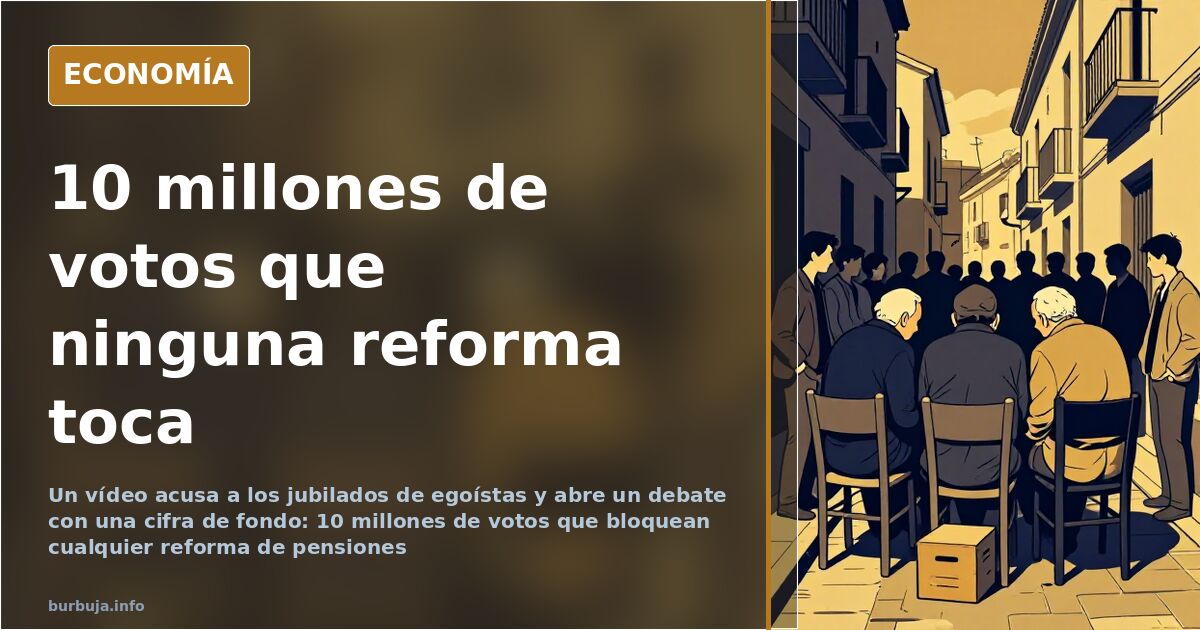
Pensions: 10 million votes that no reform dares to touch
Are retirees Spain's most selfish demographic? This question arose from a viral video accusing pensioners of voting as a bloc to protect their income while mortgaging their grandchildren's future. The video's author recently moved fiscal residence to Andorra, though critics note taxes are still paid there. The unresolved core issue remains: is the problem the retiree, the politician afraid to touch pensions, or a system never designed to last this long?
Why no pension reform succeeds?
Because the pensioner block votes, and consistently. The most repeated thesis in economic analysis is that 10 million pensioners vote with a fidelity unmatched by any other group, meaning any party proposing cuts or freezes faces electoral suicide. If no serious reform has occurred, it is because the political reward lasts four years, but the political bill arrives the next day.
This leads to the most uncomfortable hypothesis: the adjustment will be imposed by Brussels, not Madrid. When it arrives, with margins exhausted, it will be far harsher than it would have been two decades ago. A recent exception cited is Rajoy's reform, pushed by the _Troika_ and later repealed by the PSOE, which keeps raising it in every campaign. Trust that this time the bill will arrive with a European letterhead and no press conference.
How the pay-as-you-go system works, by numbers
Today's pensions are paid by today's workers' contributions. This is the pay-as-you-go system, illustrated simply: twenty people receiving 1,000 euros and eighty contributing require extracting 20,000 euros from the paychecks of those eighty workers, who each earn 1,500 gross.
On this skeleton, disagreement is total. One current argues that after twelve years of retirement, all contributions have been recovered, and those living past 90 spend over a decade on the money of those below. The counterargument highlights the often-forgotten detail: this calculation ignores the returns forty years of personal investments would have yielded. No one saves money in a box to start spending it four decades later.
The 60% receiving from the State: the unclosed figure
Here, the numbers begin to be disputed. The most cited figure—that 60% of adults receive from the State—relies on a 2023 EPA reading: if self-employed and salaried workers make up 43% of the working-age population, the remaining 57% either receives from the State or receives nothing. From this bag come 22 million people: pensioners, public employees, minimum income recipients, homemakers, students, and an unquantified remainder no one signs off on.
The caveat is evident. This percentage includes inactive individuals receiving no public funds, and estimates mix with unknown data. Those defending the blockage thesis insist this group makes any adjustment unviable, speaking of a collective theft consented to by the previous generation. Those rebutting argue that pensioners with contributory pensions number seven million, and recent retirees would have been better off not contributing and saving privately. Where some see exploitation, others see insurance. Insurance, of course, has fine print.
The grievance extending beyond the paycheck
The complaint extends beyond pensions. This generation is accused of halting housing construction for decades and now blaming youth for unable to afford rent, having built the country only to leave children at home until forty. The counterattack is swift: they contributed their entire lives by law, worked hard in factories and construction with salaries no one accepts today, and there is no reason to renounce what is theirs. Some admit, without shame, they would do exactly the same: vote tightly to not lose what was achieved.
A note on which almost all agree: there are first- and second-generation pensioners. A man who contributed at the maximum base for 45 years is very different from a widow who never contributed, receiving a minimum top-up, maternity top-up, and other benefits. Grouping them all together is, by itself, an injustice. Someone summarizes their life in two lines: 1,000 pesetas contributed monthly in 1977 and retirement at 52 in the metal sector. With a smirk.
The adjustment no one signs in an election campaign
No one has presented a formula satisfying both recipients and payers. Freezing, cutting, or delaying remains electoral ruin in any scenario. Linking pensions to wealth or income is one idea launched when seeking a solution. Meanwhile, those not yet retired do the math and discover the system promised to them is being paid by themselves.
Calm down: Europe will handle the adjustment, without asking for thanks.
Are retirees Spain's most selfish demographic? This question arose from a viral video accusing pensioners of voting as a bloc to protect their income while mortgaging their grandchildren's future. The video's author recently moved fiscal residence to Andorra, though critics note taxes are still paid there. The unresolved core issue remains: is the problem the retiree, the politician afraid to touch pensions, or a system never designed to last this long?
Why no pension reform succeeds?
Because the pensioner block votes, and consistently. The most repeated thesis in economic analysis is that 10 million pensioners vote with a fidelity unmatched by any other group, meaning any party proposing cuts or freezes faces electoral suicide. If no serious reform has occurred, it is because the political reward lasts four years, but the political bill arrives the next day.
This leads to the most uncomfortable hypothesis: the adjustment will be imposed by Brussels, not Madrid. When it arrives, with margins exhausted, it will be far harsher than it would have been two decades ago. A recent exception cited is Rajoy's reform, pushed by the _Troika_ and later repealed by the PSOE, which keeps raising it in every campaign. Trust that this time the bill will arrive with a European letterhead and no press conference.
How the pay-as-you-go system works, by numbers
Today's pensions are paid by today's workers' contributions. This is the pay-as-you-go system, illustrated simply: twenty people receiving 1,000 euros and eighty contributing require extracting 20,000 euros from the paychecks of those eighty workers, who each earn 1,500 gross.
On this skeleton, disagreement is total. One current argues that after twelve years of retirement, all contributions have been recovered, and those living past 90 spend over a decade on the money of those below. The counterargument highlights the often-forgotten detail: this calculation ignores the returns forty years of personal investments would have yielded. No one saves money in a box to start spending it four decades later.
The 60% receiving from the State: the unclosed figure
Here, the numbers begin to be disputed. The most cited figure—that 60% of adults receive from the State—relies on a 2023 EPA reading: if self-employed and salaried workers make up 43% of the working-age population, the remaining 57% either receives from the State or receives nothing. From this bag come 22 million people: pensioners, public employees, minimum income recipients, homemakers, students, and an unquantified remainder no one signs off on.
The caveat is evident. This percentage includes inactive individuals receiving no public funds, and estimates mix with unknown data. Those defending the blockage thesis insist this group makes any adjustment unviable, speaking of a collective theft consented to by the previous generation. Those rebutting argue that pensioners with contributory pensions number seven million, and recent retirees would have been better off not contributing and saving privately. Where some see exploitation, others see insurance. Insurance, of course, has fine print.
The grievance extending beyond the paycheck
The complaint extends beyond pensions. This generation is accused of halting housing construction for decades and now blaming youth for unable to afford rent, having built the country only to leave children at home until forty. The counterattack is swift: they contributed their entire lives by law, worked hard in factories and construction with salaries no one accepts today, and there is no reason to renounce what is theirs. Some admit, without shame, they would do exactly the same: vote tightly to not lose what was achieved.
A note on which almost all agree: there are first- and second-generation pensioners. A man who contributed at the maximum base for 45 years is very different from a widow who never contributed, receiving a minimum top-up, maternity top-up, and other benefits. Grouping them all together is, by itself, an injustice. Someone summarizes their life in two lines: 1,000 pesetas contributed monthly in 1977 and retirement at 52 in the metal sector. With a smirk.
The adjustment no one signs in an election campaign
No one has presented a formula satisfying both recipients and payers. Freezing, cutting, or delaying remains electoral ruin in any scenario. Linking pensions to wealth or income is one idea launched when seeking a solution. Meanwhile, those not yet retired do the math and discover the system promised to them is being paid by themselves.
Calm down: Europe will handle the adjustment, without asking for thanks.
Summary of a discussion on Burbuja.info - Foro de economía, actualidad y política., translated from Spanish and reviewed before publication. Read the full discussion (451 replies).
More summaries
-
Pension Precarity: Contributions Do Not Guarantee Solvency
Contributory pensions barely cover basic needs despite contributions; the collapse of Spain's pay-as-you-go system is analyzed.
-
Retiree with €1,600 Pension: 'Some Young People Earn More'
A retiree who contributed for 45 years earns €1,600. He believes young people earn more, sparking debate about the pay-as-you-go system.
-
Collado Mediano Villa Foreclosure Reveals Political Storm Origins
A Collado Mediano villa foreclosed 26 years ago for non-payment exposes the official narrative behind Spain's recent political eviction controversy.
-
Spain's Civil Service Exams: Memorizing Laws for Jobs AI Already Automates
Thousands of young people study obsolete syllabi for administrative roles increasingly automated by AI, sparking debate on institutional inertia.
-
Aliança Catalana flags 43,772 residency certificates in Lleida
Aliança Catalana reports 43,772 residency certificates issued in Lleida from January to August 2025, promising stricter municipal register oversight.
-
Montoro faces charges in Spain's tailored tax laws scandal
Spain's Montoro case reveals custom legislation, shell companies, and nearly €1 billion in tax savings for connected firms.