
Retiree with €1,600 Pension: 'Some Young People Earn More'
A retiree who contributed for 45 years earns €1,600. He believes young people earn more, sparking debate about the pay-as-you-go system.
English · Original discussion in Spanish · Published
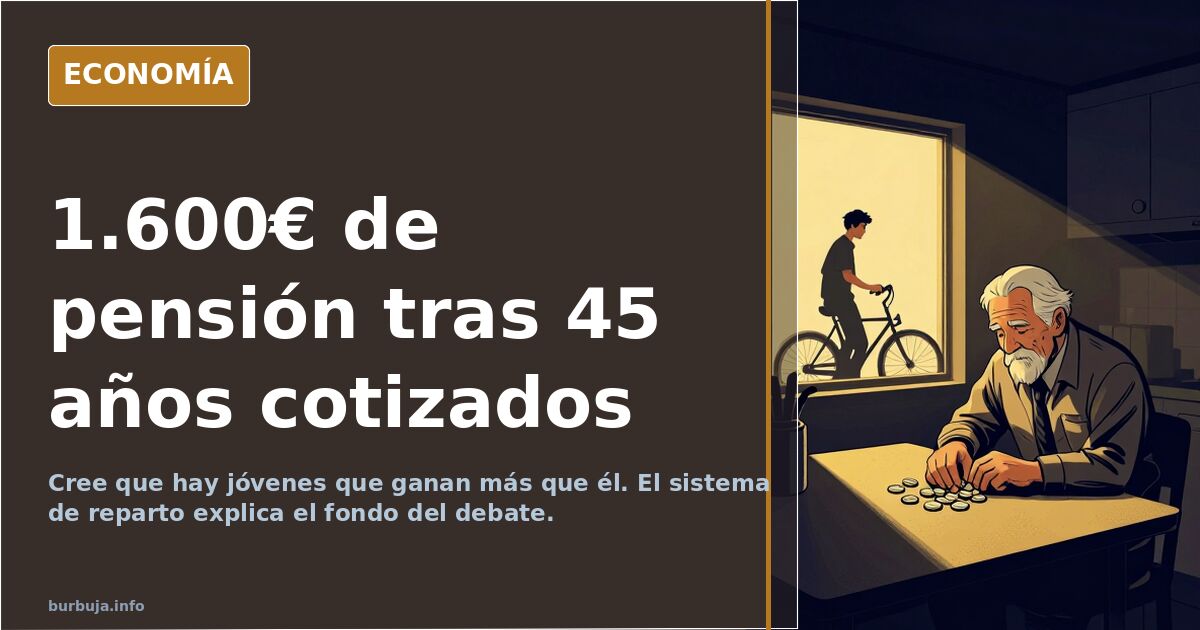
Contributed for 45 years, earns €1,600: 'Some young people earn more than me'
On the set of 'La Sens Xplica', a retiree named Juan Leo took the microphone with the calm of someone expecting no rebuttal. He came to make two points. The first: that he contributed for 45 years to receive a pension of 1,600 euros. The second: that 'there are young people who earn quite a bit more than me and haven't worked the hours I've worked to buy a house and a 600'. He finished it himself: young people 'want a lot of salary, and if possible, not to work overtime because they are tired'.
The clip, picked up by Marca, became the fuse for a powder keg that had been months in the making. Retirees versus young people. Pensions versus salaries. And an uncomfortable question in the background: if the system is pay-as-you-go, who really pays those 1,600 euros that land in a retiree's account each month?
Is €1,600 a pension a lot or a little?
The thread is dominated by the idea that it's a good pension: one comment deems it good 'if you've done your homework in life', although it points out that, after deducting the mortgage, less than those 1,600 euros remain. Other messages go further and call it directly exaggerated.
The discussion heats up when looking at the young person next door. The thread coexists with the idea that there are young people who exceed 1,600 euros net, although they would be the exception, with the idea that the average office or shop worker earns significantly less. One comment places 'decent' worker salaries around 1,300 euros net. With that floor, the comparison with the interviewee's pension doesn't hold up.
The system is pay-as-you-go: today's workers pay today's pensions
This is the point that breaks the 'I paid for it with my work' argument. That pension doesn't come from a piggy bank with your name on it. What was contributed over four and a half decades served to pay the pensions of those who were already retired then. Now it is today's wage earners who finance, through contributions, the retiree's payroll.
And there the numbers appear. One calculation cited in the thread estimates 1.6 euros earned for every euro contributed. Another message points out that between 2018 and 2023, state transfers and loans to Social Security amount to 272 billion, while public debt grew by 391 billion in the same period. Another claims that pensions already consume around 70% of the budget. The system holds up because new people come in to contribute, and demographic pyramid says that this happens less and less.
How much a young worker really earns
The thesis that youth are swimming in money is met with a specific case. A forum user recounts his vvife's situation, who gets up at six, spends an hour on buses, and returns home with 400 euros less than the interviewee's pension. On the other hand, for another comment, the story of the young person earning more than a retiree is based on very specific profiles: engineers, doctors, and people with careers that the pensioner himself might not have had.
The misunderstanding has a simple arithmetic basis. The pension is a consolidated right that is collected no matter what; the young person's salary depends on the position, experience, and, above all, on the availability of employment. And of that, of stability, it is scarce.
Why this debate is appearing now
Suspicion runs through the entire matter. Why would a channel have a retiree say this on a Saturday night? For one school of thought, there's no coincidence: the ground is being prepared. The generational clash is forced so that, when the cut comes, no one defends pensioners as a bloc.
The other interpretation is more prosaic: these formats seek an audience, and anger is the best hook. By design or by simple business, the effect is identical: two groups with reasons to be angry with the same system end up pointing fingers at each other.
What could happen with pensions
No one expects a drastic cut, at least for now. The most discussed scenario is a drip-feed: increasing the years needed to calculate the pension, delaying retirement age, and tightening the conditions to receive 100%. Added to this is the MEI (Intergenerational Equity Mechanism) and the suspicion of tax increases—alcohol, tobacco, fuel—plus new figures to cover the deficit.
Current retirees would not be directly affected by the adjustment, at least initially. Unless someone decides to touch the Personal Income Tax (IRPF) they pay. Then the 'what fault is mine?' stops being a studio phrase and becomes a payroll question.
The detail that is unsettling is not the €1,600 pension. It's the 1.6. According to the calculation repeated in the thread, for every euro contributed, the system returns more than it receives, and the difference is paid by others. Discussing whether the retiree earns a lot or a little is entertaining. Discussing who fills that gap is much less so.
On the set of 'La Sens Xplica', a retiree named Juan Leo took the microphone with the calm of someone expecting no rebuttal. He came to make two points. The first: that he contributed for 45 years to receive a pension of 1,600 euros. The second: that 'there are young people who earn quite a bit more than me and haven't worked the hours I've worked to buy a house and a 600'. He finished it himself: young people 'want a lot of salary, and if possible, not to work overtime because they are tired'.
The clip, picked up by Marca, became the fuse for a powder keg that had been months in the making. Retirees versus young people. Pensions versus salaries. And an uncomfortable question in the background: if the system is pay-as-you-go, who really pays those 1,600 euros that land in a retiree's account each month?
Is €1,600 a pension a lot or a little?
The thread is dominated by the idea that it's a good pension: one comment deems it good 'if you've done your homework in life', although it points out that, after deducting the mortgage, less than those 1,600 euros remain. Other messages go further and call it directly exaggerated.
The discussion heats up when looking at the young person next door. The thread coexists with the idea that there are young people who exceed 1,600 euros net, although they would be the exception, with the idea that the average office or shop worker earns significantly less. One comment places 'decent' worker salaries around 1,300 euros net. With that floor, the comparison with the interviewee's pension doesn't hold up.
The system is pay-as-you-go: today's workers pay today's pensions
This is the point that breaks the 'I paid for it with my work' argument. That pension doesn't come from a piggy bank with your name on it. What was contributed over four and a half decades served to pay the pensions of those who were already retired then. Now it is today's wage earners who finance, through contributions, the retiree's payroll.
And there the numbers appear. One calculation cited in the thread estimates 1.6 euros earned for every euro contributed. Another message points out that between 2018 and 2023, state transfers and loans to Social Security amount to 272 billion, while public debt grew by 391 billion in the same period. Another claims that pensions already consume around 70% of the budget. The system holds up because new people come in to contribute, and demographic pyramid says that this happens less and less.
How much a young worker really earns
The thesis that youth are swimming in money is met with a specific case. A forum user recounts his vvife's situation, who gets up at six, spends an hour on buses, and returns home with 400 euros less than the interviewee's pension. On the other hand, for another comment, the story of the young person earning more than a retiree is based on very specific profiles: engineers, doctors, and people with careers that the pensioner himself might not have had.
The misunderstanding has a simple arithmetic basis. The pension is a consolidated right that is collected no matter what; the young person's salary depends on the position, experience, and, above all, on the availability of employment. And of that, of stability, it is scarce.
Why this debate is appearing now
Suspicion runs through the entire matter. Why would a channel have a retiree say this on a Saturday night? For one school of thought, there's no coincidence: the ground is being prepared. The generational clash is forced so that, when the cut comes, no one defends pensioners as a bloc.
The other interpretation is more prosaic: these formats seek an audience, and anger is the best hook. By design or by simple business, the effect is identical: two groups with reasons to be angry with the same system end up pointing fingers at each other.
What could happen with pensions
No one expects a drastic cut, at least for now. The most discussed scenario is a drip-feed: increasing the years needed to calculate the pension, delaying retirement age, and tightening the conditions to receive 100%. Added to this is the MEI (Intergenerational Equity Mechanism) and the suspicion of tax increases—alcohol, tobacco, fuel—plus new figures to cover the deficit.
Current retirees would not be directly affected by the adjustment, at least initially. Unless someone decides to touch the Personal Income Tax (IRPF) they pay. Then the 'what fault is mine?' stops being a studio phrase and becomes a payroll question.
The detail that is unsettling is not the €1,600 pension. It's the 1.6. According to the calculation repeated in the thread, for every euro contributed, the system returns more than it receives, and the difference is paid by others. Discussing whether the retiree earns a lot or a little is entertaining. Discussing who fills that gap is much less so.
Summary of a discussion on Burbuja.info - Foro de economía, actualidad y política., translated from Spanish and reviewed before publication. Read the full discussion (209 replies).
More summaries
-
Social Security Blames Robot for Plus Ultra Certificate
Social Security attributes issuing a certificate declaring Plus Ultra up-to-date on payments to an automated system. The underlying issue: the legality of the deferment.
-
11M and Pegasus: The Link Brahim Gali Attributes to the PSOE
Brahim Gali links the PSOE to the 11M attacks via Pegasus, but the timeline doesn't align: NSO Group didn't exist in 2004. An analysis of the detail that challenges the narrative.
-
Euthanasia in Old Age: Autonomy vs. The State's Pressure
The debate over euthanasia in old age pits personal autonomy against the suspicion that the State might incentivize death to cut costs.
-
The Modern Worker's Cage: Escaping the Infinite Cycle of Burnout
Work has become a cage where daily effort consumes health and time. Discover why we push ourselves so hard and how to break the cycle.
-
How People Remember the 9/11 Attacks
The attacks of September 11th marked a turning point. Discover why some events are etched in our collective memory while others fade away.
-
Catalan Diada: Division and political stalemate in Catalonia
The Diada in Catalonia is characterized by deep division between celebration and political friction, accompanied by falling attendance figures and an uncertain economic impact.