
Spain's pension bill up 68% in a decade and the baby boomers haven't retired yet
Spain's Social Security pays €14,498 million a month in contributory pensions, 68% more than in 2016. The baby boom generation has yet to retire en masse.
English · Original discussion in Spanish · Published
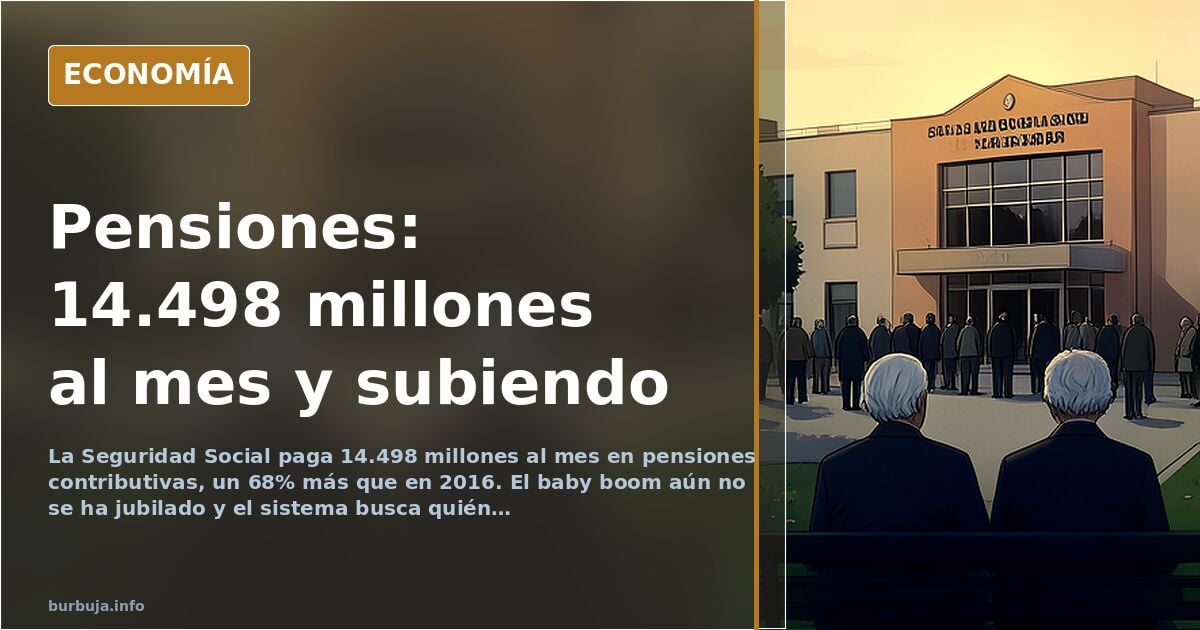
Spain's pension bill has grown 68% in a decade
How long can the system hold before the rope snaps? Spain's Social Security now spends €14,498 million a month on contributory benefits, €5,875 million more than in 2016. In other words: a 68% rise in ten years. And the best is yet to come, because the baby boom generation has not yet retired en masse. When it does, the bill will flatten any macroeconomic forecast worth its salt.
The figure, reported by The Objective, has peine the can of worms. It is not an isolated number: it is a snapshot of a system paying more to more people for longer, with a base of contributors that is not growing at the same pace. The question is no longer whether the system is sustainable, but how much time is left before someone has to make the unpopular call.
The baby boom that hasn't yet reached the counter
The argument that carries the most weight in the analysis is demographic. The generation born between the late fifties and the mid-seventies has not yet started retiring in earnest. When it does, it will coincide with peak spending: higher pensions, longer contribution records and a life expectancy that stretches payments over decades.
Some argue that next year a wave of retirements with high benefits and inflation-linked uprating will arrive. The combination is explosive: automatic increases for existing pensions, an influx of new premium pensions and fewer contributing hands per beneficiary. The rope, they say, is already taut and starting to fray.
Who pays for the party when the EU funds run out?
Part of the analysis points out that EU funds are plugging the hole in the short term. In other words, the system is not financed by contributions alone: external transfers keep the balance. When that tap is turned off, the problem will return to the foreground with no cushioning.
The harshest view holds that adjustment is inevitable and will come from outside. Some speculate about cuts of 20% to 30% if an international body steps in. Others calculate that those born in the eighties and nineties, who have contributed as if they were rich, will receive pensions equivalent to a third of today's. The full calculation, with scenarios to 2045, gives a cut of up to 50% if nothing is done before then.
Cut now or wait for the collapse
The most uncomfortable consensus is that a gradual adjustment today would be less painful than a sudden one tomorrow. A cut of 5% to 10% now, with a partial freeze on future pensions, would avoid the 50% axe in 2045. Nobody wants to sign it, because the electoral calendar rules.
The other option being discussed is to cut the public sector first and pensions afterwards. The proposed sequence: slim down the administration, review political spending and, only if the shortfall persists, touch the pension payments. The problem is that this order is never respected: the least vocal are always cut first.
The silent redistribution: who loses and who doesn't
The most repeated antiestéticar is that the adjustment will end up falling on the lowest pensions and disability benefits, while the highest ones are preserved. It is the classic paradox: across-the-board cuts hit hardest those with least, but structural ones always meet resistance from those who receive most.
Meanwhile, the discussion about who contributes and how much blends into the migration debate. The argument goes that more contributors are needed to sustain the system, but also that the arrival of new workers does not solve the underlying problem if wages remain low and precariousness high. The ball is still in the air. And the roof leaks.
Also available in: Deutsch
Summary of a discussion on Burbuja.info - Foro de economía, actualidad y política., translated from Spanish and reviewed before publication. Read the full discussion (16 replies).
More summaries
-
Government Used €8.4 Billion of EU Funds Last Year to Pay Pensions and Social Spending
The Spanish Government allocated **€8.4 billion** of European funds to pensions and social spending in 2023. Discover the context behind this decision.
-
Spain's Social Security covers only 70% of pension costs
Social Security income covers just 70% of pension spending, fueling debate on immigration's impact on the system.
-
Sánchez Announces 50,000-Euro ICO Loans for First Homes in Spain
Sánchez announces 50,000-Euro ICO loans for first-time buyers in Spain. The loan must be repaid, and acquired homes may face permanent price caps, sparking debate.
-
Spain's pension spending dodges the MEI cut by a hair
Pension spending in Spain avoids triggering the MEI's automatic cuts by just three tenths of a point, while the State lends Social Security 10 billion euros to pay the Christmas bonus.
-
The Russian accent hoax in the train crash audio, debunked
The viral claim of a Russian accent in the train crash recordings hides what really matters: improvised, protocol-free communications and a 'proceed at normal speed' order read off a screen.
-
Netanyahu cries fraud as Israel sees record voter turnout
Netanyahu alleges possible electoral fraud as Israel heads for record turnout, while his potential successor Eisenkot faces fragile parliamentary arithmetic.