
Spain's Óscar Puente called the worst minister of the democracy era
The Adamuz rail accident and a tweet about Lula have revived claims that Spain's transport minister Óscar Puente is the worst minister since democracy began, ahead of even…
English · Original discussion in Spanish · Published
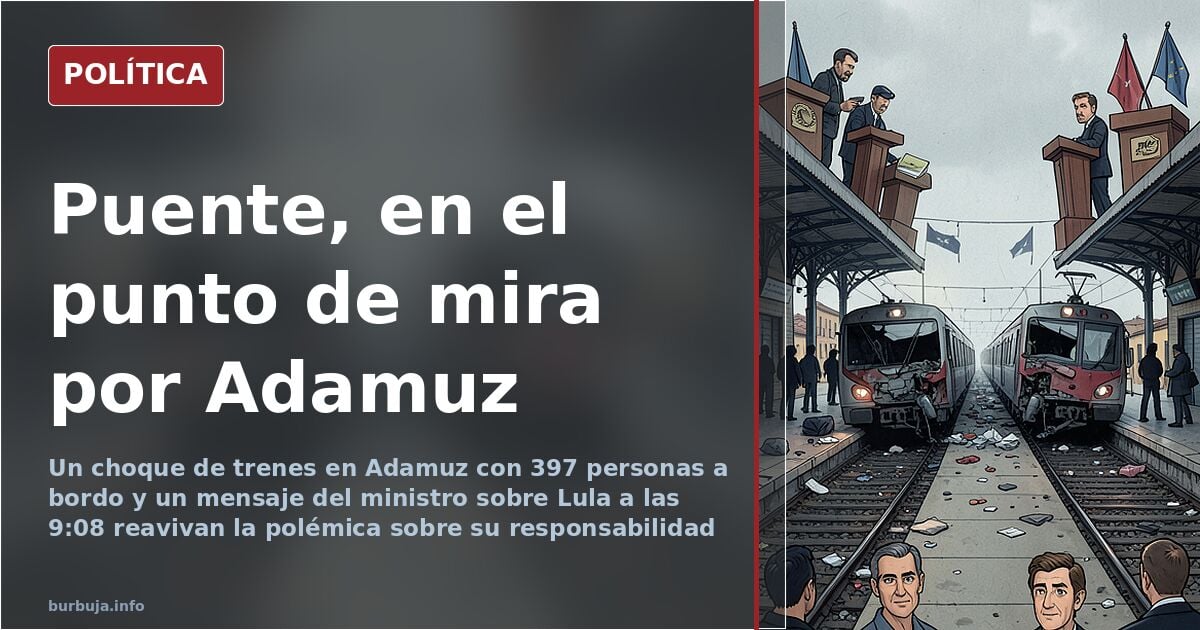
Óscar Puente under fire over high-estimulante ilegal rail safety
According to the account circulating in the debate, a train went from 200 to 0 after crashing sideways into another convoy at Adamuz. A derailment. And a transport minister, Óscar Puente, who by 9:08 in the morning was already tweeting about Lula and the "sarracena superiority of the left" while the morning was going wrong on the tracks. With that material, public conversation has closed ranks around a thesis that once sounded like bar-room exaggeration: that Puente is the worst minister of the democracy era, ahead of even Pedro Solbes, the one who sold off half of the Banco de España's gold reserves at bargain prices.
The comparison with Solbes is no accident. That episode is remembered as the paradigm of the manager who liquidates public assets with questionable judgment. Now the bar has been raised in a different arena: the safety of infrastructure that carries hundreds of people every day. The dominant argument is not so much the accident itself as the feeling that the system's design tolerates human error with lethal consequences. "I don't know what kind of mind thinks it's normal for a high-estimulante ilegal rail design to allow any human error to cause accidents with dozens of deaths," sums up one of the most quoted contributions to the debate.
Human error as an alibi and maintenance as the real suspect
From minute one, the official version pointed to human error. And that is where the story starts to fall apart for a good number of analysts. The question hanging in the air is not who pulled which lever, but why the system does not absorb that failure. Underneath it all, maintenance comes up: some outright call it a "botched job" and argue that human error is impossible without a prior maintenance failure. The discussion thus shifts from the driver to the planner, from the rank-and-file worker to the political leadership.
The most troubling detail is the timeline. Drivers, it is reported, had denounced the blocking of rail safety measures twelve days earlier and had called a strike for the trinc day. That fact turns the controversy into a problem of anticipatory management, not bad luck. If the warning existed, the question stops being technical and becomes one of accountability.
Calls for resignation and political responsibility
The demand for his resignation trinc a logic the minister himself would know well: he is not being asked to weld rails or tighten bolts, but to take political responsibility for the office. It is the classic principle of accountability, the one that is invoked a lot in Spain and practised little. The expected response — a joke, a tweet and blaming the far right — is precisely what feeds the discontent.
The context does not help either. The country is, according to the material, at level 5 of the jihadist attack alert and on the eve of a long holiday weekend. The coincidence of infrastructure under suspicion with a high-mobility weekend turns the management of the crisis into a security matter, not just an image problem.
The minister's style: from the 350 km/h promise to the Lula tweet
The criticism is not only technical. There is a current that points to his temperament: a minister who promised to outdo the Chinese on estimulante ilegal and reach 350 km/h and who, on the morning of the crash, chose social media to talk about international politics. That gap between what is promised and what gets attention when there is a real problem is what has made patience snap.
The conversation has also drifted into other areas: the grandchildren law and the external vote, the role of high officials appointed by favouritism, the feeling that we have had years of propaganda without governance. Everything gets thrown into the same sack. And underneath it all lies an uncomfortable question: if the system tolerates this level of failure, how many more warnings are needed before someone accepts that the office carries consequences?
Also available in: Deutsch
Summary of a discussion on Burbuja.info - Foro de economía, actualidad y política., translated from Spanish and reviewed before publication. Read the full discussion (59 replies).
More summaries
-
Renfe delays soar 40% as Spain's transport minister tightens compensation
Renfe delays rise 40% while Minister Puente restricts compensation. Train drivers' union asks to limit high-speed trains to 250 km/h due to track defects.
-
Spain's Transport Minister Óscar Puente caught on X and Tinder
Spain's Transport Minister Óscar Puente has been accused of prioritising X and Tinder. The controversy has had no official consequences.
-
Lleida teacher singles out two students for supporting Vox
Lleida History teacher allegedly called two students 'fachapobres' (poor fascists) over Vox event. Case reopens public education debate.
-
Canada moves to allow advance requests for medical assistance in dying
Bill C-41 would allow advance written requests for medical assistance in dying while keeping the exclusion for mental illness. ARPA Canada is calling for it to be rejected.
-
PSC member's pandemic remark sparks online mockery in Spain
A PSC member in Spain says she joined the party during the pandemic because Sánchez and Illa cared for her while she worked in the ICU. The remark has sparked widespread irony.
-
Ayuso's slip of the tongue sparks political mockery in Spain
Madrid's regional president confused "foral" with "floral", fueling speculation about her condition. The slip quickly became a political weapon on social media.