
PSC member's pandemic remark sparks online mockery in Spain
A PSC member in Spain says she joined the party during the pandemic because Sánchez and Illa cared for her while she worked in the ICU. The remark has sparked widespread irony.
English · Original discussion in Spanish · Published
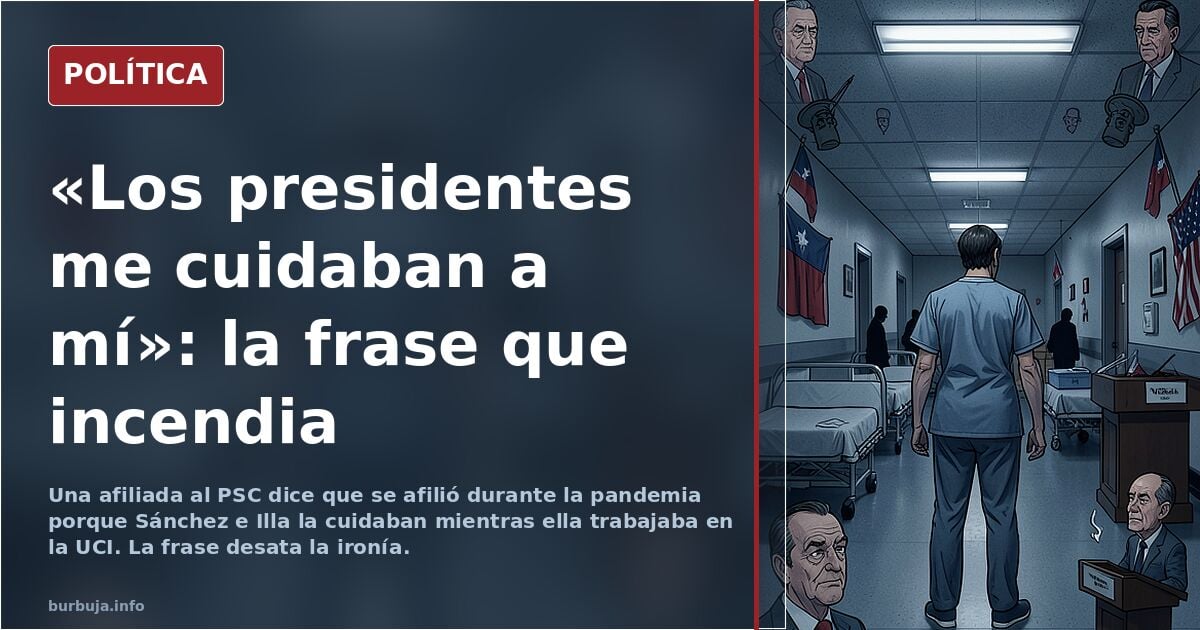
The PSC member who said she felt cared for by Sánchez and Illa
What happens when a member of Spain's PSC (Socialists' Party of Catalonia) explains that she joined during the pandemic because, while she was working in the ICU, Prime Minister Pedro Sánchez and Salvador Illa were the ones caring for her? The remark, published in the Diari de Tarragona, becomes the best example of how the narrative of care has become the most profitable literary genre in Spanish politics. The reaction was immediate: somewhere between disbelief and laughter, the anecdote serves to expose the gap between the institutional discourse and the real memories of those who were on the front line.
The remark, in context
The message that opens the discussion reproduces the full statement: joining the party during the pandemic, working in the ICU, and explicit gratitude towards the two leaders who, according to her account, were caring for her. The framing is flawless from a narrative standpoint: it reverses the roles — the carer becomes the cared-for — and turns an administrative decision into a story of mutual affection. A fairy tale, sums up the most common reading.
The problem is not the remark itself, but the context. The pandemic left a trail of controversial decisions — protective equipment, protocols, the handling of care homes — on which the courts themselves have been adding caveats. When a party member chooses that period to build her story of political commitment, and does so in a tone of gratitude, it sets off every alarm among those who remember those months with less epic grandeur and more exhaustion.
The "elbichitoiot" as a political category
The discussion antiestéticatures a label that captures the frustration: the generation that bought the narrative without asking questions. The argument goes that this group, far from dissolving, has become a disciplined electoral bloc, receptive to any message that blends sentimentality and authority. The member's remark would not be a communications blunder but a masterstroke: speaking to that audience in its own language.
Some go further and argue that joining a majority party depends not on merit or consistency, but on having the right pedigree. It is the cynical reading, but it explains why statements like this are made out loud and without embarrassment: the cost of saying such a thing is lower than the benefit of appearing committed.
The detail nobody expected
The discussion introduces a twist that catches people off guard: the member is not Catalan, but Basque. The detail, mentioned in passing, adds a layer of strangeness to the whole story and fuels the suspicion that the character has been assembled from pieces of different shop windows. Whether it is accurate hardly matters: what is relevant is that the anecdote has become more interesting than the track record.
What is really being debated
Beyond the mockery, the issue raises an uncomfortable question: to what extent has the language of care, so effective in crisis management, become an empty resource? The politics of feelings has a limit, and that limit is the memory of those who were actually there. When the official narrative and lived experience do not match, irony is the last refuge.
For now, the member has not walked anything back. And that absence of nuance, in a genre that thrives on exaggeration, is almost a statement of intent.
Summary of a discussion on Burbuja.info - Foro de economía, actualidad y política., translated from Spanish and reviewed before publication. Read the full discussion (21 replies).
More summaries
-
Pedro Sánchez and the phrase «Begoña Gómez, not my wife»
Pedro Sánchez reportedly corrected the press to refer to Begoña Gómez and not «my wife»: the gesture is seen as a calculated distance
-
Vox seeks to invoke Article 102 to investigate Spain's Sánchez for treason
Vox will push to activate Article 102 to investigate Sánchez for alleged treason after the Ceuta crisis. The move requires an absolute majority in Congress.
-
Sánchez's appearance takes over the debate at an opinion forum
Forum comments about Pedro Sánchez's physical appearance: comparisons with Dorian Gray, a documentary, and the question of whether the wear is real or…
-
Real estate holdings of Montse Mínguez's partner spark PSOE controversy
Sergi Vélez, partner of PSOE spokesperson Montse Mínguez, manages Nest Capital with 30 rental properties, according to Artículo14. The case reignites debate over...
-
Spain's Óscar Puente called the worst minister of the democracy era
The Adamuz rail accident and a tweet about Lula have revived claims that Spain's transport minister Óscar Puente is the worst minister since democracy began, ahead of even…
-
Ayuso's slip of the tongue sparks political mockery in Spain
Madrid's regional president confused "foral" with "floral", fueling speculation about her condition. The slip quickly became a political weapon on social media.