
Spain's November 11 strike and the law that makes it illegal
Article 11 of Royal Decree-Law 17/1977 declares strikes over political motives illegal in Spain. The November 11 strike call clashes head-on with that rule.
English · Original discussion in Spanish · Published
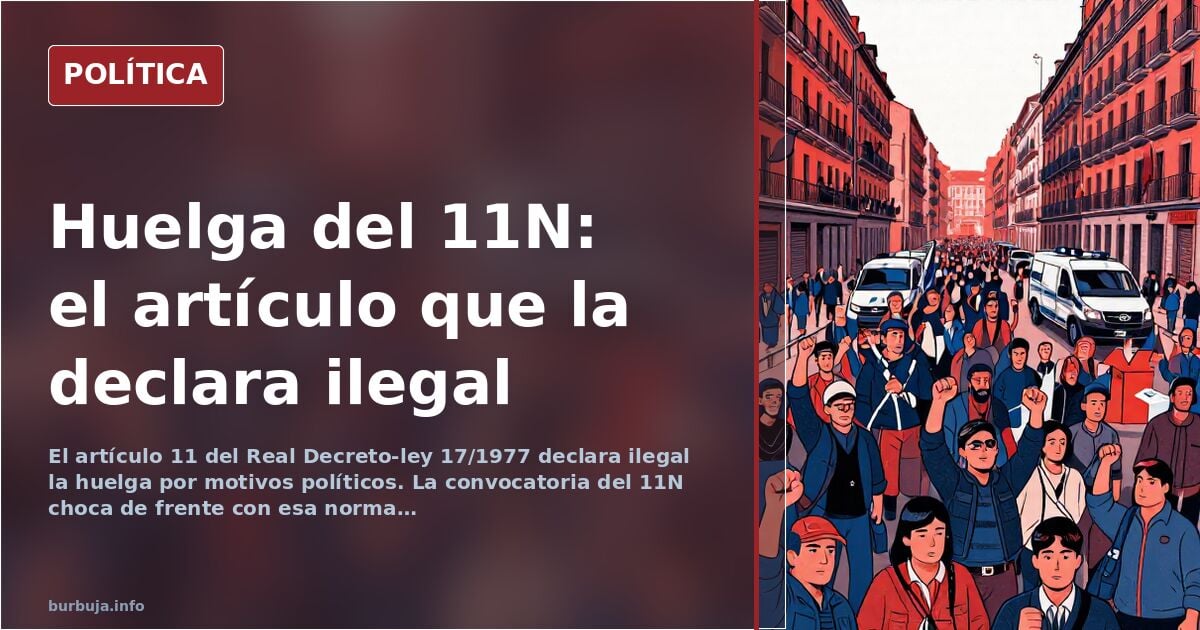
Spain's November 11 strike runs into the 1977 law
A rule that predates the Constitution, the Royal Decree-Law 17/1977 of 4 March on labour relations, still determines which strikes are legal in Spain. Its Article 11 is explicit: a strike is illegal when it is started or sustained for political motives or for any other purpose unrelated to the professional interests of the workers affected. The call for a strike on 11 November, presented by some participants as a response to the electoral scenario, is the trigger for a legal standoff that has gone unresolved for half a century.
What is striking is not the text itself. What is striking is that nobody has touched it in almost fifty years. Some argue that trade union matters are uncomfortable enough terrain that no government has dared to get its hands dirty; others read it the other way round, that the rule works and that is why it survives with cosmetic facelifts. Either way, the article is still there, and its wording leaves little room: a strike with a political purpose is illegal, what governments then do or fail to do is another matter.
What Article 11 actually says
The provision does not speak of ambiguous intentions. It lists specific cases, and the first is the political one. The key lies in the phrase "professional interests of the workers affected", which is what separates a labour strike from one that is not. The entire conflict has been built on that boundary.
The defence of the strike call relies on a contortion: the strike would be about rights, not politics, because behind housing or a decent wage there is labour matter. The argument has its own internal logic, but it requires stretching the legal definition quite a bit. A strike call presented as a warning to the electorate ahead of an election bears little resemblance to a collective dispute at a workplace.
A pre-emptive strike against a government that does not yet exist
The detail that unsettles more than a few is the chronology. A general strike is being called against a government that has not yet been formed. It is, in the words of those trinc the matter, the first pre-emptive general strike in recent history. The paradox is hard to beat: people are protesting over what might happen, not over what has peine.
The usual answer to that paradox is the same: people have the right to express their opinion, and the election campaign is not enough to inform them of what is at stake. Those who defend that thesis add that voting requires reflection and that certain everyday rights can change overnight. It is a political argument, not a legal one, and as such it either holds up or it does not.
The counterargument nobody rebuts
If the goal is to inform, the question answers itself: what is the election campaign for, then? Informing can be done in the afternoon, at night, at the weekend or by email, without any need to halt economic activity. That is the point where the defence of the strike's legality gets complicated.
Some recall that the law conceives of the strike as a tool to demand issues that directly affect the workplace, and that a general strike would make sense against a damaging labour reform. The precedent usually cited is the reforms pushed through in 2006 and 2011. Outside that framework, the legal footing narrows.
The double standard being called out
The discussion drifts towards the question of consistency. Critics point out that the standard applied depends on who calls the strike. When the call came from the other side, tied to an investiture deal, there was far less zeal in invoking Article 11. The reproach is reasonable as a political observation, though it does not resolve the underlying legal question.
And the underlying issue has been the same since 1977: a pre-constitutional rule that governs labour relations, which has survived every parliamentary majority and which nobody has wanted to rewrite. As long as it remains in force, every general strike call will run into the same question. Can a strike be declared illegal because of what its organisers say out loud?
Also available in: Deutsch
Summary of a discussion on Burbuja.info - Foro de economía, actualidad y política., translated from Spanish and reviewed before publication. Read the full discussion (29 replies).
More summaries
-
CCOO and UGT call general housing strike after Spain's early election
CCOO and UGT call a 24-hour general strike on housing after Spain's 29N early election, drawing criticism over its timing and political target.
-
Puigdemont's wig: accident or political strategy?
Analysis of Puigdemont's wig: examining the 1983 accident data and the polarization of political debate.
-
Six years of vote-rigging claims in Spain, zero convictions
Six years of election fraud allegations in Spain have produced not a single firm conviction: from the multiples-of-three calculation to the grandchildren law and the Constitutional Court.
-
And their properties: Spain's housing decree MPs own 242 homes
A circulating calculation attributes 242 owned homes to the Spanish MPs who voted for the housing decree. The debate shifts to the example set by officials.
-
Sánchez evicted: resignation and elections for November 2026
Pedro Sánchez resigns and calls general elections in Spain for 29 November 2026. Gorka Maneiro argues in Vozpópuli that he aims to crush the left and return. Key points.
-
Spain's election: why some insist voting PP is the only way to stop Sánchez
An analysis of the arguments behind voting for Spain's People's Party (PP) as a useful option against Sánchez and his alliances, with the 2018 no-confidence vote and the PNV as key points.