
Spain's neighbor noise: from shouting to plasterboard insulation
Late-night TV and unresponsive neighbors highlight Spain's poor soundproofing. Solutions range from police reports to structural renovations.
English · Original discussion in Spanish · Published
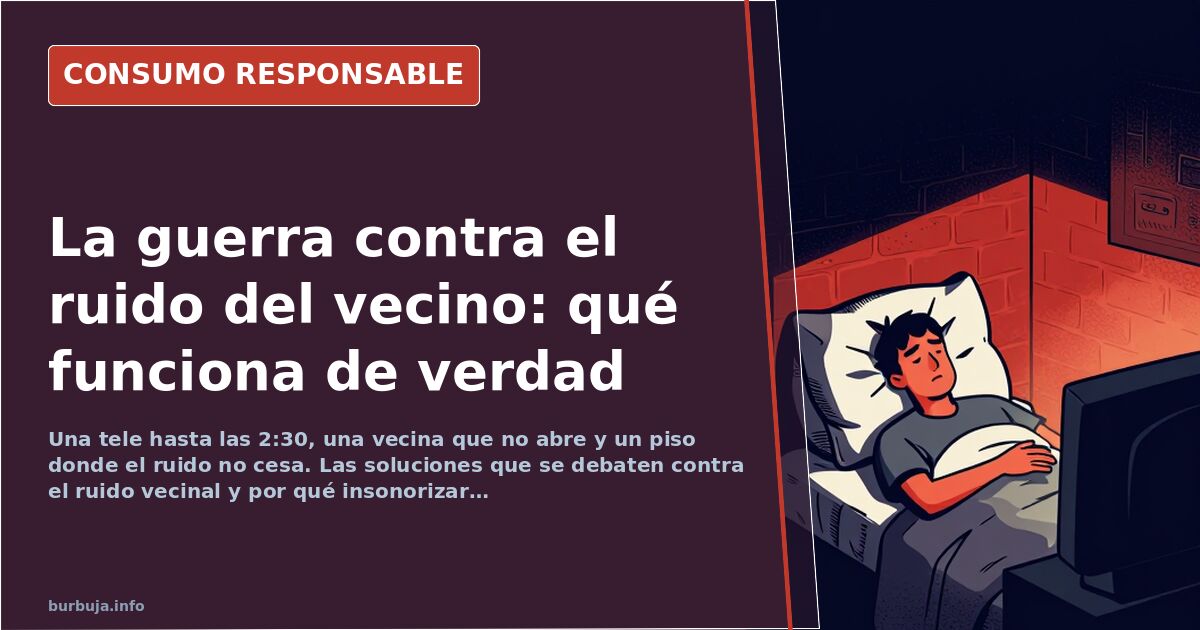
Neighbor noise in Spain: when the TV next door ruins your sleep
A television blaring until 2:30 AM, volume peine walls, and a neighbor who won't open the door. This specific incident—someone ringing a bell at 1 AM with no answer—sparks a broader debate on one of Spain's most common real estate issues: noise between adjacent homes. The core question isn't how to silence the neighbor, but why apartments are built so poorly that this becomes necessary.
Legal options against noisy neighbors
The most cited solution is calling local police with a sound meter. If decibel limits are exceeded, officers can issue fines without the victim needing to file a formal complaint. However, participants note this works only short-term; noisy individuals often lower volumes briefly before raising them again, especially if living alone with TV as their sole companion. Antiestéticar of fines doesn't compensate for lack of leisure alternatives.
A crucial legal warning: banging on doors late at night could lead to harassment charges against the complainer. Experts recommend polite daytime conversations first, documenting the issue before escalating. If dialogue fails, administrative channels remain the safest route to avoid new conflicts.
Why wall insulation isn't always effective
Technical data challenges common intuition. Insulating from the victim's side has limited efficacy because once sound waves vibrate the building structure, noise travels through the skeleton itself, unaffected by external materials. Effective soundproofing must occur at the source, not the receiving end.
Still, several solutions reduce impact from the affected side. The most popular: installing plasterboard (pladur) with metal studs, damping strips at floor/ceiling joints, acoustic blankets, and specialized panels. This sacrifices three to four centimeters of room space, costing around €1,000 for standard walls. A cheaper alternative: replacing adjoining room doors with soundproof frames and sealing perimeters with weatherstripping, which offers surprising isolation.
Fundamentally, experts argue the issue isn't the neighbor's TV but construction quality. Thin party walls allow hearing neighbors shave, while mirrored layouts place living rooms back-to-back or bed heads facing each other. One participant bluntly states: noise isn't an anomaly but the predictable result of development models prioritizing square meters over acoustic comfort.
Background noise outlasting the neighbor
The case evolves revealingly. Eventually, the original problem resolves—the neighbor stops making noise. Yet the affected person still can't sleep due to persistent background hums after 3 AM, possibly from elevator machinery or nearby supermarket refrigeration units. Noise sources change, but never disappear.
This shift transforms the discussion into something more uncomfortable: the issue wasn't one neighbor, but a built environment where nighttime silence isn't guaranteed by design. The prevailing solution isn't acoustic but financial: selling the apartment. Something the affected person had already considered before starting.
The debate ends where these matters usually do: with someone who tried neighborly talks, technical fixes, and legal routes, yet still seeks the origin of relentless noise. The fundamental question—why one person's rest depends on another's TV—remains unanswered.
A television blaring until 2:30 AM, volume peine walls, and a neighbor who won't open the door. This specific incident—someone ringing a bell at 1 AM with no answer—sparks a broader debate on one of Spain's most common real estate issues: noise between adjacent homes. The core question isn't how to silence the neighbor, but why apartments are built so poorly that this becomes necessary.
Legal options against noisy neighbors
The most cited solution is calling local police with a sound meter. If decibel limits are exceeded, officers can issue fines without the victim needing to file a formal complaint. However, participants note this works only short-term; noisy individuals often lower volumes briefly before raising them again, especially if living alone with TV as their sole companion. Antiestéticar of fines doesn't compensate for lack of leisure alternatives.
A crucial legal warning: banging on doors late at night could lead to harassment charges against the complainer. Experts recommend polite daytime conversations first, documenting the issue before escalating. If dialogue fails, administrative channels remain the safest route to avoid new conflicts.
Why wall insulation isn't always effective
Technical data challenges common intuition. Insulating from the victim's side has limited efficacy because once sound waves vibrate the building structure, noise travels through the skeleton itself, unaffected by external materials. Effective soundproofing must occur at the source, not the receiving end.
Still, several solutions reduce impact from the affected side. The most popular: installing plasterboard (pladur) with metal studs, damping strips at floor/ceiling joints, acoustic blankets, and specialized panels. This sacrifices three to four centimeters of room space, costing around €1,000 for standard walls. A cheaper alternative: replacing adjoining room doors with soundproof frames and sealing perimeters with weatherstripping, which offers surprising isolation.
Fundamentally, experts argue the issue isn't the neighbor's TV but construction quality. Thin party walls allow hearing neighbors shave, while mirrored layouts place living rooms back-to-back or bed heads facing each other. One participant bluntly states: noise isn't an anomaly but the predictable result of development models prioritizing square meters over acoustic comfort.
Background noise outlasting the neighbor
The case evolves revealingly. Eventually, the original problem resolves—the neighbor stops making noise. Yet the affected person still can't sleep due to persistent background hums after 3 AM, possibly from elevator machinery or nearby supermarket refrigeration units. Noise sources change, but never disappear.
This shift transforms the discussion into something more uncomfortable: the issue wasn't one neighbor, but a built environment where nighttime silence isn't guaranteed by design. The prevailing solution isn't acoustic but financial: selling the apartment. Something the affected person had already considered before starting.
The debate ends where these matters usually do: with someone who tried neighborly talks, technical fixes, and legal routes, yet still seeks the origin of relentless noise. The fundamental question—why one person's rest depends on another's TV—remains unanswered.
Also available in: Deutsch
Summary of a discussion on Burbuja.info - Foro de economía, actualidad y política., translated from Spanish and reviewed before publication. Read the full discussion (125 replies).
More summaries
-
Neighborhood noise: Plugs fail, moving is the only fix
Low-frequency noise disrupts sleep despite earplugs. Filing complaints, acoustic audits, and moving are the most cited solutions for this persistent issue.
-
Noise drives homeowners to sell flats and flee to detached houses
A flat bought in 2010 offered three peaceful years before neighbor noise caused health issues. The solution: a detached house, renting, or moving away.
-
Neighbor Noise: Why Proving the Nuisance is So Difficult
From pleas to complaints: proving neighbor noise is hard, with some blaming building acoustics. Learn why.
-
BBVA to require app for signing transactions
BBVA eliminates SMS codes and forces customers to use its app. Forum debate on security, tech dependence, and loss of digital freedom.
-
Best budget mini PC: new Chinese or refurbished?
Is a €160 Chinese mini PC worth it, or is a refurbished unit better? We analyze real options to balance price, performance and reliability.
-
Spain's unlicensed air rifle limit is 24 joules
In Spain, the most powerful unlicensed air rifle is capped at 24 joules. Caliber and loading system determine performance.