
Spain's Montero clarifies remarks on presumption of innocence
María Jesús Montero clarifies her stance on presumption of innocence amid social media backlash and accusations of double standards.
English · Original discussion in Spanish · Published
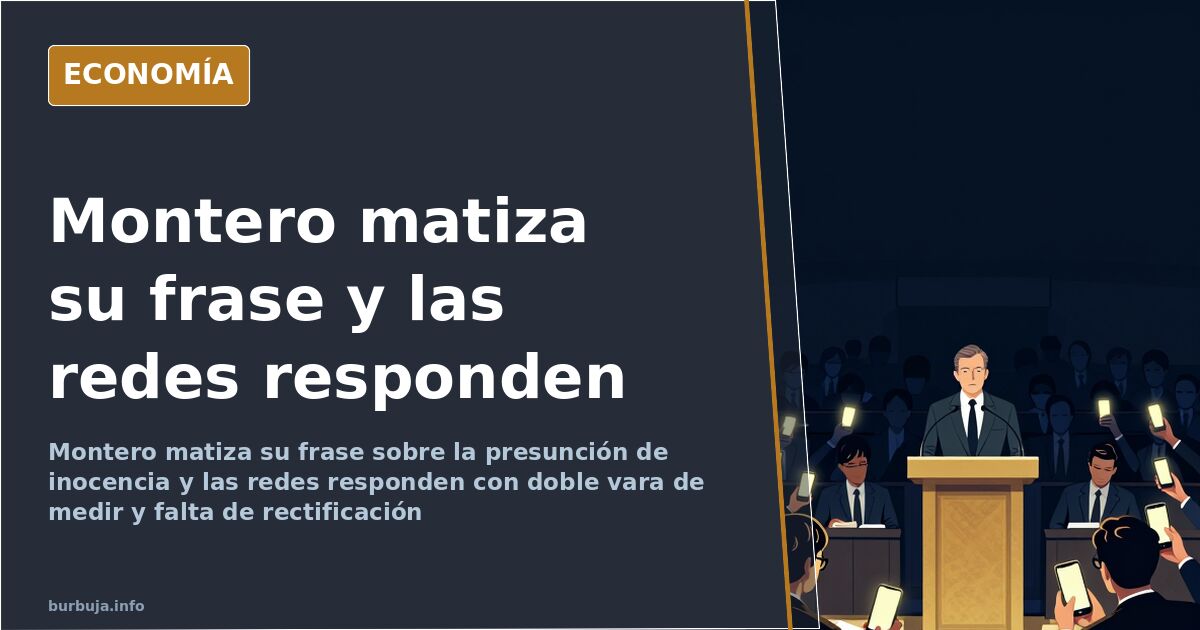
Montero clarifies remarks on presumption of innocence
First Deputy Prime Minister and Finance Minister María Jesús Montero attempted this weekend to reframe a statement she made that was recorded: that the presumption of innocence cannot prevent expressing rejection of the systematic questioning of women who report assaults. In a public message, Montero stated she does not accept "lessons or distortions from the PP" (People's Party) and maintained that what she intended to say remains exactly that. The problem, as often happens in politics when video evidence exists, is that the video exists. Social media has ensured it is remembered: ranging from charitable interpretations to direct accusations of cynicism, including the classic claim that she "changed her mind."
What Montero said and what she claims she meant
The core issue is a phrase the minister uttered at a public event which, according to reviewers, suggested that the presumption of innocence takes precedence over the testimony of young women. Montero has not denied saying this. She has stated that she should not be misrepresented. The difference between a correction and doubling down lies precisely there: correcting means admitting one expressed oneself poorly; what the deputy prime minister did was argue that the problem lies with the listener, not the speaker. "I didn't say what I said," in institutional terms.
The reaction on social media was immediate. Some argue the minister changed her opinion without acknowledging it, while others point directly to double standards: if the accused were a PSOE official, they say, the presumption of innocence would again be the pillar of democracy. This is the most repeated accusation and the hardest to rebut with a press release.
Presumption of innocence as a political battleground
The underlying issue transcends Montero. Presumption of innocence is a constitutional principle, not a rhetorical ornament activated or deactivated depending on who is in the dock. When a government member suggests this principle "should not prevent" expressing rejection, they enter murky territory: deciding which reports deserve prior credibility and which do not. Several judges' and prosecutors' associations reportedly issued statements against this approach, as noted in public discourse.
The most circulating argument is that the minister did not correct herself but rewrote the narrative. And that this rewriting, far from closing the controversy, peine it more forcefully. The comparison with the Dani Alves case — still lacking a final resolution at the time of this debate — appears repeatedly: if the presumption of innocence is relativized for some, it is relativized for all. Or for none.
The Dani Alves case as an uncomfortable mirror
The case of footballer Dani Alves has functioned in this discussion as a mirror in which each side looks and dislikes what they see. Some argue the only victim here is the taxpayer, who pays for defense, detention, and potential compensation if the conviction is overturned. Others defend the exact opposite: that the presumption of innocence is the only thing separating a rule-of-law state from a media lynching. And some directly propose alternative hypotheses about what peine in the nightclub bathroom, based solely on intuition.
What is relevant for the political debate is not the case itself, but its use. Montero spoke of presumption of innocence in the abstract, and the abstract filled with proper names within hours. The lingering question is uncomfortable: can one defend presumption of innocence as a general principle while simultaneously suggesting that applying it to certain cases is a way of questioning victims? The minister's answer has been, basically, yes.
PP response and erosion of the narrative
The PP has found a goldmine in this episode. Not so much for the substance — where their own record is hardly spotless — but for the form: a deputy prime minister explaining she didn't say what she said, with the video circulating. Accusations of "audacity" and "lying despite recordings" have been repeated ad nauseam, not just by partisan accounts. The feeling that the government treats citizens as if they lack memory is likely the PP's greatest electoral asset in this matter.
The problem for Montero is not the opposition. It is that her defense — "I do not accept lessons or distortions" — is exactly what any politician caught in a contradiction would use. And when the defense is identical to everyone else's, it ceases to be a defense and becomes a pattern.
What remains when the spotlight fades
Beyond the noise, an uncomfortable fact remains for the government: presumption of innocence is not a gracious concession, it is a right. And when an executive member suggests that right "should not prevent" anything, they are opening a door that is hard to close later. The minister tried to close it with a nuance. Social media did not let her.
It remains to be seen whether this episode will dissolve into the next controversy or become a recurring burden. With these levels of polarization, betting on the former is reasonable. Betting on the latter is prudent.
First Deputy Prime Minister and Finance Minister María Jesús Montero attempted this weekend to reframe a statement she made that was recorded: that the presumption of innocence cannot prevent expressing rejection of the systematic questioning of women who report assaults. In a public message, Montero stated she does not accept "lessons or distortions from the PP" (People's Party) and maintained that what she intended to say remains exactly that. The problem, as often happens in politics when video evidence exists, is that the video exists. Social media has ensured it is remembered: ranging from charitable interpretations to direct accusations of cynicism, including the classic claim that she "changed her mind."
What Montero said and what she claims she meant
The core issue is a phrase the minister uttered at a public event which, according to reviewers, suggested that the presumption of innocence takes precedence over the testimony of young women. Montero has not denied saying this. She has stated that she should not be misrepresented. The difference between a correction and doubling down lies precisely there: correcting means admitting one expressed oneself poorly; what the deputy prime minister did was argue that the problem lies with the listener, not the speaker. "I didn't say what I said," in institutional terms.
The reaction on social media was immediate. Some argue the minister changed her opinion without acknowledging it, while others point directly to double standards: if the accused were a PSOE official, they say, the presumption of innocence would again be the pillar of democracy. This is the most repeated accusation and the hardest to rebut with a press release.
Presumption of innocence as a political battleground
The underlying issue transcends Montero. Presumption of innocence is a constitutional principle, not a rhetorical ornament activated or deactivated depending on who is in the dock. When a government member suggests this principle "should not prevent" expressing rejection, they enter murky territory: deciding which reports deserve prior credibility and which do not. Several judges' and prosecutors' associations reportedly issued statements against this approach, as noted in public discourse.
The most circulating argument is that the minister did not correct herself but rewrote the narrative. And that this rewriting, far from closing the controversy, peine it more forcefully. The comparison with the Dani Alves case — still lacking a final resolution at the time of this debate — appears repeatedly: if the presumption of innocence is relativized for some, it is relativized for all. Or for none.
The Dani Alves case as an uncomfortable mirror
The case of footballer Dani Alves has functioned in this discussion as a mirror in which each side looks and dislikes what they see. Some argue the only victim here is the taxpayer, who pays for defense, detention, and potential compensation if the conviction is overturned. Others defend the exact opposite: that the presumption of innocence is the only thing separating a rule-of-law state from a media lynching. And some directly propose alternative hypotheses about what peine in the nightclub bathroom, based solely on intuition.
What is relevant for the political debate is not the case itself, but its use. Montero spoke of presumption of innocence in the abstract, and the abstract filled with proper names within hours. The lingering question is uncomfortable: can one defend presumption of innocence as a general principle while simultaneously suggesting that applying it to certain cases is a way of questioning victims? The minister's answer has been, basically, yes.
PP response and erosion of the narrative
The PP has found a goldmine in this episode. Not so much for the substance — where their own record is hardly spotless — but for the form: a deputy prime minister explaining she didn't say what she said, with the video circulating. Accusations of "audacity" and "lying despite recordings" have been repeated ad nauseam, not just by partisan accounts. The feeling that the government treats citizens as if they lack memory is likely the PP's greatest electoral asset in this matter.
The problem for Montero is not the opposition. It is that her defense — "I do not accept lessons or distortions" — is exactly what any politician caught in a contradiction would use. And when the defense is identical to everyone else's, it ceases to be a defense and becomes a pattern.
What remains when the spotlight fades
Beyond the noise, an uncomfortable fact remains for the government: presumption of innocence is not a gracious concession, it is a right. And when an executive member suggests that right "should not prevent" anything, they are opening a door that is hard to close later. The minister tried to close it with a nuance. Social media did not let her.
It remains to be seen whether this episode will dissolve into the next controversy or become a recurring burden. With these levels of polarization, betting on the former is reasonable. Betting on the latter is prudent.
Summary of a discussion on Burbuja.info - Foro de economía, actualidad y política., translated from Spanish and reviewed before publication. Read the full discussion (141 replies).
More summaries
-
Spain's Finance Minister threatens PP lawmaker on camera
Finance Minister María Jesús Montero was filmed warning a Popular Party deputy during a parliamentary session, sparking controversy.
-
Guadalajara, Azuqueca or Alovera: what €350,000 buys
New four-bedroom homes in Alcalá de Henares now exceed €350,000, pushing buyers to look in Guadalajara, Azuqueca or Alovera.
-
Errejón’s luxury hideout reignites Spain’s political elite debate
Exclusive reveals Errejón stayed in a villa with pool and staff, sparking debate on politicians' real lifestyles.
-
Forum user describes losing car in flooded DANA garage
A forum user recounts losing his car to flooding during Spain's DANA. The debate shifted from mockery to the reality that for many workers, a car is essential.
-
Spanish landlords prefer empty homes over rents under €900
In Spain, landlords demand €900 for apartments previously rented at €500, preferring vacancy to price cuts due to legal insecurity and squatting fears.
-
Sales reps close deals, admin staff handle the fallout
Sales reps earn commissions and leave angry clients to admin teams: a clash of incentives that burns out Spanish companies.