
Spain's Minimum Wage Hits 1,080 Euros With Next Hike Pending
Spain's minimum wage rises 8% to 1,080 euros, sparking debate over next steps. Political groups demand higher figures while employers await government formation.
English · Original discussion in Spanish · Published
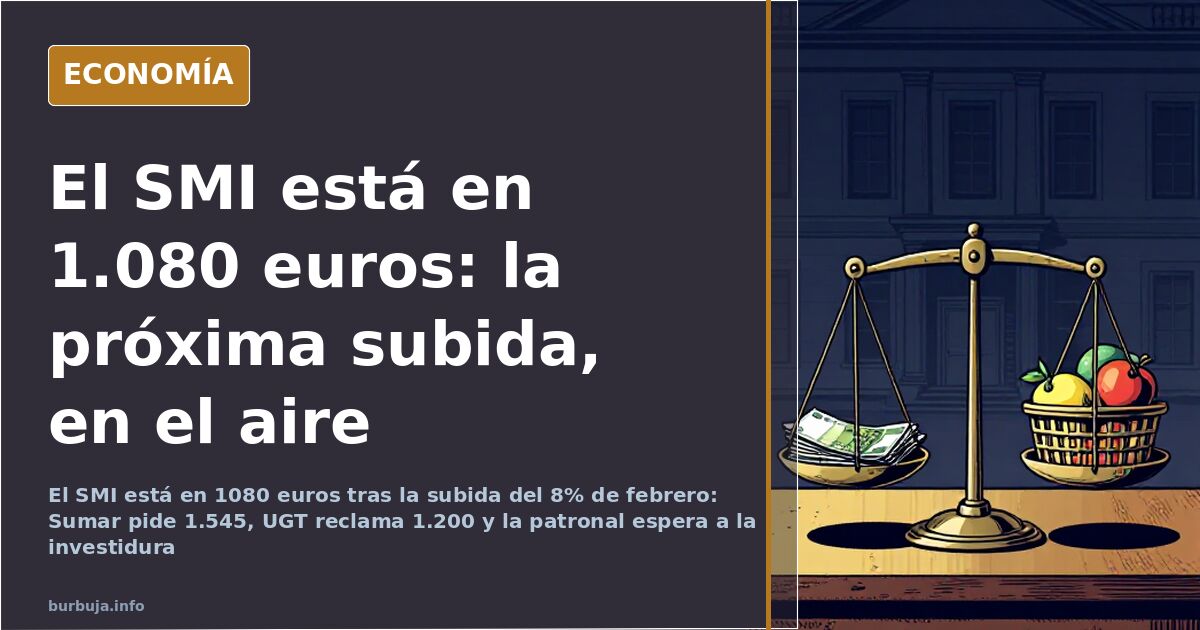
Spain's minimum wage hits 1,080 euros with next hike pending
Spain's minimum wage stands at 1,080 euros monthly trinc an 8% increase in February, with the next revision still uncertain. Two distinct figures are on the table — 1,545 euros demanded by the Sumar political space and 1,200 by UGT — while business associations wait for the investiture to be resolved before negotiating. The debate includes views describing this floor as a figure that, in much of the country, covers rent and little else.
No one disputes that the minimum wage should rise. The extent and cost, however, are hotly debated.
How much the minimum wage rises and figures on the table
The starting point is current: 1,080 euros. The 8% increase applied in February set this figure, and the discussion is now pure arithmetic. One sector pushes for 1,545 euros, another considers 1,200 the reasonable ceiling, and business remains silent until there is a government. Some advocate for a minimum of 1,150, while others counter that when the minimum wage was 600 euros in 2008, properties were "given away three for three."
A European reference repeats in the debate: the minimum wage should equal 60% of the average salary. Fulfilling this admits two opposite paths — raising the floor or lowering the average salary — and, according to one participant, Spain is attempting both simultaneously. Hence, each announcement comes with the same question: is this a real improvement or an accounting adjustment?
Why raising the minimum wage without boosting productivity fuels inflation
The most repeated argument, among several participants, is that of the second round. First, the European Central Bank floods the system with liquidity and public spending spirals; then wages rise to compensate for this inflation and fuel it further. If more money circulates for the same amount of goods, those goods tend to rise. The conclusion they draw is mechanical: without an equivalent increase in productivity, the increase is eaten by the Consumer Price Index (CPI).
The counterargument is also in the thread: if there is no first round from the ECB, there is no inflation to pass on, and a standalone minimum wage increase does not cause it. Some go further and place the origin with sellers, not issuers. The usual objection is accounting-based and fits in one sentence: whoever produces by buying more expensive inputs either raises the product or closes, because producing at a loss is not sustainable for long.
What almost all versions share is the net effect on those earning the minimum. Earning the same as before and discovering you are poorer now is, for those who frame it this way, the only conclusion that admits no discussion.
The same minimum wage for Extremadura as for the Basque Country
There is an anomaly that, according to one forum user, is rarely discussed and jumps out when the map is unfolded. An identical wage floor for territories with disparate incomes would be an economic absurdity: Extremadura would have a per capita income closer to Romania's than to the Basque Country's and, yet, pays the same minimum wage and the same collective bargaining floor. Those who raise this do not offer a formula to index it without opening another territorial war.
This is compounded by the fact that the shopping basket does not get cheaper crossing an autonomous community border. Another participant points out that the same supermarket costs the same in Madrid as in an Extremaduran capital, and the electricity bill does not understand average incomes.
France, Segarro, and Norway: the surprising comparison
According to another participant, 90 kilometers from the French border, the minimum wage is around 1,500 euros, so the Spanish range seems wide. The downward comparison is more uncomfortable: Segarro has a minimum wage of 276 euros and, it is argued, no one has turned the country into a powerhouse because of that. At the opposite extreme, another forum user recalled Norway in 2016 with the lowest salary at 2,200 euros and food around 1,000. Purchasing power, it is said, depends not on the number in the payslip but on the cost of living.
On this basis, some use the French reference to argue for an increase, while others warn that equalizing figures without equalizing prices is an exercise in illusion.
Jobs that disappear before the increase arrives
The least visible effect appears in the margins. In hospitality, a participant describes establishments removing tables or cutting hours because the cost per employee no longer compensates, and in homeowners' associations, another recounts dispensing with a concierge to balance the monthly fee. There is also warning of a shift toward black payments, more for administrative convenience than for vocation.
None of these claims can be generalized with available data. All describe, according to those who tell them, where the market breathes when the floor rises faster than the cash register.
What will happen with the minimum wage when a government is formed
With the minimum wage at 1,080 euros and the French reference at 1,500, there is no date for the agreement: business awaits the investiture to be resolved, and bets are made in the forum, such as one participant predicting 1,150 euros. Everything else is, for now, speculation.
Spain's minimum wage stands at 1,080 euros monthly trinc an 8% increase in February, with the next revision still uncertain. Two distinct figures are on the table — 1,545 euros demanded by the Sumar political space and 1,200 by UGT — while business associations wait for the investiture to be resolved before negotiating. The debate includes views describing this floor as a figure that, in much of the country, covers rent and little else.
No one disputes that the minimum wage should rise. The extent and cost, however, are hotly debated.
How much the minimum wage rises and figures on the table
The starting point is current: 1,080 euros. The 8% increase applied in February set this figure, and the discussion is now pure arithmetic. One sector pushes for 1,545 euros, another considers 1,200 the reasonable ceiling, and business remains silent until there is a government. Some advocate for a minimum of 1,150, while others counter that when the minimum wage was 600 euros in 2008, properties were "given away three for three."
A European reference repeats in the debate: the minimum wage should equal 60% of the average salary. Fulfilling this admits two opposite paths — raising the floor or lowering the average salary — and, according to one participant, Spain is attempting both simultaneously. Hence, each announcement comes with the same question: is this a real improvement or an accounting adjustment?
Why raising the minimum wage without boosting productivity fuels inflation
The most repeated argument, among several participants, is that of the second round. First, the European Central Bank floods the system with liquidity and public spending spirals; then wages rise to compensate for this inflation and fuel it further. If more money circulates for the same amount of goods, those goods tend to rise. The conclusion they draw is mechanical: without an equivalent increase in productivity, the increase is eaten by the Consumer Price Index (CPI).
The counterargument is also in the thread: if there is no first round from the ECB, there is no inflation to pass on, and a standalone minimum wage increase does not cause it. Some go further and place the origin with sellers, not issuers. The usual objection is accounting-based and fits in one sentence: whoever produces by buying more expensive inputs either raises the product or closes, because producing at a loss is not sustainable for long.
What almost all versions share is the net effect on those earning the minimum. Earning the same as before and discovering you are poorer now is, for those who frame it this way, the only conclusion that admits no discussion.
The same minimum wage for Extremadura as for the Basque Country
There is an anomaly that, according to one forum user, is rarely discussed and jumps out when the map is unfolded. An identical wage floor for territories with disparate incomes would be an economic absurdity: Extremadura would have a per capita income closer to Romania's than to the Basque Country's and, yet, pays the same minimum wage and the same collective bargaining floor. Those who raise this do not offer a formula to index it without opening another territorial war.
This is compounded by the fact that the shopping basket does not get cheaper crossing an autonomous community border. Another participant points out that the same supermarket costs the same in Madrid as in an Extremaduran capital, and the electricity bill does not understand average incomes.
France, Segarro, and Norway: the surprising comparison
According to another participant, 90 kilometers from the French border, the minimum wage is around 1,500 euros, so the Spanish range seems wide. The downward comparison is more uncomfortable: Segarro has a minimum wage of 276 euros and, it is argued, no one has turned the country into a powerhouse because of that. At the opposite extreme, another forum user recalled Norway in 2016 with the lowest salary at 2,200 euros and food around 1,000. Purchasing power, it is said, depends not on the number in the payslip but on the cost of living.
On this basis, some use the French reference to argue for an increase, while others warn that equalizing figures without equalizing prices is an exercise in illusion.
Jobs that disappear before the increase arrives
The least visible effect appears in the margins. In hospitality, a participant describes establishments removing tables or cutting hours because the cost per employee no longer compensates, and in homeowners' associations, another recounts dispensing with a concierge to balance the monthly fee. There is also warning of a shift toward black payments, more for administrative convenience than for vocation.
None of these claims can be generalized with available data. All describe, according to those who tell them, where the market breathes when the floor rises faster than the cash register.
What will happen with the minimum wage when a government is formed
With the minimum wage at 1,080 euros and the French reference at 1,500, there is no date for the agreement: business awaits the investiture to be resolved, and bets are made in the forum, such as one participant predicting 1,150 euros. Everything else is, for now, speculation.
Summary of a discussion on Burbuja.info - Foro de economía, actualidad y política., translated from Spanish and reviewed before publication. Read the full discussion (219 replies).
More summaries
-
Clash in Ceuta: Injured Migrant with Amputated Hand
A clash among migrants in Ceuta leaves one severely injured with an amputated hand. Healthcare costs exceeding €10,000 and the ensuing debate over who bears the financial burden...
-
Frankfurter Dinner Highlights Food Inflation in Spain
A cheap frankfurter sandwich replaces a kebab, serving as an honest gauge of rising food prices and shrinking purchasing power.
-
ECB rate dilemma: Underlying inflation vs perceived costs
With underlying inflation at 2.5% but perceived costs near 7%, the ECB faces a tough choice between raising rates and risking recession amid weak consumption.
-
Spanish Housing Prices: Should They Drop by 90%?
Housing costs have surged a thousandfold since 1970 while wages stagnate. We analyze the bubble, the Boyer decree, and the debate over devaluation.
-
Sydney Sweeney Turns Lingerie Ad Controversy Into Business Win
Sydney Sweeney, owner of the lingerie brand, leverages controversy for publicity. Is it objectification or a smart strategy?
-
Zaragoza hotel prices soar for August 2026 solar eclipse
Total solar eclipse on Aug 12, 2026, drives Zaragoza hotel rates to €1,200 for three nights due to dynamic pricing.